 If you’re American, do you usually drink at the “water fountain,” the “drinking fountain,” or (my personal favorite, all you Rhode Islanders) the “bubbler”? And how about that fizzy fountain beverage–what do you call it in your neck of the woods?
In the same way that the above-mentioned drink is known variously to American speakers of English as soda, pop, or coke, Japanese speakers also use different terms for the same thing depending on where they live. In fact, Japanese regional dialects, known as hōgen (方言), can differ so much from the standard Japanese (hyōjungo [標準語]) spoken in the Tokyo area and national media, that subtitles are often necessary when someone speaks with a thick local accent on TV. It’s not just the pronunciation that differs; often the form of words and syntactical structures are completely distinct.
To show you what we’re talking about, we’d like to introduce five examples of words that look and sound completely different from standard Japanese when said in regional dialects. If you’re a speaker of Japanese and you use one of these words when speaking to someone from a different part of the country, you may be met with a blank stare if your terms for the same thing are mutually unintelligible.
We hope all of you linguistics-loving readers enjoy the following language maps and discussion!
Remember, just because a particular prefecture or region tends to use a specific local word more than its standard Japanese equivalent, that doesn’t mean that all of the people use it on a regular basis or are even familiar with it. There may even be further regional variations within the prefecture as well.
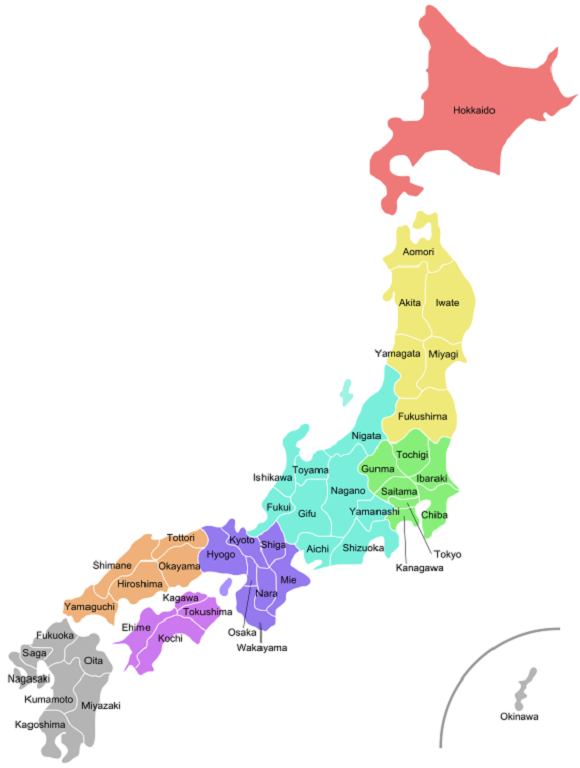
Please refer to this map of Japan’s 47 prefectures if you need to brush up on your geography while reading about the regional linguistic variations:
1. How do you say “Band-Aid/adhesive bandage” in some regional dialects of Japanese (standard Japanese: bansōkō)?
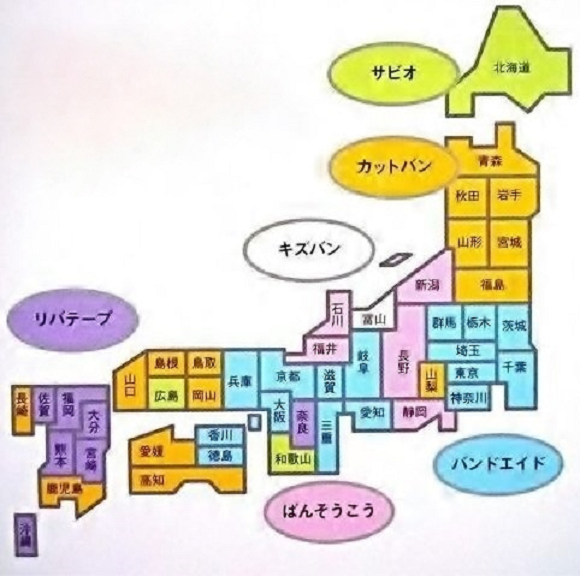
Japanese speakers tend to use either the traditional Japanese word, bansōkō, or the borrowed English term, bandoeido, on a regular basis. Here are some other regional terms, according to the map:
The light greenish areas (Hokkaido, Wakayama, and Hiroshima Prefectures) often refer to a band-aid as sabio.
The light blue areas around Tokyo and central Japan often use the typical English term, bandoeido.
The orange areas that cover all of Tohoku and some prefectures down south often use the word kattoban.
The light pinkish areas often use the standard term, bansōkō.
The purple areas mostly around Kyushu often use the word ribateepu.
Toyama Prefecture, the lone prefecture in white, often uses the word kizuban.
The Japanese author of this source article also recalls saying pecchin (ペッチン) as a child, but he was unsure if this term is a child-specific use or a regional use of the word.
2. How do you say “not feeling well/exhausted” in some regional dialects of Japanese (standard Japanese: taichō ga warui)?
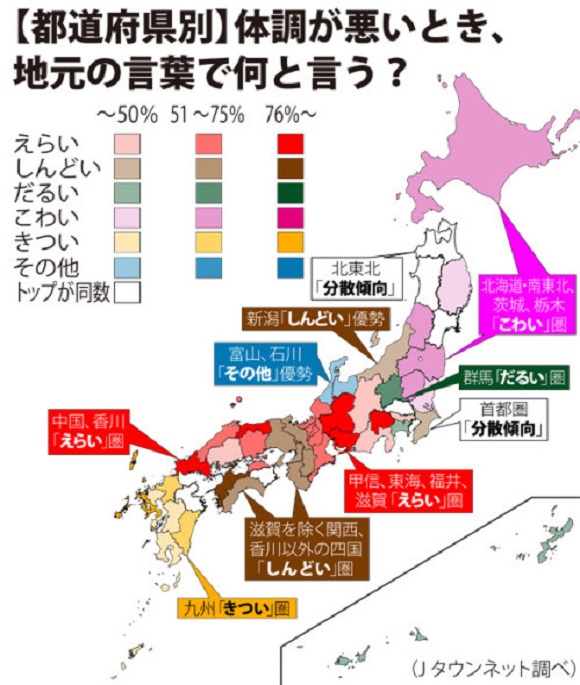
The above map has an interesting way of displaying information. Each dialectal term is assigned a color gradation. For each term there are three columns to the right: the lightest color gradient signifies that the term is used 50 percent or less of the time in a specific area, the middle color gradient means that it used 51-75 percent of the time, and the darkest color gradient means that it is used 76 percent or more of the time. From top to bottom, the dialectal terms are:
erai
shindoi
darui
kowai (Note: this one could be especially confusing because kowai typically means “scary” in standard Japanese)
kitsui
Other
There are multiple common terms in the area (white)
As you can see, erai, which is signified by the dark red patches on the map, appears to be the dialectal phrase for “not feeling well” that is used the most.
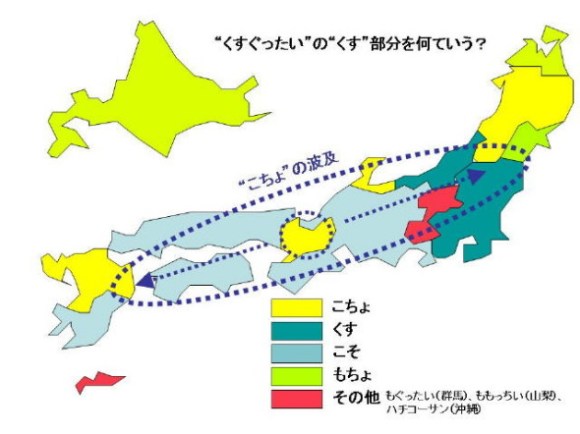
3. How do you say “ticklish” in some regional dialects of Japanese (standard Japanese: kusuguttai)?
As this map illustrates, the kusu portion of kusuguttai varies from region to region:
The yellow areas tend to say kochoguttai
The teal area surrounding Tokyo tends to say kusuguttai, the standard term
The light blue areas tend to say kosoguttai
The green areas tend to say mochoguttai
The red areas tend to use various other terms, including moguttai (Gunma Prefecture), momocchoi (Yamanashi Prefecture), and hachikoosan (Okinawa Prefecture)
Don’t you think all the regional words for “ticklish” just sound plain cute?
4. How do you say “snail” in some regional dialects of Japanese (standard Japanese: katatsumuri)?

Who knew there could be so many ways to express “snail”! According to the map (from north to south),
Sapporo (Hokkaido Prefecture) likes to say katatsumuri
Aomori likes to say either katatsumuri or namekuji
Iwate likes to say either dendenmushi or katatsumuri
Chiba likes to say either katatsumuri or maimai
Gifu likes to say ~tsumuri
Osaka likes to say dendenmushi
Hiroshima likes to say maimai
Kochi likes to say katatsumuri
Nagasaki likes to say dendenmushi
Kumamoto likes to say namekuji
Okinawa likes to say chin’nan or tsun’name
While there are relatively few total regional terms for “snail,” it is interesting to see how those different terms seem to be arbitrarily spaced out throughout the country.
5. How do you say “a stye on the eyelid” in some regional dialects of Japanese (standard Japanese: monomorai)?
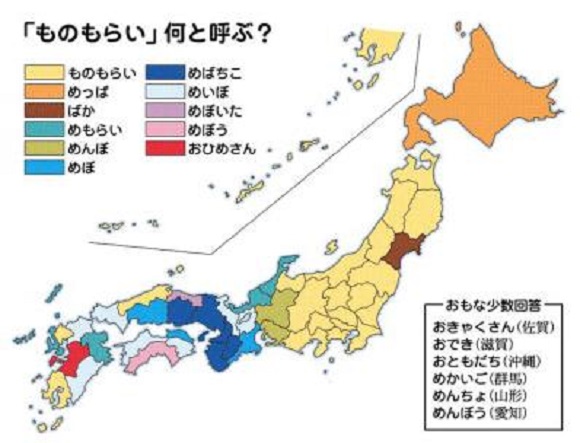
We can’t think of many instances when you would need to say this word unless you’re unfortunate enough to get one while in Japan, so here’s hoping you don’t find yourself at the doctor with this map anytime soon!
The areas colored in yellow which span eastern Japan (minus Miyagi Prefecture) and a few areas down south tend to use the standard Japanese term, monomorai. Besides that, starting with the orange in the left column and working your way down to the red at the bottom of the right column, other regional terms include:
meppa
baka
memorai
menbo
mebo
mebachiko
meibo
meboita
mebō
ohimesan [literally: “princess”!]
And that’s not all; here are some even rarer terms!
okyakusan [literally: “guest”!] (Saga Prefecture)
odeki (Shiga Prefecture)
otomodachi [literally: “friend”!] (Okinawa Prefecture)
mekaigo (Gunma Prefecture)
mencho (Yamagata Prefecture)
menbou (Aichi Prefecture)
We hope you’ve enjoyed learning some interesting Japanese hōgen! These have been examples of only five words that vary across Japanese dialects–there are a whole lot more out there! Do you recognize any of them from your own travels in Japan? Or maybe you’ve heard a completely different word? Next time you’re traveling outside of Tokyo, try using one of the above words in the appropriate prefecture and impress the locals with your great command of the language!
Source/Images: Japaaan