
“Beating up tea” and college classes and “fixing” things that aren’t broken.
Our Japanese-language reporter Udonko grew up in a small town in east Japan, so when she graduated from high school and moved to Kyoto to start college, she had some adjusting to do. It wasn’t just the transition from small-town to big-city life or the switch from living with her parents to having her own apartment that Udonko had to get used to, though, because there was another set of new challenges waiting for her in Kyoto: how the people there speak Japanese.
The Japanese language has a number of regional dialects. Over time, the style of speaking in Tokyo and east Japan has become what’s considered hyojungo, or “standard Japanese.” On the other hand, the Kansai region, which includes the cities of Osaka, Kyoto, and Kobe, has its own dialect, called Kansai-ben.
Unlike, for instance, Chinese dialects, the differences between Japanese dialects aren’t so pronounced that speakers of hyujungo and Kansai-ben can’t generally understand each other pretty easily. Core grammar is basically the same across Japanese dialects, as is almost all vocabulary. However, sometimes the same word, or words that are pronounced the same, can have very different meanings in standard Japanese and Kansai dialect. Here are four that tripped up Udonko, and might do the same to you if you’ve been studying/speaking standard Japanese before arriving in Kansai.
1. naosu
In standard Japanese, naosu means “to fix” or “to repair,” and if you want to make it a command, you say naoshite.
So imagine Udonko’s confusion when one of her art class schoolmates handed her a brush that, to Udonko’s eyes, was in perfect condition, and told her “Naoshite.”
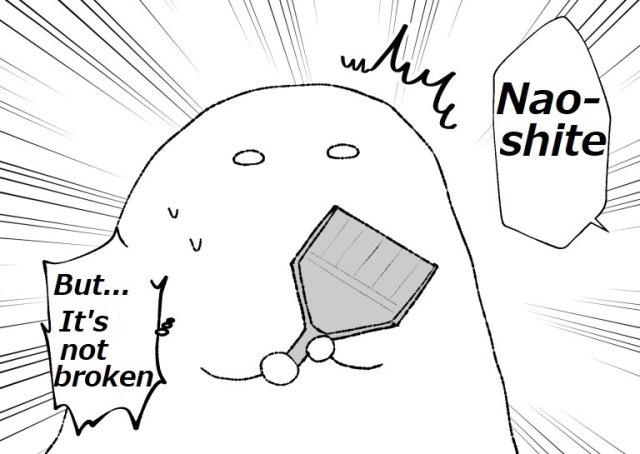
This happened shortly after Undoko had moved to Kyoto, and she was completely stumped as to what her classmate wanted her to do. Was there some hidden defect that she just wasn’t noticing? But then she looked around and saw other people putting their art supplies away. It turns out that in Kansai, naosu can also be used the same way as the word katatzukeru (katatzukete in its command form), which means “to straighten up, put away, or organize” something.
2. -kaisei
Kaisei, written in kanji as 回生, means “regenerate,” “resuscitate,” or “resurrect.” It’s pretty easy to trace why, as 回 means, loosely, “iteration” and 生 means “life.”
As a result, Udonko was pretty shocked when she was having a conversation with a guidance counselor at her new school and the administrator recommended a selection of classes for her ikkaisei, or, to Udonko’s east Japan brain, her “first-time life.”

Was…was Udonko’s guidance counselor telling her that she was going to die? Wait, wait, maybe she was just saying that Udonko was going to meet with some grievous injury, and that these classes would be a manageable study load as she…regenerated? Was the school going to teach her how to regrow parts of her body?!?
The truth, though, was far less morbid/awesome. The counselor was simply giving Udonko a list of recommended classes to take as a first-year student. In standard Japanese, a first-year student is called an ichinensei (literally “year-one life”). In Kansai, though, first-year university students can also be called ikkaisei, because it’s their first time making an iteration around that specific school’s academic year.
3. sara
Depending on where/how it’s used in a sentence, sara has a couple of potential meanings, even in standard Japanese. When it’s used as a verb, though, sara generally means a “plate” or “dish,” as in the kind you eat off of.
Yet when Udonko, who’d just finished putting a new protective sheet on her tablet, showed off the recently reinforced gadget to one of her new Kansai friends, that friend smiled and said, “Oh, wow! You made it sara!” which Udonko took to mean “Oh, wow! You made it a plate!”

Kansai in general is known for having a rich culinary culture, and that goes double for Kyoto. But Udonko couldn’t imagine that when it’s time to eat in Kansai, people just lay their electronic devices down on the table and put their food on the screen, regardless of whether or not it’s outfitted with a protective sheet.
Actually, though, in Kansai dialect sara is a way of saying “new” or “a new one.” Unlike the above examples of naosu and kaisei, where the same words can have different meanings depending on the region, Kansai’s “new” sara is a homonym to the “plate” sara, but it’s one that momentarily caused Udonko’s brain to bug out all the same.
4. cha wo shibaku
Udonko had one more food/beverage-related linguistic culture shock after arriving in Kyoto. Cha means “tea,” and shibaku means “to hit, strike, or beat.” So Udonko was baffled, and a little frightened, when a friend nonchalantly suggested that they go cha wo shibaku, or “Beat up some tea.”

The gap between Udonko’s violent vocabulary and cheerful demeanor was unnerving…until Udonko learned that, in Kansai, cha wo shibaku is an alternate way of saying ocha suru, the standard Japanese way of saying “have some tea,” and by extension “take a break and have something to drink (and probably some snacks or sweets).”
▼ It’s worth noting, too, that cha wo shibaku doesn’t carry the same rowdy tone of saying “Let’s crush some beers!” in English, and so Udonko and her friend’s “tea-beating” session ended with no cups shattered or desserts thrown across the room.

Again, Japanese dialects aren’t so different that people from different parts of the country face an actual language barrier, but that makes it all the more jarring when situations like these do pop up. There were far from the last bit of Kansai dialect Udonko encountered for the first time while living in Kyoto, but they’re the ones that left the deepest impression on her, so keep an ear out for them if you’re in region, and keep them in your back pocket if you want to sprinkle them into conversation with your Kansai-ben friends.
Illustrations ©SoraNews24
Top photo: Pakutaso
Insert photo: Pakutaso
● Want to hear about SoraNews24’s latest articles as soon as they’re published? Follow us on Facebook and Twitter!
[ Read in Japanese ]
Follow Casey on Twitter, where he once confused his hyojungo-speaking coworkers by saying “tawan.”