Wait, what? These weren’t in chapter one of Genki….
If you’ve studied Japanese, then chances are you’ve seen the voicing marks (tenten in Japanese) that go above some hiragana. You’ve also probably encountered the little circles (maru in Japanese) that go above the hiragana for ha, hi, fu, he, ho, turning them into pa, pi, pu, pe, po.
But something you might’ve never seen before is the little circles being used with other hiragana, namely ka, ki, ku, ke, ko.
▼ Everything I thought I knew about Japanese is a lie….
They may look a little strange to learners of Japanese. How would you even pronounce them? P-ha, p-hi, p-fu?
Nope! These weirdos represent voiced nasal sounds and are pronounced similar to: nga, ngi, ngu, nge, ngo.
▼ Skip to 0:30 in this video to have a nice man in a hat pronounce the difference between the normal ga, gi, gu, ge, go and nga, ngi, ngu, nge, ngo.
Okay, so that’s great and all, but where are these hiragana used? And if they’re so cool, why aren’t students of language ever taught them?
Good questions! These voiced nasal sounds are mostly exclusive to the Eastern dialect of Japan in the Kanto and Tohoku regions (Tokyo, Fukushima, Aomori, etc.). In the Western regions (Hiroshima, Kyushu, etc.), the voiced nasal sounds don’t exist, and they somehow get along just fine with only ga, gi, gu, ge, go.
Since Tokyo Japanese is considered “standard” Japanese, news anchors and announcers have to go through rigorous voice training programs to ensure that they’re giving the “correct” nasal touch to their voiced sounds.
So if you want to sound like a fancy Tokyo-ite, then here’s a handy guide to when your ga, gi, gu, ge, gos should turn into nga, ngi, ngu, nge, ngos:
▼ Red represents the voiced nasal (ng),
and blue represent the normal voiced (g).
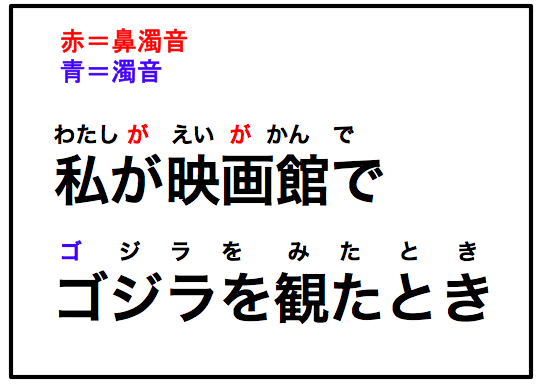
▼ The voiced nasal is used for the particle ga, and for every
ga, gi, gu, ge, go sound that doesn’t come at the beginning of a word.
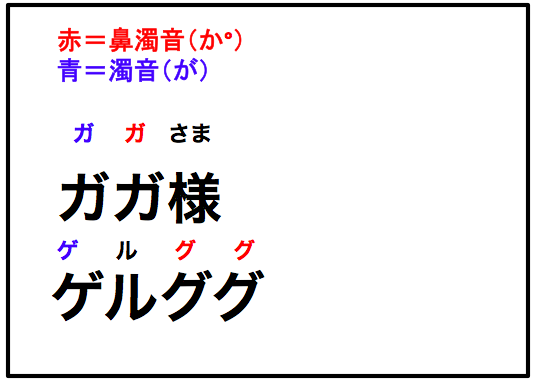
Aside from those undergoing announcer training though, most Japanese people never encounter these bizarre-looking hiragana, and that’s why students of Japanese aren’t taught them.
It makes sense though; in the U.S., we don’t usually take dialect differences into account when spelling English either: “aunt” is spelled the same even in places that pronounce it as “ant,” and “soda” is spelled the same even in places that pronounce it as “pop.”
According to Japanese linguists, the voiced nasal has been slowly dying off, being replaced by the normal voiced sounds that we’re all familiar with. At this rate it might not be too much longer before they’re extinct sounds.
▼ Skip to 1:40 to see how the red circles (normal g) has been invading from the west to take over the green circles (nasal ng) over the past 50 years.
Personally I know that whenever I use the voiced nasals, I just feel like I sound pretentious, so I usually keep them hidden away in my nose. But what do you do when you speak Japanese? Were you taught to use the voiced nasals? If so, let loose with some in the comments, so we can preserve their nasal-y beauty for all eternity.
References: NHK Online, Notre Dame Seishin University
Images: ©RocketNews24
[ Read in Japanese ]


Learn Japanese through ridiculous manga: A Tick on Titan 【Episode #3】
Learn Japanese through ridiculous manga: Fullmedal Alchemist 【Episode #5】
Learn Japanese through ridiculous manga: Dragon Bowl【Episode #4】
Learn Japanese through ridiculous manga: Death Vote 【Episode #6】
How do you pronounce “Among Us” in Japanese? Simple question has linguistically deep answer
Naruto and Converse team up for new line of shinobi sneakers[Photos]

The other side of Shibuya Station has a great restaurant for trying tamagokakegohan
Sakura Totoro is here to get spring started early with adorable pouches and plushies
Foreign tourists in Japan will get free Shinkansen tickets to promote regional tourism
Playing Switch 2 games with just one hand is possible thanks to Japanese peripheral maker
Japan has trams that say “sorry” while they ride around town…but why?
Starbucks Japan unveils new sakura Frappuccino for cherry blossom season 2026
Ichiran Ramen opens new premium branch in Ginza with high-class boxed noodles
End of the line for Japan’s absolute favorite waitress uniform and one of its favorite pie places
Can you eat lunch in Tokyo for less than 500 yen?
Japan’s newest Shinkansen has no seats…or passengers [Video]
Starbucks Japan releases new sakura goods and drinkware for cherry blossom season 2026
Foreigners accounting for over 80 percent of off-course skiers needing rescue in Japan’s Hokkaido
Super-salty pizza sends six kids to the hospital in Japan, linguistics blamed
Take a trip to Japan’s Dododo Land, the most irritating place on Earth
Now is the time to visit one of Tokyo’s best off-the-beaten-path plum blossom gardens
Japan releases first official sakura cherry blossom forecast for 2026
Archfiend Hello Kitty appears as Sanrio launches new team-up with Yu-Gi-Oh【Pics】
China’s don’t-go-to-Japan warning looks to be affecting tourist crowds on Miyajima
Survey asks foreign tourists what bothered them in Japan, more than half gave same answer
Japan’s human washing machines will go on sale to general public, demos to be held in Tokyo
Starbucks Japan releases new drinkware and goods for Valentine’s Day
We deeply regret going into this tunnel on our walk in the mountains of Japan
Studio Ghibli releases Kodama forest spirits from Princess Mononoke to light up your home
Major Japanese hotel chain says reservations via overseas booking sites may not be valid
Put sesame oil in your coffee? Japanese maker says it’s the best way to start your day【Taste test】
No more using real katana for tourism activities, Japan’s National Police Agency says
The science behind why English speakers can’t pronounce the Japanese “fu”
The surprising reasons why some hiragana aren’t allowed to be used on Japanese license plates
Why does Japanese writing need three different sets of characters? (Part 2)
Why does Japanese writing need three different sets of characters? (Part 1)
Japanese writing system gets turned into handsome anime men with Hiragana Boys video game
World’s first moaning hiragana character either a stroke of genius or just plain weird【Video】
The top 10 hardest Japanese words to pronounce – which ones trip you up?【Video】
Japanese elementary school student teaches us all how to pronounce English like a native speaker
Magazine teaches Japanese using Kemono Friends anime, Japanese netizens can’t stop laughing
Learn Japanese through ridiculous manga: Narutoe 【Episode #2】
One simple kanji character in super-simple Japanese sentence has five different pronunciations
The reason why Japanese students don’t pronounce English properly
Seven mistakes foreigners make when speaking Japanese—and how to fix them
Pronunciation anxiety: many Japanese people don’t want to speak English unless it’s “perfect”
Let’s learn how to sing “Jingle Bells” in Japanese with the help of Santa Pikachu!【Video】