

Many Japanese animation fans can rattle off a list of the animation directors or character designers they admire, but the visuals are only half of the way anime stimulates the senses. For everything that you’re hearing during your favorite show, you can thank the sound director.
It’s a role Kazuhiro Wakabayashi has been filling for decades, and we recently sat in on a talk the industry veteran gave about the unique challenges a sound director faces, what it’s like to work with some of the biggest names in Japanese animation, including Studio Ghibli’s Hayao Miyazaki and Ghost in the Shell’s Mamoru Oshii, and the surprisingly deep human element of creating the audio environment for a fictional world.
This week, Wakabayashi gave a special lecture at Digital Hollywood, a four-year university and specialty school preparing its students to work in creative industries such as animation, computer graphics, and web design. Even if Wakabayashi’s name doesn’t immediately ring any bells, if you’ve been watching anime for any length of time, odds are you’ve seen or heard of something he worked on. The 50-year-old Tokyo native has been involved with such productions as Ranma 1/2, The Vision of Escaflowne, Soul Eater, xxxHolic, Squid Girl, Moribito, and recently wrapped TV series The Seven Deadly Sins.
His theatrical filmography is even more impressive, as Wakabayashi is a long-time collaborator with Studio Ghibli and Production I.G, two of Japan’s most accomplished animation houses. Over the course of his career, Wakabayashi has served as sound or recording director for the Academy Award-winning Spirited Away, Princess Mononoke, Howl’s Moving Castle, and Ghost in the Shell.
▼ You’d think having completed such a huge body of work wouldn’t leave a guy with much energy left to smile, but the cheerful and outgoing Wakabayashi would prove you wrong.
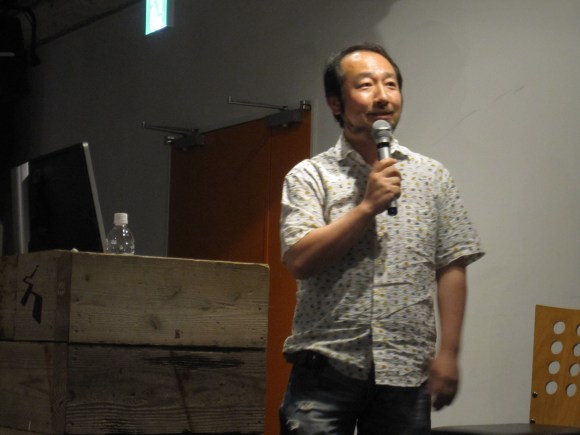
After a warm greeting to the audience, Wakabayashi gave an overview of what a sound director’s responsibilities are, and suffice to say they’re about as broad and numerous as an animation director’s. “Most overall directors are so focused on how the show looks, they only have a vague concept of how they want it to sound,” he explained. As such, a sound director will take on duties including auditioning voice talent, coaching them through their lines, creating sound effects, and handling the final mixing of dialogue, music, and sound effects.
It can be a difficult job, especially given the rapid pace of TV anime production, in which a new episode is aired each and every week. Oftentimes, Wakabayashi explained, he has to be creating the audio before the art is finished. Sometimes this means working off of rough animation tests that are in black and white or have odd patches of flat color where digital effects are to be added later.
In the most extreme cases, he’s got nothing but a script, making his job even harder since he has to direct voice actors who’re doing their recording without any visual references. There is one upside to this, though. “If both the visuals and audio are done, but there’re out of sync, a decision has to be made as to which one to fix. But if the audio is completed before the visuals, then we can just have the visual staff match up to what we’ve done, and we don’t have to go back and redo our work,” he laughed.

Speaking to a crowd composed primarily of young men and women diligently studying as part of their pursuit of a career in animation, Wakabayashi, who was born in 1964, was somewhat sheepish in recounting how he became an anime professional almost by accident. “When I was a student, there weren’t any specialized schools for animation,” he recalls. But on the flip side, anime being a fairy young industry also meant some studios were run rather casually. Being a fan of then-airing comedy anime Urusei Yatsura, Wakabayashi decided to pop into the studio producing the show for a visit.
He turned out to have great timing. Not only did Wakabayashi show up on a day when the staff had enough spare time to show him around, it also turned out they’d just had a part-timer quit, and they offered him a job. The young fan accepted, and went to work helping out with sound recording and other audio-related tasks.
Still, Wakabayashi wasn’t locked into an anime career just yet, and after finishing his education he initially worked as an electronics salesman. However, in his second year on the job he got into a heated argument with his boss. Thankfully, just as Wakabayashi could feel that position had run its course, he was offered another by a contact he’d made while working on Urusei Yatsura, who asked his former coworker to join him at the sound production company where he was currently employed. From then on out, Wakabayashi has been working in anime sound recording and direction.
Another important connection Wakabayashi made during his days as a part-timer was with Mamoru Oshii, who served as director for the first half of the immensely popular Urusei Yatsura. This would eventually lead to Wakabayashi being tapped for many of Oshii’s later projects such as the first Patlabor movie (Wakabayashi’s theatrical debut), international hit Ghost in the Shell and its sequel, Innocence, and The Sky Crawlers.
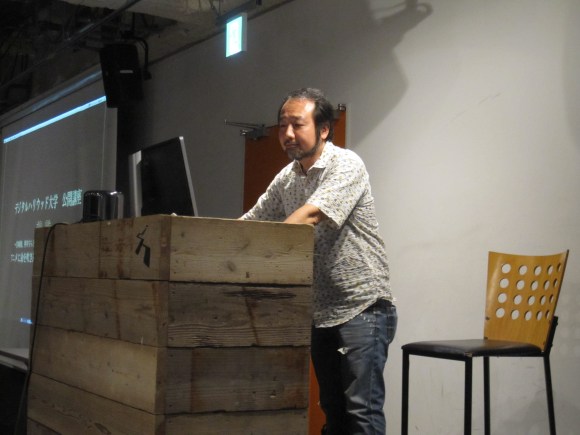
Oshii isn’t the only big-name director Wakabayashi has worked with, either, as he’s also lent his talents to many of Hayao Miyazaki’s films. As one might expect, Miyazaki is a stickler for perfection, so aside from supplying Wakabayashi with a larger staff than normal (Wakabayashi had about 10 people working under him on Spirited Away), the sound director also had more work to do during his year-long involvement with the film. For example, even if the same sort of sound, say a bug’s legs scurrying across the floor, was called for multiple times, Wakabayashi wouldn’t reuse the exact same effect, but would create a new one as many times as needed for a more natural end result. Even for something as seemingly simple as a drawer being opened in the enchanted bathhouse where main character Chihiro works, Wakabayashi travelled to an open-air architectural museum in Tokyo with a preserved apothecary filled with similar wooden compartments to record an authentic-sounding effect.
During his presentation at Hollywood Digital, Wakabayashi was asked to compare his experiences working with the vastly different Miyazaki and Oshii. “If Miyazaki is thinking of work, and has to spend longer than is absolutely necessary talking to someone, he gets in a bad mood,” Wakabayashi recalls. “If he doesn’t like how something has been drawn, he’ll just grab the animator’s paper and start drawing how he wants things done all over it.”
Oshii, on the other hand, can’t really draw, despite his considerable talents as a director. “If Oshii wants someone to do something differently, he has to talk with him, so he’s get a lot more aptitude for communicating with people in that way than Miyazaki does.”
While Wakabayashi didn’t judge working with one of the two as being easier or more rewarding than the other, he did speak at length on the importance of human relationships for an anime sound director. “Being alone at your work station, with the power to make the anime sound just like you want to, is fun. It can make you kind of feel like a god,” he said. “But in anime production, you have to work with many other people, like the director and the original creator…As you get more experience, you start to develop the ability to predict what sort of vision the other project members have, and how to make choices that will work well with theirs.”
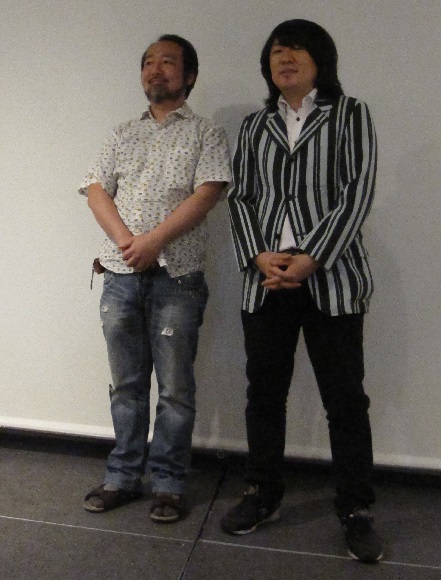
▼ Kobayashi and presenter/Digital Hollywood associate professor Mitsuteru Takahashi
Working with voice actors also requires the proper mike-side manner. “On Spirited Away, for example, we were working with child actors, but they’re still actors, so you have to be able to communicate with them and give them direction. But any performer, if you just tell them what they’re doing is wrong, they’ll start to lose energy and motivation. So I always let my actors know what they’re doing right first, and then go on to what we need to fix.”
If all of this sounds like a surprisingly collaborative attitude for someone who actually wields quite a bit of authority in the projects he works on, that’s exactly what Wakabayashi is hoping for.
“My advice would be to never get hung up on a simulation you’ve run in your head all by yourself, to never say ‘This is exactly how I’m going to make the sound for this anime,’” he told those in attendance, reminding everyone that while working in anime means working in fiction, the best results still come from collaborating in harmony with other people.
Related: Digital Hollywood
Photos: © RocketNews24
 Director of Ghost in the Shell shares his favorite Hayao Miyazaki movie and scene
 Spirited Away to be adapted to live-action stage play by English director John Caird
 List of anime directors fans expect the most from topped by….Goro Miyazaki?!
 Studio Ghibli answers Spirited Away fan questions, reveals exciting facts and trivia behind the film
 Teaser trailer released for new Ghost in the Shell movie, set to open summer 2015 【Video】
 Japan reportedly adding Japanese language skill requirement to most common foreigner work visa
 7-Eleven Japan’s new baked-in-store sweet treat is only available in three parts of the country
 You can assemble a well-balanced team of Pokémon, them eat them, thanks to Japanese cake chain
 Pokémon and Ikea Japan cross over into each other’s worlds with collaboration events
 Starbucks Japan closing only Shinkansen platform branch for popularity-triggered renovations
 Tokyo Station’s perfect breakfast spot might just be this izakaya Japanese-style pub
 Tokyo turns its phone booths into free Wi-Fi hotspots, and here’s how to use them
 Site of Japan’s most famous samurai murder is now a Kyoto karaoke joint
 McDonald’s Japan adds new Hello Kitty and Pompompurin drinks to the menu for a limited time
 Train station platform ramen store closes its doors on half a century of history in Tokyo
 Pokémon lacquerware series expands for Year of the Horse with new handcrafted design[Video]
 Two food hacks take Japan’s convenience store fried chicken to amazing new sandwich heights
 Tokyo’s best museum for foreign travelers finally reopens after being closed for four years
 Totoro Fund line of beautiful artwork and apparel lets you help the real-world Totoro Forest
 Fading Tokyo – Searching for signs of the Showa era as local neighborhoods evolve[Photos]
 Japan now has a special desk for people who work at home with a pet cat[Photos]
 Famous Tokyo cherry blossom spot installs view-blocking screens to fight overcrowding[Video]
 Uniqlo announces new T-shirts for One Piece, Naruto and more for manga publisher’s 100th birthday
 Starbucks Japan releases new My Fruit³ Frappuccino at only 34 stores around the country
 Studio Ghibli releases Catbus pullback keychain that runs like the anime character
 Krispy Kreme releases Super Mario doughnuts in Japan for a limited time
 Japanese onsen egg maker from 100-yen store Daiso needs to be on your shopping list
 Nine great places to see spring flowers in Japan, as chosen by travelers (with almost no sakura)
 Survey asks foreign tourists what bothered them in Japan, more than half gave same answer
 Japan’s human washing machines will go on sale to general public, demos to be held in Tokyo
 Starbucks Japan releases new drinkware and goods for Valentine’s Day
 We deeply regret going into this tunnel on our walk in the mountains of Japan
 Studio Ghibli releases Kodama forest spirits from Princess Mononoke to light up your home
 Starbucks Japan releases new sakura goods and drinkware for cherry blossom season 2026
 Japan’s newest Shinkansen has no seats…or passengers [Video]
 Major Japanese hotel chain says reservations via overseas booking sites may not be valid
 Put sesame oil in your coffee? Japanese maker says it’s the best way to start your day【Taste test】
 No more using real katana for tourism activities, Japan’s National Police Agency says
 A hauntingly beautiful live performance of Ghost in the Shell anime music 【Video】
 Teaser trailers released for Hollywood’s live-action Ghost in the Shell movie【Videos】
 Shimotsuki Matsuri: The extraordinary winter festival that inspired Ghibli’s ‘Spirited Away’
 New Studio Ghibli exhibition opens in Tokyo, features giant talking Yubaba from Spirited Away
 Hayao Miyazaki talks on how working hard isn’t something to be proud of, not forgiving yourself
 “Spirited Away doesn’t belong to me” says Hayao Miyazaki
 Hayao Miyazaki comments on Chihiro’s final test scene in Spirited Away
 There’s one thing that really bugs me about the live-action Ghost in the Shell trailer【Video】
 Boro the Caterpillar anime now showing at the Ghibli Museum in Tokyo 【SoraReview】
 Was Spirited Away based on a real-life tale?
 “Ghost in the Shell for beginners” – Our Japanese film critic’s impressions of the Hollywood film
 Mythbuster’s Adam Savage explores Ghost in the Shell’s coolest practical effects【Video】
 Spirited Away live-action stage play opens in Tokyo, and the photos look amazing
 Studio Ghibli animator reveals the secret food eaten by Chihiro’s parents in Spirited Away
 Unhappy with live-action Ghost in the Shell? You’ll be happy to know a brand-new anime is coming