

Japan has proper rules and procedures for everything, and office tea is one of the most complex.
Serving tea is as integral to Japanese work culture as business cards and bowing. Giving drinks to company guests is considered part of Japanese omotenashi (“hospitality”) and it would be both rude and bizarre for tea not to be served at most business meetings.
But there’s a lot more to serving tea than just filling cups. There are proper steps and procedures that must be followed, or else you run the risk of being misunderstood as rude. There are company instruction manuals exclusively dedicated to how to correctly serve office tea, and office workers often have to undergo training before they’re allowed to do it.
That’s why today we’re counting down the top five ridiculous details of Japanese office tea. Whether you’re on the sipping or dripping side of the tea rituals, it’s good to know what to expect in the absurdly detailed world of office tea.
So let’s get to it! Starting off with…
#5. There’s a correct way to prepare the tea
うちの会社はお茶くみさせられます。なので全員のお茶やコーヒーの濃さミルク 砂糖の有無を覚えています。 pic.twitter.com/Kv7tcjPNSq
— OLあるある(笑)bot (@OL_aruaru_bot) August 1, 2016
The details of office tea begin the second the water starts to boil. To achieve the perfect cup of hot tea, most guidelines recommend serving the tea between 70 and 90 degrees Celsius (158 to 194 Fahrenheit), tending to go lower the higher quality the tea so as to not burn it and extract as much flavor as possible. Usually the correct serving temperature can be achieved after steeping in a teapot for one minute.
Once the tea is actually brewed though, you’ve only just begun. Don’t start pouring tea wildly everywhere. You should have a tray, and then on the the tray place however many matching teacups and saucers you will need. But whatever you do, don’t place the cups on the saucers yet. Walking around with a tray of tea-filled cups on shaky saucers is a recipe for spillage.
Lastly, when you’re pouring the tea into the cups, don’t fill it to the brim. Seven-tenths full is the optimum to maximize tea generosity and minimize any chance of stuff sloshing around and making a mess.
▼ Basically if your serving tray looks anything different than this,
all you’ll be serving your guests is shame.

#4. There’s a correct way to serve the tea
「女子」という理由でお茶出し係に任命される。 https://t.co/Z86GrhFzFx
— OLあるある(笑)bot (@OL_aruaru_bot) September 5, 2016
All right so the tea is made, the tray is set, and now you’re all ready to go, right? Just pass out some cups and call it a day!
Wrong. You’ve barely just begun.
You knock on the door to the meeting room, enter, look at everyone, say shitsurei shimasu (“excuse me”), bow, and then quietly place the serving tray at a nearby table or in front of the lowest-ranking empty seat.
Now you’re ready to actually start dishing out the tea. One at a time take a cup, place it on a saucer, and then using two hands (right hand holding the cup left hand holding the saucer), place it in front of the person being served by going around their right side, and be sure to say douzo (“here you go”) or shitsurei shimasu again.
Of course, that’s only basic-level serving. If you’re giving out a sweet snack to go with the tea (like mochi, candy, whatever), then that is served before any tea gets put out. That way everyone can get a nice sweet taste in their mouth before the bitter tea takes over. Oh and by the way, don’t forget you’re supposed to serve the sweet from the person’s left side.
And you’d better believe that all deviations from the norm have their own special apologies. If the room’s walls prevent you from serving tea on someone’s right side, you’re supposed to say hidari kara shitsurei shimasu (“sorry it’s from the left”). And if the room is too cramped for you to serve them from behind, you need to say mae kara shitsurei shimasu (“sorry it’s from the front”). And if everyone’s talking about big important business stuff, you’re not supposed to say anything at all.
Got all that? Good, because…
#3. There’s an EVEN MORE correct way to serve the tea
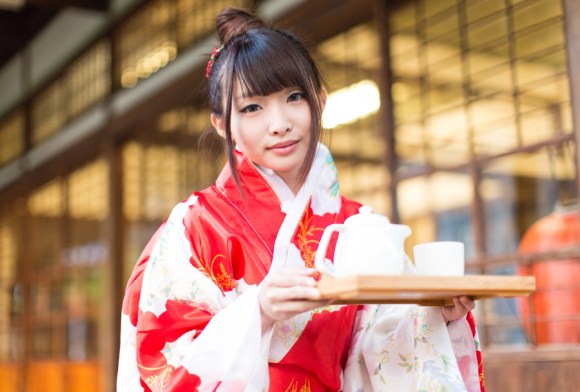
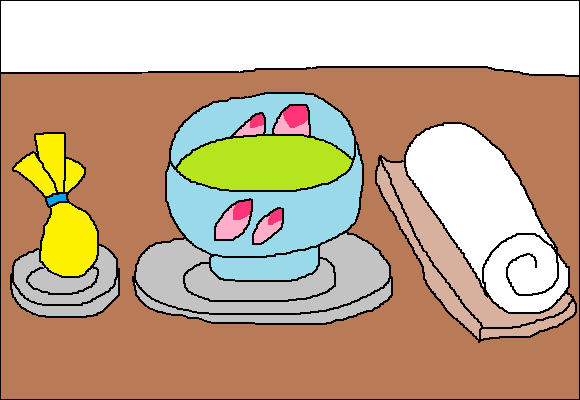
If you’re serving cold tea, don’t use saucers. Instead place a coaster on the table first to prevent condensation leakage, then place the cup on top of that.
Also if the teacup has a handle, be sure that the handle is facing to the right.
Also make sure that if the teacup has a design on the outside or inside, the design is facing the drinker.
Also if you’re giving your guests an oshibori hot napkin (which you definitely should), place it to the right of the teacup.
Also the oshibori and sweet snack should have their own coasters/holders.
▼ You disgusting barbarian!
How dare you even think to serve our guests tea like this!
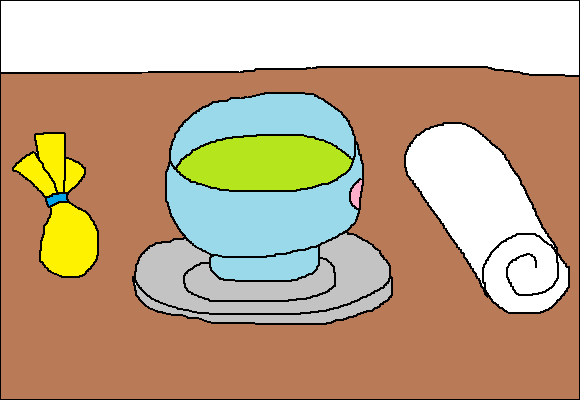
▼ There. Much better.
#2. There’s correct order to serve the tea in
「東京大改革」のインフラである「都政改革本部」の第一回会議。ポイントは都庁職員による「自律改革」です。外部専門家の助言も得て、自らが改革するのです。公務員のラストリゾートではいけません。都民ファーストで行きましょう! pic.twitter.com/KPLXxvG2ZS
— 小池百合子 (@ecoyuri) September 1, 2016
Whoops, sorry we forgot to mention this earlier. Because if you served tea in the wrong order, you most likely offended your guests, embarrassed your coworkers, and cursed your family.
Japanese hierarchies can be pretty complicated, but the general rules are:
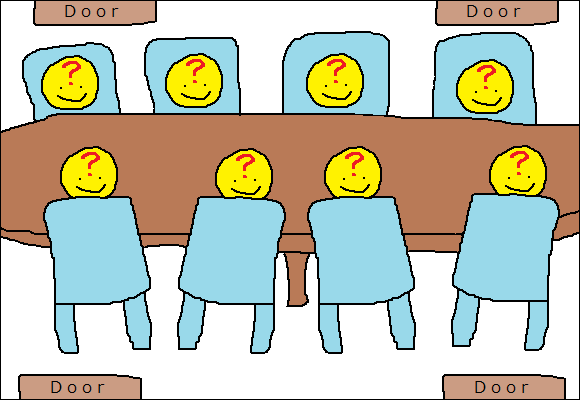
1) The seat furthest away from the door is the “best” seat.
2) The seat next to the “best” seat is the “second best” seat.
3) Except if there are an odd number of seats, then the middle seat is the “best” seat.
Guests are seated in the “best/better” seats according to their own internal hierarchy, and the company being visited takes the “worse/worst” seats according to their own internal hierarchy. When serving tea, you’re supposed to serve in order from “best” to “worst” seat.
Here’s some horrible drawings to help visualize it:
▼ Wouldn’t life be so much easier if everyone just had numbers stamped
on their heads telling you which order to serve them tea in?
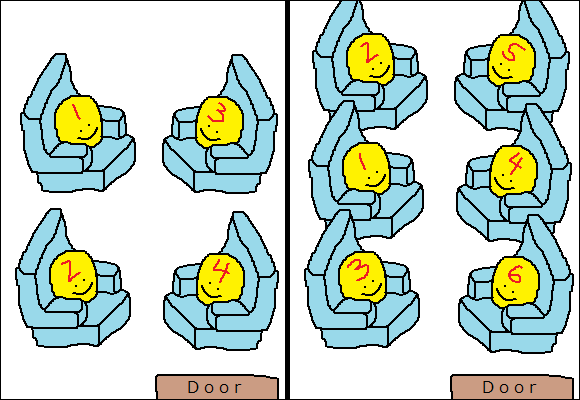
▼ Of course, things can get more complicated.
I assume this is every OL’s nightmare.
And the #1 most ridiculous details of Japanese office tea is…
.
.
.
.
.
.
.
.
.
.
1. There’s a correct person to do it all… and it’s always a woman
OLは楽でいいよなーと言われますが、そんなに楽じゃないです。 pic.twitter.com/4uKaPRJN3S
— OLあるある(笑)bot (@OL_aruaru_bot) September 2, 2016
In Japan, the land of despressingly low gender equality, office tea is the epitome of the division between sexes: serving tea is a woman’s job, and that’s that.
When I worked in Japan, out of hundreds of office tea servings, I only remember one time when a man served tea to guests. And it was only because there was literally no one else at the office except for me and him. The entire time, the guests kept laughing and making comments about how strange it was that a man was serving them tea.
I’m not saying men serving tea never happens, but the vast, vast majority of the time office tea is served by women. Typically there is either a “tea lady” whose job is exclusively to prepare and serve tea, a low-ranking office lady who does it when necessary, or if there’s an office with only one woman and the rest of the workers are men, it doesn’t matter what her title/rank is – she’ll be the one making tea.
You might expect that (the very small minority) of female CEOs in Japan would have men serve them and their guests tea, but that’s not the case. Since most of their guests will be men, having a man serve them tea while speaking to a female CEO would probably be too much for the average Japanese salaryman to handle.
This is all in stark contrast to traditional Japanese tea ceremony which is much more gender-balanced and has had men as some of the greatest tea masters.
Will the stigma of men serving office tea dissolve away as Japan’s work environments become more gender-equal? Or will it always be women serving the business beverages? Personally, I hope that it becomes more inclusive; I don’t think anyone should be spared the joy of learning how to apologize over serving tea from the left and counting tea numbers over people’s heads.
So there you have it, the top five ridiculous details of Japanese office tea. Have you ever served or been served tea at a Japanese company before? If so, were all the rules followed to a… tea? Make your own terrible tea puns and let us know in the comments below!
References: JP-Guide, Digital Sense
Featured/top image: GAHAG (Edited by RocketNews24)
Insert images: ©RocketNews24 (unless otherwise noted)
We’ll be back next Thursday with some strange-looking kanji. In the meantime, give me a follow on Twitter and let me know if there’s any topics you’d like to see covered on W.T.F. Japan. See you next week!
 W.T.F. Japan: Top 5 strange Japanese office occurrences【Weird Top Five】
 W.T.F. Japan: Top 5 most ridiculous kanji handwriting shortcuts【Weird Top Five】
 W.T.F. Japan: One year anniversary special! Top 5 W.T.F. Japan articles 【Weird Top Five】
 W.T.F. Japan: Top 5 confusing Japanese hand gestures【Weird Top Five】
 W.T.F. Japan: Top 5 unique Japanese toilet functions【Weird Top Five】
 Ramen restaurant in top Tokyo tourist neighborhood skips price gouging, but how does it taste?
 Uniqlo announces new T-shirts for One Piece, Naruto and more for manga publisher’s 100th birthday
 Japan’s ministry of economy reminds us to “use sound judgment” before buying toilet paper
 How many doughnuts can you pack in a Mister Donut all-you-can-pack deal?
 Japanese fast food chain serves up burgers with Camembert “buns”
 Ghibli Museum building becomes a cuddly cushion
 “Online streamer” tops dream job poll for young Japanese kids, older kids not so interested
 Japan now has a “for foreign tourists only” Mt. Fuji sightseeing train[Video]
 Krispy Kreme releases Super Mario doughnuts in Japan for a limited time
 Umamusume food and drinks dash into real world at Family Mart convenience stores[Taste test]
 Japanese onsen egg maker from 100-yen store Daiso needs to be on your shopping list
 Starbucks Japan releases new My Fruit³ Frappuccino at only 34 stores around the country
 Tokyo government organizes food truck event to clear out delinquent/homeless teen gathering area
 Cherry blossoms begin blooming in Japan with record-early starts for sakura season
 Nine amazing off-the-beaten-path cherry blossom spots in Japan for yaezakura and shidarezakura
 Stunning central Japan wisteria festival is like a purple fantasy straight out of a Ghibli movie
 Create a tiny Ghibli anime world on your bookshelf with new miniature papercraft art kits
 Studio Ghibli releases the My Neighbour Totoro tea caddy, with a magical self-closing lid
 When will the cherry blossoms reach full bloom in Japan this year?[Forecast]
 Starbucks Japan unveils new sakura cherry blossom collection for hanami season 2026
 Train station platform ramen store closes its doors on half a century of history in Tokyo
 Studio Ghibli releases Catbus pullback keychain that runs like the anime character
 Nine great places to see spring flowers in Japan, as chosen by travelers (with almost no sakura)
 Starbucks Japan releases first-ever Hinamatsuri Girls’ Day Frappuccino
 Studio Ghibli adds new Mother’s Day gift sets to its anime collection in Japan
 Virtual idol Hatsune Miku redesigned with look that adds new elements and brings back old ones
 Survey asks foreign tourists what bothered them in Japan, more than half gave same answer
 Japan’s human washing machines will go on sale to general public, demos to be held in Tokyo
 Starbucks Japan releases new drinkware and goods for Valentine’s Day
 We deeply regret going into this tunnel on our walk in the mountains of Japan
 Studio Ghibli releases Kodama forest spirits from Princess Mononoke to light up your home
 Starbucks Japan releases new sakura goods and drinkware for cherry blossom season 2026
 Japan’s newest Shinkansen has no seats…or passengers [Video]
 Major Japanese hotel chain says reservations via overseas booking sites may not be valid
 Put sesame oil in your coffee? Japanese maker says it’s the best way to start your day【Taste test】
 No more using real katana for tourism activities, Japan’s National Police Agency says
 W.T.F. Japan: Top 5 nicest sounds in Japan【Weird Top Five】
 W.T.F. Japan: Top 5 hardest Japanese habits to break 【Weird Top Five】
 W.T.F. Japan: Top 5 biggest Japanese food challenges【Weird Top Five】
 W.T.F. Japan: Top 5 most hilarious Japanese euphemisms 【Weird Top Five】
 W.T.F. Japan: Top 5 kanji with the longest readings 【Weird Top Five】
 W.T.F. Japan: Top 5 strangest ways to be polite in Japan 【Weird Top Five】
 W.T.F. Japan: Top 5 best Tamagotchi releases 【Weird Top Five】
 W.T.F. Japan: Top 5 most annoying sounds in Japan 【Weird Top Five】
 W.T.F. Japan: Top 5 “shikata ga nai” (“it can’t be helped”) situations in Japan【Weird Top Five】
 W.T.F. Japan: Top 5 offensive Japanese insults【Weird Top Five】
 W.T.F. Japan: Top 5 crazy awesome features of Japanese restaurants 【Weird Top Five】
 W.T.F. Japan: Top 5 reasons sleeping on the floor Japanese-style is awesome 【Weird Top Five】
 W.T.F. Japan: The top five “sora” references of all time! 【Weird Top Five】
 W.T.F. Japan: Top 5 odd ways Japanese people beat the summer heat【Weird Top Five】
 W.T.F. Japan: Top 5 strangest Japanese home goods【Weird Top Five】