

Words about corrupt grocers and reading people’s minds? Sign me up!
Finding out the origins of words is awesome. Whether they’re borrowings from other languages, cultural misunderstandings, or other bizarre linguistic coincidences, it’s always fun to discover the stories behind the words we use in conversations.
And the words that have the best stories are the ones that you can practically make movies out of. There aren’t a ton of them, but whenever you do find one, it feels like you’ve just discovered the language equivalent of a gold nugget.
That’s why today we’re counting down the top five Japanese words with cool ancient origin stories. You can spice up your vocabulary, and subsequently your conversation topics, by using these words more often.
So let’s get to it! Starting off with…
#5. Chiin (知音) – a very close friend

This one may not be a common word, which is why it’s number five on the list, but it still has a great story behind it. Instead of referring to your bestie as the usual tomodachi (“friend”) or shin’yū (“best friend”), you can call then your chiin, a word that combines the kanji chi (“to know”) and in (“sound”).
What does “knowing sound” have to do with friendship? Here’s the story behind the word:
In China during the Warring States period (475 BC to 221 BC) there were two good friends: Bo Ya and Zhong Ziqi. Bo Ya was very good at playing the guqin (stringed Chinese instrument), and Zhong Ziqi was very good at listening to the guqin.
When Bo Ya thought about tall mountains while playing, Zhong Ziqi would listen and say, “It makes me think of the towering Mount Tai!” When Bo Ya thought about flowing water while playing, Zhong Ziqi would listen and say, “It makes me think of the Huang and Yangtze rivers!” No matter what Bo Ya played, Zhong Ziqi was able to read his thoughts through the music.
When Zhong Ziqi eventually passed away, Bo Ya broke the strings on his guqin and vowed never to play again, because no one would ever understand his music the same way as his friend.
▼ The original bromance.
鍾子期「お前の琴が好きだったんだよ!(迫真)」
— 鯨 (@Philosophy_cure) December 4, 2013
伯牙「う、羽毛」 pic.twitter.com/z93690PjA7
And that’s the origin of the word chiin. The two friends were so close that they “knew” (chi) the other’s thoughts through “music” (in).
So if you have a friend who can basically read your mind, or whose feelings you can read perfectly depending on what song they’re playing on their smartphone, then you may have a chiin too, just like in ancient China.
#4. Yaochō (八百長) – a fixed game/match

This is one of the least intuitive words on the list but also one of the funniest.
To even start this one, first we need to explain the origin of the Japanese word for “grocery store,” yaoya. Originally they were called aoya, short for aomonoya (literally, “green things shop” or “vegetable shop”). Eventually aoya combined with the word yaorozu (“countless things”), presumably because grocers wanted to imply that they had more stock than other places, and yaoya (“grocery store”) was born.
So knowing all of that, at first glance you might think that yaochō (with chō meaning “head/leader”) simply means “owner of the grocery store.” But no, it actually means “a fixed game/match.” W-w-what?!
The reason why goes back not quite to ancient history, but to the Meiji Era (1868 to 1912) in Japan:
There was an owner of a grocery store who was called Yaochō (“owner of the grocery store”). He was good friends with a well-off sumo wrestler named Isenoumi Godayū. The two of them would often play Go together, and even though Yaochō was a better player, depending on how well the shop was doing, he would sometimes lose on purpose to Isenoumi. That would put Isenoumi in a good mood and he would buy more from Yaochō.
Eventually it was found out that Yaochō would lose on purpose, and while we don’t know what happened between him and Isenoumi after that (besides a few hefty sumo moves being pulled off on him, most likely), his name now lives on as the literal word for “fixing a game/match.”
▼ I suppose there are worse ways to have your name
immortalized in the dictionary, but not many.
Friday goal: Pull a Homer pic.twitter.com/DWt4myYirP
— joshtys (@joshtys) November 4, 2016
#3. Shushu (守株) – sticking with what worked in the past and not changing
 GAHAG (edited by RocketNews24)
It may not be a common word, but shushu gets major points for being one of those words with such a nuanced definition that you feel like a language master when you finally use it, like “zeitgeist” or “vis-à-vis” in English.
The kanji for this word are shu (“guard/protect”) and shu (“tree stump”). What does guarding a stump have to do with keeping outdated traditions? Here’s the story:
There was a Chinese farmer during the Song Dynasty (960-1279) who was lazy and not very bright.
One day he saw a rabbit run head first into a tree stump, break its neck, and die, which got him an easy meal for that day. Then, the farmer thought, if I just wait by this stump, then another rabbit will come along and do the same thing!
So the farmer quit his work and spent the rest of his days guarding and watching the stump, waiting for another rabbit to come. Of course that did not happen, and the man became the laughing stock of the village.
▼ “I’ll show them! I just know this stump
is a magic rabbit-magnet.”
So if you need to poke fun at someone for sticking to something long after they should’ve let it go, feel free to shushu them and tell them the story about “guarding the tree stump.”
#2. Mujun (矛盾) – contradiction
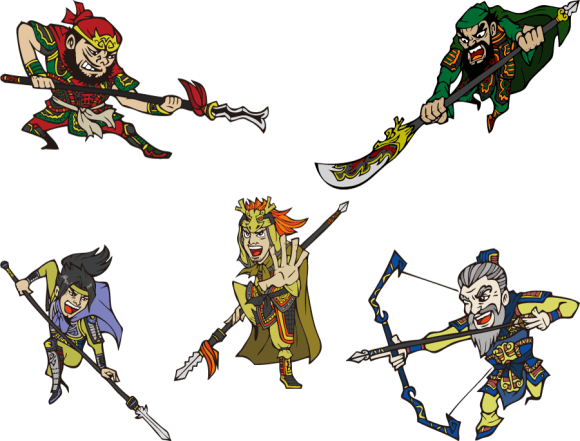
Let’s say you have a friend who says they hate fast food but every meal they eat is through the drive-thru, they love to exercise but their new running shoes and dumbbells are still in their boxes, and they can’t stand politics but it’s all they ever talk about. Finally one day you tell them, “you are a living contradiction!”
The Japanese word for contradiction is mujun with the kanji for “spear” (mu) and shield (jun). But wait a minute, what do spears and shields have to do with contradictions?
Here’s the story:
In ancient China, in the state of Chu, there was a merchant. When he wanted to sell one of his spears he would say, “This spear is so sharp it can pierce any shield!” And when he wanted to sell one of his shields he would say, “This shield is so strong it can stop any spear!”
But then when a customer asked him what would happen if he used the unstoppable spear on the impenetrable shield, the merchant didn’t have an answer, because what he was saying contradicted itself.
And that’s how we ended up with the word mujun, a fairly common word that traces its roots all the way back to this ancient story.
▼ When you have contradicting feelings
about your contradicting friend.
This seems like a contradiction pic.twitter.com/KsKy3hMblQ
— Michelle Ehrhardt (@ChelleEhrhardt) January 9, 2017
And the #1 Japanese word with a cool ancient origin story is…
.
.
.
.
.
.
.
.
.
.
1. Baka (馬鹿) – idiot/stupid
 GAHAG (
There aren’t too many words much more common than baka. Even if you only know a few words in Japanese, chances are this word for “idiot/stupid” is one of them.
Even though baka is usually written phonetically in hiragana or katakana, when it’s written in kanji, it uses the kanji for “horse” (ba) and “deer” (ka). That’s not what most would expect, and the reason why – of course! – has a story behind it:
During the rule of Qin Er Shi, the second emperor of the Qin dynasty (229 BC to 207 BC), a man named Zhao Gao was an advisor to the emperor. But he wanted to overthrow the dynasty and take control.
To make sure that the other government officials would go along with him, Zhao Gao brought a deer before the emperor and officials, and he told the emperor that it was a horse. The emperor laughed and said it was a deer, and then he asked the other officials what they thought. Some of them agreed with the emperor and said it was a deer, while others agreed with Zhao Gao and said it was a horse.
In doing that, Zhao Gao found out who would be loyal to him, and he executed the ones who called the deer a deer, eventually leading the way to the overthrow of the Qin dynasty.
Thus the saying “calling a deer a horse” was born, which originally meant “deliberate misrepresentation for ulterior purposes.” Over a couple thousand years the meaning of the phrase changed to just “someone stupid enough to call a deer a horse.”
▼ And the rest, as they say, is history.
Why is this so funny?! https://t.co/Reu7Cdp63p#anime #funny #meme #baka pic.twitter.com/pkoDvshBxY
— Saiko+ (@SaikoPlus) December 11, 2016
So there you have it, the top five Japanese words with cool ancient origin stories. Do you have any other favorite words with interesting etymologies? Let us know in the comments and maybe we can add “lecturing about word etymologies” to the list of the top five ways to get rid of the annoying door-to-door NHK guy.
References: Wikipedia (1, 2), Gogen Yurai Jiten (1, 2, 3, 4), Manapedia,
Top image: GAHAG (edited by RocketNews24)
W.T.F. Japan will be back next Thursday. In the meantime, give me a follow on Twitter and let me know if there’s any topics you’d like to see covered. See you next week!
 W.T.F. Japan: Top 5 most confusing Japanese counter words【Weird Top Five】
 W.T.F. Japan: Top 5 offensive Japanese insults【Weird Top Five】
 W.T.F. Japan: Top 5 confusing Japanese Internet slang words 【Weird Top Five】
 W.T.F. Japan: One year anniversary special! Top 5 W.T.F. Japan articles 【Weird Top Five】
 W.T.F. Japan: Top 5 kanji with the longest readings 【Weird Top Five】
 New Travelling Bento pouches turn your luggage into a Japanese lunch box
 Peanuts and Coke becomes a viral hit in Japan, but is it a trend worth joining?
 Mt. Fuji decorated with a 500,000-flower pink carpet is Japan’s ultimate spring view
 Japan reportedly adding Japanese language skill requirement to most common foreigner work visa
 Does a long line mean a sweeter deal? We compare two sweets from a Hokkaido food fair【Taste test】
 Häagen-Dazs Japan’s delicious mochi ice cream makes a comeback this fall
 Japanese government proposes raising age of consent from its current 13 years old
 Foreign man arrested for walking on Shinkansen tracks, claims he was on the run from yakuza
 In Kyoto, “Hey, you’ve got a really nice watch” is NOT a compliment, Japanese businessman says
 Shimane has a secret hot spring town that feels like stepping into an old Japanese film
 Pokémon and Ikea Japan cross over into each other’s worlds with collaboration events
 Starbucks Japan closing only Shinkansen platform branch for popularity-triggered renovations
 Two food hacks take Japan’s convenience store fried chicken to amazing new sandwich heights
 You can assemble a well-balanced team of Pokémon, them eat them, thanks to Japanese cake chain
 Tokyo turns its phone booths into free Wi-Fi hotspots, and here’s how to use them
 Fading Tokyo – Searching for signs of the Showa era as local neighborhoods evolve[Photos]
 Tokyo teahouse serves up a sakura matcha dessert you won’t find anywhere else
 7-Eleven Japan’s new baked-in-store sweet treat is only available in three parts of the country
 Man bites woman at cherry blossom park in Japan, dies shortly after
 Japan now has a special desk for people who work at home with a pet cat[Photos]
 Famous Tokyo cherry blossom spot installs view-blocking screens to fight overcrowding[Video]
 Uniqlo announces new T-shirts for One Piece, Naruto and more for manga publisher’s 100th birthday
 Train station platform ramen store closes its doors on half a century of history in Tokyo
 Starbucks Japan releases new My Fruit³ Frappuccino at only 34 stores around the country
 Studio Ghibli releases Catbus pullback keychain that runs like the anime character
 Krispy Kreme releases Super Mario doughnuts in Japan for a limited time
 Japanese onsen egg maker from 100-yen store Daiso needs to be on your shopping list
 Survey asks foreign tourists what bothered them in Japan, more than half gave same answer
 Japan’s human washing machines will go on sale to general public, demos to be held in Tokyo
 Starbucks Japan releases new drinkware and goods for Valentine’s Day
 We deeply regret going into this tunnel on our walk in the mountains of Japan
 Starbucks Japan releases new sakura goods and drinkware for cherry blossom season 2026
 Studio Ghibli releases Kodama forest spirits from Princess Mononoke to light up your home
 Japan’s newest Shinkansen has no seats…or passengers [Video]
 Major Japanese hotel chain says reservations via overseas booking sites may not be valid
 Put sesame oil in your coffee? Japanese maker says it’s the best way to start your day【Taste test】
 No more using real katana for tourism activities, Japan’s National Police Agency says
 W.T.F. Japan: Top 5 myths about learning Japanese【Weird Top Five】
 W.T.F. Japan: Top 5 most confusing Japanese compound words【Weird Top Five】
 W.T.F. Japan: Top 5 nicest sounds in Japan【Weird Top Five】
 W.T.F. Japan: Top 5 most difficult Japanese tongue twisters (with videos!) 【Weird Top Five】
 W.T.F. Japan: Top 5 confusing Japanese hand gestures【Weird Top Five】
 W.T.F. Japan: Top 5 most annoying sounds in Japan 【Weird Top Five】
 W.T.F. Japan: Top 5 hardest Japanese habits to break 【Weird Top Five】
 W.T.F. Japan: Top 5 budget Japanese Halloween costumes 【Weird Top Five】
 W.T.F. Japan: Top 5 steps to immigrate to Japan 【Weird Top Five】
 W.T.F. Japan: Top 5 most ridiculous kanji handwriting shortcuts【Weird Top Five】
 W.T.F. Japan: Top 5 strange Japanese office occurrences【Weird Top Five】
 W.T.F. Japan: Top 5 strangest ways to be polite in Japan 【Weird Top Five】
 W.T.F. Japan: The top five “sora” references of all time! 【Weird Top Five】
 W.T.F. Japan: Top 5 most hilarious Japanese euphemisms 【Weird Top Five】
 W.T.F. Japan: Top 5 most perfectly translated Pokémon names【Weird Top Five】