

The number one pick is derived from the lyrics of a song that’s sung in neither Japanese nor English.
Alongside Japan’s annual Kanji of the Year selection, we always look forward to the various year-end lists detailing the trendiest Japanese buzzwords of the year. Part of the fun is to channel our inner teenagers to see just how attuned we are to the slang of today’s youth, but we inevitably end up lamenting the years that have taken their toll on our linguistic hipness.
Fashion magazine Egg, which hit the scene back in 1995 and became the premier guide for all the latest in Japanese street fashions and subcultures, recently released the results of their 2020 Buzzword Awards. The ten picks were selected after compiling results from 5,000 survey takers including Egg models, street models featured in the magazine, and Egg followers. This year, the words were overwhelmingly derived from and diffused through social media influencers including YouTubers and TikTokers.
Let’s see how familiar you are with the trendiest Japanese slang terms of this past year!
▼ Egg models count down the top picks
▼ The winners in Japanese
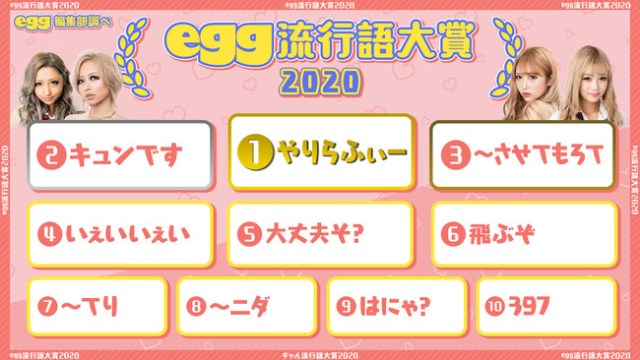
10. 397 (397)
In Japanese, the numbers 3-9-7 can be read as san-kyu-na, which sounds like an informal way of “hey, thanks” (サンキューな ) in Japanese (borrowed from the English) and is much faster to text. Just be sure to use it among close pals only–it isn’t appropriate to use with anyone older or of a higher status.
9. Hanya? (はにゃ?)
This one’s a cute interjection used when the speaker doesn’t know something or wants to play dumb. “Hanya? What do you mean Demon Slayer: Kimetsu no Yaiba the Movie: Mugen Train is now the third highest-grossing film ever in Japan?”
▼ Come to think of it, Nezuko often makes a puzzled hanya? kind of face.
Confused Nezuko because why not#DemonSlayer #nezuko pic.twitter.com/gJWackYS6E
— Dalola (@Dalolaart) March 11, 2020
8. ~nida (~ニダ)
Just like Japanese, the Korean language employs a number of different politeness levels that affect the formation of individual words. One such verb suffix used in super-polite deferential language contains ~nida at the end. Perhaps because it’s easily distinguishable even to those who don’t speak Korean, Japanese youth have adopted this suffix to add a Korean flair to any Japanese word. Ironically, the most polite form has now become a colloquialism in the process!
7. ~teri (~てり)
This structure is a corruption of the standard Japanese ~(shi)teru, a continuous verb form which indicates that someone is in the process of doing something. According to Japanese youth, why end your sentences with ru when ri sounds cuter? Test it out with a friend and see how you feel–ask them Nani shiteri? (“What are you doing?”) and maybe they’ll reply Gohan tabeteri (“I’m eating”).
6. Tobu zo (飛ぶぞ)
You know that feeling when something is so out-of-this-world delicious that you can’t even contain your excitement and imagine yourself blasting off on a gastronomic high? That’s the kind of situation that calls for tobu zo (“I’m gonna fly away”).
Interestingly, the use of the phrase was popularized by Riki Choshu, a retired professional wrestler who used it while eating some delicious scallops on a TV show in what is now an infamous video clip. While his visible reaction may have been a bit underwhelming, his choice of phrasing is now one for the record books.
▼ Listen for tobu zo at the 0:08 mark
5. Daijobu so? (大丈夫そ?)
This one’s a variation of Daijobu kana?, which is a soft way of asking “Are you okay?” E.g. “You just tried that new giant water bug gin? Daijobu so?”
4. Yeyyey (いぇいいぇい)
Just like in English, you can use this interjection when you and your friends are really excited about something. In Japanese it’s also become common to use it in place of kanpai when saying “cheers.”
3. ~sasete morote (~させてもろて)
There must be something really alluring to Japanese teens about trading one sound for another to make it “cuter.” This grammatical structure is a corruption of the standard Japanese ~sasete moratte which is tacked on to the end of a verb when asking someone else to do something for you. In the context of high school students, think of your romantic crush pleading to “study” together while using this phrasing and whether you’d have the willpower to resist.
2. Kyun desu (キュンです)
Kyunkyun in Japanese is a kind of onomatopoeia that refers to a sudden beating of the heart or the state of being choked up with emotion. Kyun, followed by the polite copula desu, is now used in combination to denote any such swoonworthy situation. The expression exploded in popularity after a song called “Poketto kara kyun desu” by Hirame was featured in an ever-expanding collection of TikTok videos including this one from a heartthrob fisherman. Also important–don’t forget to make finger hearts while you’re saying it!
▼ TikToks set to “Poketto kara kyun desu” by Hirame
1. Yarirafi~ (やりらふぃ〜)
At its core, this term refers to an energetic person who enjoys going to parties or the club, but it can also refer to a particular kind of fashion involving articles of clothing such as skinny jeans and tight T-shirts. Japanese youth use the phrase as a Twitter hashtag or in Instagram stories to describe any of the above. However, what’s most bizarre is the actual origin of the phrase from the upbeat Norwegian dance song “Chernobyl 2017” by Meland x Hauken (feat. Benjamin Beats). This song went viral at many high schools in Japan and its popularity only grew as more and more students filmed themselves dancing to it in TikTok videos.
The lyric in question is actually “Jeg vil at vi” which is sung at the beginning of each chorus. Apparently that phrase sounded like yarirafi~ to Japanese ears and has now taken on this whole new set of slang meanings half a world apart.
▼ Do you hear yarirafi~ at the 0:35 mark like a Japanese speaker? Also, check out the number of video comments in Japanese!
Does this ranking make you feel kyun desu? Or does it leave you scratching your head with a hanya? One thing’s for sure–Japanese youth are forces of nature when it comes to coining new expressions and we can’t wait to see what wacky linguistic expressions they come up with next.
Source: PR Times, YouTube/egg Channel
Images: PR Times
● Want to hear about SoraNews24’s latest articles as soon as they’re published? Follow us on Facebook and Twitter!
[ Read in Japanese ]
 Diving into the 2024 JC & JK Buzzword Award nominations for trendy Japanese slang and more
 Krispy Kreme releases Super Mario doughnuts in Japan for a limited time
 Uniqlo announces new T-shirts for One Piece, Naruto and more for manga publisher’s 100th birthday
 Japanese kindness restores our faith in humanity after a highway bus accident in Tokyo
 Japan’s ministry of economy reminds us to “use sound judgment” before buying toilet paper
 Japanese politicians working to promote plastic model culture as a cultural asset
 7-Eleven Japan releases a crazy new viral sandwich: Chocolate Sprinkles and Whipped Cream
 Ramen restaurant in top Tokyo tourist neighborhood skips price gouging, but how does it taste?
 One Piece and music lovers can now add Brook’s iconic Shark Guitar to their collections!
 Number of foreigners working in Japan hits all-time high, 25 percent come from same country
 Japanese vending machine sells just one thing at this station
 Starbucks Japan releases new My Fruit³ Frappuccino at only 34 stores around the country
 Tokyo government organizes food truck event to clear out delinquent/homeless teen gathering area
 Nine amazing off-the-beaten-path cherry blossom spots in Japan for yaezakura and shidarezakura
 Japan now has a “for foreign tourists only” Mt. Fuji sightseeing train[Video]
 Stunning central Japan wisteria festival is like a purple fantasy straight out of a Ghibli movie
 Studio Ghibli releases the My Neighbour Totoro tea caddy, with a magical self-closing lid
 Japanese onsen egg maker from 100-yen store Daiso needs to be on your shopping list
 Create a tiny Ghibli anime world on your bookshelf with new miniature papercraft art kits
 Starbucks Japan unveils new sakura cherry blossom collection for hanami season 2026
 Train station platform ramen store closes its doors on half a century of history in Tokyo
 Studio Ghibli releases Catbus pullback keychain that runs like the anime character
 Nine great places to see spring flowers in Japan, as chosen by travelers (with almost no sakura)
 Starbucks Japan releases first-ever Hinamatsuri Girls’ Day Frappuccino
 Cherry blossoms begin blooming in Japan with record-early starts for sakura season
 Studio Ghibli adds new Mother’s Day gift sets to its anime collection in Japan
 Virtual idol Hatsune Miku redesigned with look that adds new elements and brings back old ones
 Survey asks foreign tourists what bothered them in Japan, more than half gave same answer
 Japan’s human washing machines will go on sale to general public, demos to be held in Tokyo
 Starbucks Japan releases new drinkware and goods for Valentine’s Day
 We deeply regret going into this tunnel on our walk in the mountains of Japan
 Studio Ghibli releases Kodama forest spirits from Princess Mononoke to light up your home
 Starbucks Japan releases new sakura goods and drinkware for cherry blossom season 2026
 Japan’s newest Shinkansen has no seats…or passengers [Video]
 Major Japanese hotel chain says reservations via overseas booking sites may not be valid
 Put sesame oil in your coffee? Japanese maker says it’s the best way to start your day【Taste test】
 No more using real katana for tourism activities, Japan’s National Police Agency says