
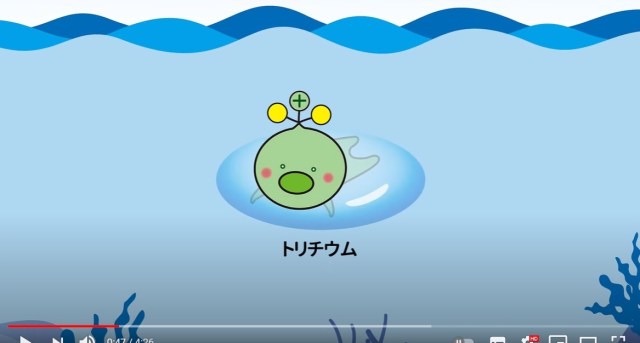
Video released on same day approval is granted for waste water project at Fukushima nuclear power plant.
As the branch of the Japanese government tasked with dealing with the effects of the 2011 Tohoku earthquake and tsunami, the responsibilities of the Reconstruction Agency include keeping people informed about health and safety issues. This being Japan, cute illustrated characters being part of public awareness campaigns usually doesn’t surprise anyone, but it’s a different story with a new video and pamphlet the Reconstruction Agency just put out.
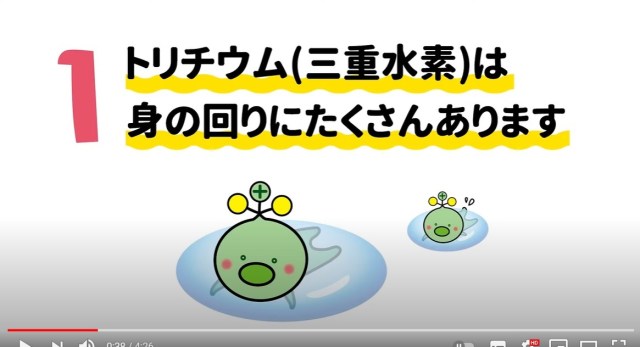
Those cute little green guys, who look like something you might find in the latest Pokémon DLC package, are meant to represent tritium, a radioactive hydrogen isotype. The video and pamphlet were released on Tuesday, which, not coincidentally, was the same day the Japanese government approved a plan to dispose of treated waste water from the Fukushima Daiichi Nuclear Power Plant, which still contains tritium, by dumping it into the ocean.
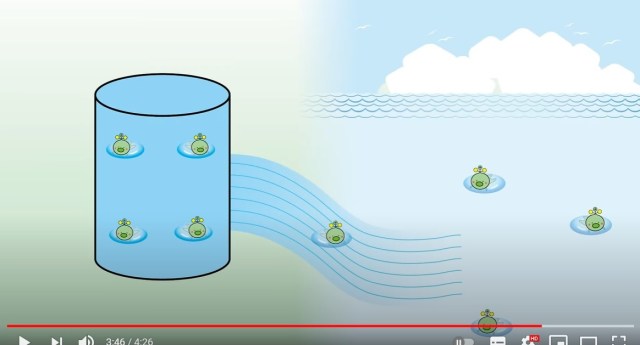
Support for the plan is far from universal among the general population and business groups such as commercial fishing operations. However, proponents argue that the measure is both necessary and harmless. Radiated water at the Fukushima Daiichi Nuclear Power Plant is being stored in tanks on the site as it is treated, with the roughly 1,000 tanks currently in use representing a volume of water that could fill the Tokyo Dome sports stadium. All of the site’s storage tanks are projected to be full by the end of 2022, and operator TEPCO (Tokyo Electric Power Company) is not legally allowed to build off-site storage containers.
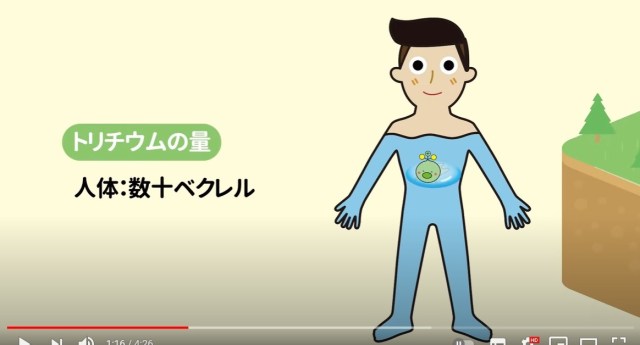
The agency says that the water to be dumped into the ocean has been treated to remove all of its radioactive material aside from tritium, which as an isotope of hydrogen presents a special problem when attempting to separate it from water. In an attempt to put people’s minds at ease, the video/pamphlet point out that tritium is weak enough that it can’t penetrate human skin, and can already be found in rainwater, seawater, tap water, and even the human body, where it hasn’t been found to be harmful in sufficiently small quantities. The awareness campaign also stresses that tritium does not accumulate in the human body, but is passed out as part of liquid human waste.
The Reconstruction Agency’s plan has the support of not only the Japanese government, but the International Atomic Energy Agency as well. The water will be further diluted before dumping to a tritium concentration that’s a mere 1/7 of the amount permissible for drinking water as per World Health Organization Standards, and it’s not like the plan is to just tip over all 1,000 containers all at once, as the release into the ocean will be paced slowly enough to take several decades to complete. The Atomic Energy Agency also adds that dumping treated water that still contains tritium into the ocean is a common practice at many nuclear power plants as part of their regular, non-emergency operations.
Still, the Reconstruction Agency explaining the plan while representing the contentious radioactive material as a cute creature isn’t sitting well with critics, whose online reactions have included:
“The Reconstruction Agency sure was quick to make a…character for image control purposes. This country has gone off the deep end.”
“That agency ain’t right in the head. They should replace the whole lot of ‘em.”
“Crazy…changing the image of something doesn’t mean it’s suddenly safe.”
It’s worth noting that despite many social media commenters referring to the illustrated tritium as a “mascot character,” with some even dubbing it “Tritium-kun,” the Reconstruction Agency itself hasn’t given the illustration a name or tried imbuing it with any personality traits or endearing characteristics beyond its appearance. “Our primary intent is to create a sense of familiarity [with the substance],” said a representative from the agency. “Our goal was a representation that was neither ‘good’ nor ‘bad,’ but intermediate.”
However, with Japanese society’s long-standing inclination to associate cuteness with godliness, it shouldn’t have been hard to foresee that some people would take the illustration as an attempt to frame tritium itself in a positive light, and the Reconstruction Agency could have saved itself some explanations by taking another route visually.
Source: Reconstruction Agency, Tokyo Shimbun via Otakomu, Twitter, Australian Broadcasting Corporation, Wall Street Journal, Forbes
Images: YouTube/復興庁/Reconstruction Agency
● Want to hear about SoraNews24’s latest articles as soon as they’re published? Follow us on Facebook and Twitter!
 Japanese government removes controversial radioactive material illustration video and pamphlet
 TEPCO in hot water for use of tasteless hashtag in recent tweet about Fukushima Nuclear Plant
 First worker to die from Fukushima radiation exposure officially recognized by Japan’s government
 Return to Fukushima: Decontaminated town reopens to residents, but is anybody living there?
 U.S. military in Japan bulk buys Japanese scallops as China’s Japanese seafood ban continues
 Wisteria season starts early with blooming of Japan’s Great Wisteria in its beautiful garden
 Japan’s best conveyor belt sushi restaurant of seven years ago has now, finally, come to Tokyo
 Japanese bento shop sells croquettes for 13 cents, but are they any good?
 Japanese government wants overseas anime market to roughly triple in 10 years, but are they crazy?
 Starbucks Japan releases FIVE new Frappuccinos in a day, and we try them all in 90 minutes
 Lawson convenience store at popular tourist site is one of the most unusual in Japan
 Japan has new rules for bicycle riders, and these 14 things could get you a fine or a court date
 It’s anime pirates vs. idols as Love Live! fans spit fire at One Piece creator’s perceived slight
 Does this video about an abandoned dog leave you wiping your eyes or shaking your fist?
 Yoshinoya invites you to give the gift of beef bowls this Mother’s Day
 Japan reportedly adding Japanese language skill requirement to most common foreigner work visa
 Mt. Fuji decorated with a 500,000-flower pink carpet is Japan’s ultimate spring view
 Japanese trains in Sapporo might be better than those in Tokyo, thanks to one special feature
 30 Pikachus want to share a Tokyo hotel room with you that has separate Grass, Water, Fire spaces
 Man bites woman at cherry blossom park in Japan, dies shortly after
 Howl’s Moving Castle’s scene-stealing dog is here to clean your home as a plushie mop
 Pokémon and Ikea Japan cross over into each other’s worlds with collaboration events
 Japan now has a special desk for people who work at home with a pet cat[Photos]
 Famous Tokyo cherry blossom spot installs view-blocking screens to fight overcrowding[Video]
 Uniqlo announces new T-shirts for One Piece, Naruto and more for manga publisher’s 100th birthday
 Train station platform ramen store closes its doors on half a century of history in Tokyo
 Starbucks Japan releases new My Fruit³ Frappuccino at only 34 stores around the country
 Krispy Kreme releases Super Mario doughnuts in Japan for a limited time
 Survey asks foreign tourists what bothered them in Japan, more than half gave same answer
 Japan’s human washing machines will go on sale to general public, demos to be held in Tokyo
 Starbucks Japan releases new drinkware and goods for Valentine’s Day
 We deeply regret going into this tunnel on our walk in the mountains of Japan
 Starbucks Japan releases new sakura goods and drinkware for cherry blossom season 2026
 Studio Ghibli releases Kodama forest spirits from Princess Mononoke to light up your home
 Japan’s newest Shinkansen has no seats…or passengers [Video]
 Major Japanese hotel chain says reservations via overseas booking sites may not be valid
 Put sesame oil in your coffee? Japanese maker says it’s the best way to start your day【Taste test】
 No more using real katana for tourism activities, Japan’s National Police Agency says