
Researchers hope results will benefit humanity, online commenters more concerned about the monkeys.
It’s quite an achievement when scientists manage to do something that no one has ever done before. Such pioneering accomplishments deepen society’s shared pool of knowledge and expand the possible scope of human endeavors for years to come.
Sometimes, though, the specific breakthroughs can be pretty startling. For example, this month researchers from Sendai’s Tohoku University announced that they’ve become the first scientist in the world to successfully induce depression in monkeys by manipulating their brain activity using magnetic stimulation.
The project, which researchers from the University of Tokyo and Showa University also contributed to, involved repetitive low-frequency transcranial magnetic stimulation of the medial frontal cortex (MFC) of Japanese macaque monkeys. “Human brain imaging studies have demonstrated…abnormalities of this brain region in patients with mood disorders,” the researchers say, and magnetic stimulation was used to suppress activity in the dorsal, posterior, and ventral regions of the MFC. While no significant changes were noted after testing for the dorsal and posterior sections, magnetic suppression of the ventral MFC resulted in a depressive state, observed through decreased social activity, physical movement, and motivation among the so-tested monkeys, as well as increased plasma cortisol levels.
Following the inducement of depression, the researchers say that administration of ketamine “ameliorated the abnormal behavioral and physiological states induced by the [magnetic stimulation],” as shown in the flow chart here, which was included in the published results.
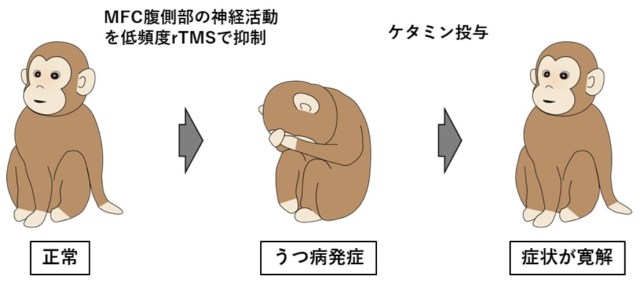
If you’re feeling a little sad thinking about that monkey in the middle, you’re not alone. Japan is usually quick to celebrate domestic discoveries in the fields of science and medicine, but Twitter reactions to the news have been largely statements of sympathy for the monkeys used in the experiment, with comments such as:
“Stop that, right now!”
“This is scary in all sorts of ways.”
“People wo sacrifice animals like this for the sake of humans are devils.”
“This isn’t the sort of experiment you should succeed at.”
“If you’re excited about this, you need to have your head examined.”
“It’s nice to see advancements in scientific knowledge, but this was an incredibly cruel experiment.”
“I hope those monkeys didn’t become depressed again once their mediation wore off.”
“It hurts my heart that the monkeys were given depression for the sake of an experiment to benefit humans. It shows that human beings’ health is built on the sacrifice of many other living things.”
It should be pointed out that the researchers’ motivation wasn’t “Hey, wouldn’t it be cool if we could mess with monkeys’ minds?” The project’s stated goal was to better understand neurological depression triggers and, in turn, how to treat the condition, with monkeys chosen as the test subjects because of their similarities to humans in terms of cerebral activity and emotional/social expression. Still, it appears that many are uncomfortable with the test subjects’ mental distress having been the price for that knowledge, especially when it’s still too soon for any practical results to be seen.
Source: Tohoku University via Nazology via Jin, National Library of Medicine, Twitter
Top image: Pakutaso
Insert images: Tohoku University
● Want to hear about SoraNews24’s latest articles as soon as they’re published? Follow us on Facebook and Twitter!