Public transport in Japan has been featured numerous times this week here on RocketNews24. We’ve seen hilarious photos of people crashed out in awkward positions, cats, pigeons and teddy bears taking up seats, and we’ve heard young people– for a change– complaining about the older generation’s bad manners and poor social conduct.
With some of the busiest stations in the world and a population that increases by more than 2 million during the daytime as people pour into the city, Tokyo relies heavily on its bus and rail networks. Crammed into those little metal tubes, sometimes for hours each day, commuters soon learn to cope with being pushed, shoved and having their personal space reduced to the few inches of space around their face.
People soon learn what is and is not acceptable on public transport, and while socially-aware conduct like switching mobile phones to silent mode and giving up seats to elderly or disabled passengers are stipulated by in-train notices or audio announcements, there remains a handful of other, often unspoken, rules that people must adhere to or else incurr the wrath of irritated passengers as they glare, tut and grumble in their direction.
Listening to music too loudly through headphones; reading sexually explicit manga; not removing a backpack during the rush hours; all are considered rude on-board trains. But there’s a special rung in commuter Hell reserved for those who eat and drink during their journey…
Japanese new site Netallica investigates the results of a recent survey into eating and drinking on-board trains, asking the question: how much is too much?
Can we sneak a quick bite of a sandwich between stops? Is popping a tiny cookie in your mouth acceptable, or are you likely to end up strung up outside Shibuya station with “glutton” painted across your naked belly?
The debate began when an anonymous internet user on information hub Goo asked the question: “Where is the line when it comes to eating and drinking on trains?”
Naturally, the responses flooded in with people of all ages and walks of life offering their opinions, with many stipulating that it depends on what exactly is being consumed:
“Sweets, gum, biscuits, cookies, sandwiches and riceballs are OK; anything with noodles, soup or pickled vegetables like kimchi are all out!” commented one fairly lenient commuter going by the name of koko-heart. “So long as it doesn’t smell too strongly, chewing gum or sucking on a boiled sweet is OK,” suggested another.
The strength of a food’s smell, it would seem, is a key issue here…
“If someone sits next to me and starts eating, I don’t like it;” explained another commenter, “I worry about them spilling it on me, and if the food they’re eating smells particularly strongly, I worry that my clothes will pick up the odour, so I usually try to change seats.”
Middle-aged commuter Marsdt, meanwhile, suggests that “Eating anything during the rush or on a busy mainline is a big no-no. If it’s a shinkansen (bullet train) or an uncrowded local train then I suppose I could permit most foods- so long as they don’t smell.”
Taking their first ride on a bullet train is an experience that many foreigners in Japan look forward to.
As well as being uber fast, the high-speed trains are meticulously clean, almost always arrive precisely on schedule and far more luxurious than regular trains.
▼An ekiben enjoyed by a friend of mine on a recent trip.
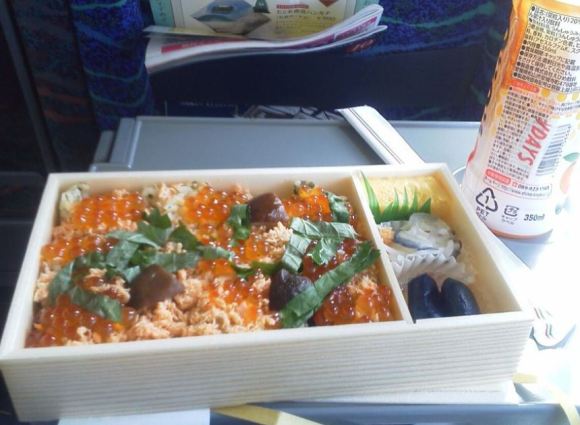
Many bullet trains even have a trolley or food-cart service not unlike those on long-haul flights, offering travellers a choice of drinks and snacks as well as alcoholic beverages and souvenirs. As well as this, many larger bullet train stations sell special ekiben packed lunches distinct to that geographical area that customers are able to enjoy during their train ride using the built-in tray tables, making it perfectly acceptable to consume food on-board a bullet train. Even so, it is considered polite to utter a quick “shitsureishimasu” (lit. “I’m being rude”) to the person sitting next to you before tucking in…
But regular trains are another matter altogether…
“Trains are public areas;” affirmed a 50-something going by the screen name of Mimicry-buddha, “if we take the train itself out of the equation, it’s basically just another a public area, and as such we shouldn’t eat.”
So, eating anywhere in public is out, too!?
In Japan, aside from outdoor festivals and munching on things like Harajuku’s famous crêpes on the street, eating outdoors, especially while moving around, is considered by many to be quite vulgar. Those with no choice but to eat while outdoors in a public area, but wishing to avoid glares or the scorn of passing old ladies, often squat down somewhere to consume their food, almost as if saying “I’m sitting, so it’s OK!”
“Unless it’s a matter of life or death, people should not eat or drink anything on trains,” the same commenter continues. “Even the sight of people chewing gum is unsightly.”
But what of drinks? Surely everyone gets a little parched during their daily journey? Should we avoid sipping from our water bottles, too?
On that topic, commenter vsvs100 has some simple advice that we might want to consider: “If you’re drinking from a plastic bottle or your own drinks container, then I think it’s ok, but cans should be avoided; they spill easily and are more likely to make a mess.”
But why, aside from the fact that some foods are simply a bit stinky when you’re not the one eating them, are the Japanese quite so against the practice of eating and drinking on public transport?
Many internet users commented that eating and drinking on trains is “shameful” and shows a lack of self-restraint and consideration for others. While these may seem like some fairly harsh words, we should bear in mind that Japanese society is traditionally group-focused and places emphasis on cooperation and not making waves.
Whether this way of thinking is a result of past governing and leadership styles, or whether it’s simply influenced by the fact that many Japanese live in close proximity to others 24 hours a day, who could say. But words like “meiwaku” (to bother or annoy) and “jama” (disturb) feature prominently in Japanese vocabulary, and people are expected to be constantly aware of the effect their own behaviour may have on those around them, which is perhaps why the mere act of eating a riceball during your morning commute is likely to draw so many stares and is best avoided…
Source: ねたりか