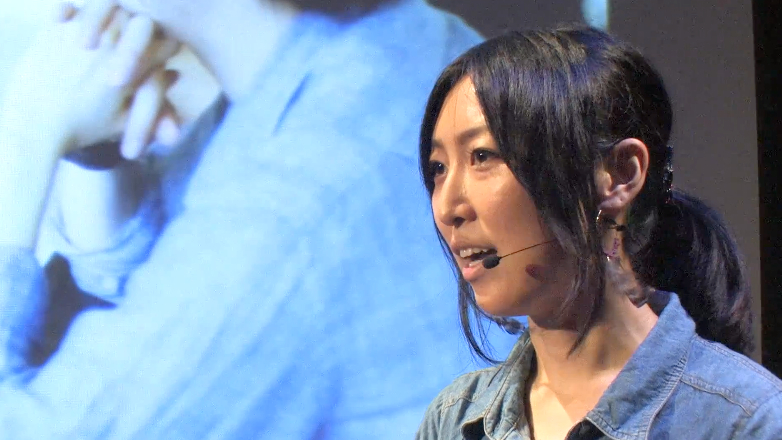
“Forgive me for asking so abruptly,” Chiharu Hatakeyama begins as she stands on a stage decked out in the familiar TED colours of black, white and red, “but who among you thinks they could wring the neck of a chicken before they ate it?”
After the events of March 11, 2011, when the largest recorded earthquake in Japanese history tore the northeast to pieces and brought with it a wall of water that smashed through everything in its path, Chiharu decided that she had to change. Realising that her entire world could be turned completely upside down in the blink of an eye and that she relied on others–most often people that she had never nor would ever meet–in almost every facet of her life, she set out to achieve a life of complete self-sufficiency. Growing her own vegetables, butchering her own meat, making accessories and clothes for herself, she is now sharing her newly acquired knowledge with as many people as she can via her blog, Facebook page, and more recently a TEDxTokyo talk. This is her story.
With all the modern conveniences we have today, our washing machines that save us hours of scrubbing and wringing, microwave ovens that heat food in mere seconds, blazingly fast internet connections that make the free exchange of information possible at the touch of a button, we often forget how fragile a society we live in.
Consider your home or the building you sit in right now. If the power were to suddenly go out, how long would you be able to continue as normal? And once your fridge became empty, if you went to your local super market only to discover that it had closed its doors and that farmers had decided to keep their produce entirely for themselves, how long would you be able to survive without the help of others?
Realising the dangers of living a life entirely reliant on others, Chiharu Hatakeyama is on a mission to change. Having sought the advice of experts and enrolled on courses to learn the skills required to live off the grid and provide for herself, sharing each of her hands-on experiences via her personal blog Chiharu no Mori, she was invited to speak at the independently run TEDxTokyo event and share with others her message for a life of self-sufficiency.
Compared to how she appears in photos posted to her blog, the Chiharu we see on the TED stage appears much more serious, and perhaps a little nervous. Far from being a natural-born public speaker or the kind of person who spends their days touring the country seeking a spotlight, she is here to share her message for purely altruistic reasons.
“I’d been so nervous about giving this presentation that I contracted stomach flu and had barely eaten for about a week before it,” she writes on her blog before posting a link to the talk itself. “I look kind of ill, so I was too embarrassed to upload the talk at first, but I received a lot of positive feedback from people who’d seen it, so I’m sharing it with you today.”
During the opening of her speech, Chiharu uses a word that appears frequently in day-to-day conversation in Japan: atarimae. Formed with the words ataru 当たる (to hit/strike upon) and mae 前 (in front of), the term is most commonly translated into English as “natural”, “obvious” or “the expected”. It is this perception of what we in the developed world have come to think of as natural or to expect as a basic right, however, that she wishes to challenge.
“It all began on March 11, 2011,” Chiharu begins, “I was in [the port town of] Yokohama when the tsunami warnings came in. Having gone to higher ground, I watched as footage of the tsunami washing through the towns appeared on the screen. It almost didn’t feel real; I just couldn’t believe it was really happening. From that day on, the things that I had always taken for granted before no longer seemed so. Safe, clean water and food; light; the fact that my family were alive and well; it suddenly dawned on me that I couldn’t just assume I would always have these things. And then, when all of the food in supermarkets was gone, my money, too, became worthless.”
To those whose lives have never been touched by events such as these, Chiharu’s words may sound like something from a movie: something that while it sounds terribly dramatic would probably never happen in real life. But as someone who considers themselves to have been one of the lucky ones in having been in a lesser-affected area of Fukushima during the events of March 11, but nevertheless spent two days visiting super markets completely stripped of food, and buying onigiri rice balls and bottled water directly out the plastic pallets they were shipped in at convenience stores (staff knowing that it wasn’t worth trying to put their limited stock on shelves), this writer, too, can confirm that when our “atarimae” lifestyle is disrupted even only very slightly, it hits hard. For all of humankind’s technological advances and our modern conveniences, the earthquake that hit Japan was a clear reminder that we are not the ones in charge here.
Since the day of the earthquake, Chiharu has strived to provide for herself as much as possible, and has begun to share her knowledge with others, explaining in her talk: “I felt that it was necessary to learn how to stand on my own two feet and still be able to lead a happy life, whatever else befell us. I decided to live a life in which I did not have to rely on others.”
Where else to begin but with food?
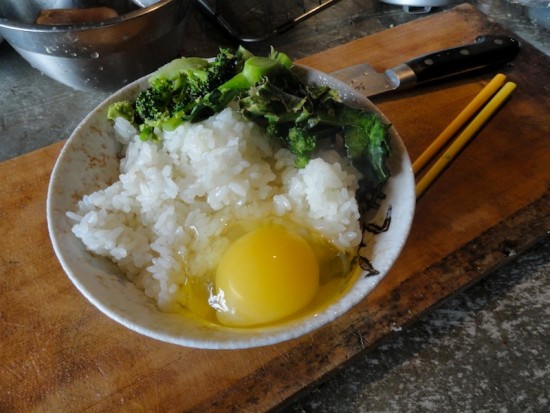
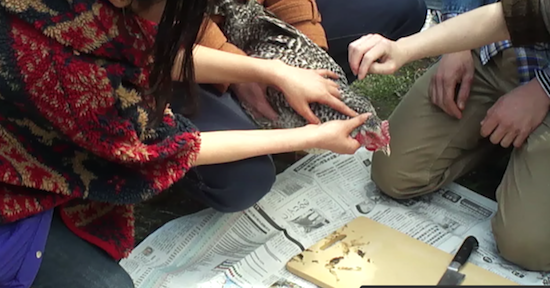
Chiharu decided that she would have to learn how to source and prepare her own food from scratch, and that meant getting her hands dirty. Documenting the event and sharing it on her personal blog, she took her first step towards self-sufficiency by learning how to wring the neck of a chicken.
“Writing about my experience on my blog,” she tells, “I received an unexpectedly large amount of feedback. It made me realise that perhaps other people, too, had come to realise the danger they were in following the events of March 11.”
To look at her: a slim, bright-eyed young woman with a warm smile, it’s difficult to imagine that Chiharu has it in her to butcher her own meat. But butcher it she does, and during winter this year she shared on her blog the entire process involved in killing and preparing a 50kg wild boar, going through everything from burning off the hair to cutting up the meat and preparing a meal with it. Slowly building up enough knowledge and experience to educate others, she began a workshop, inviting both adults and children to come along and learn not only how to kill poultry and prepare their own meat, but also to take time to realise just how much time, effort and unpleasantry is involved–all of which, of course, we miss when we pick up our meat and vegetables from a supermarket where it comes in convenient, shrink-wrapped packs. “The aim,” Chiharu explains, “is for people to take that experience home with them.”
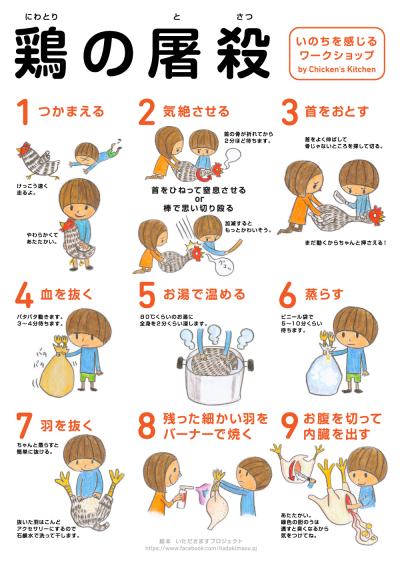
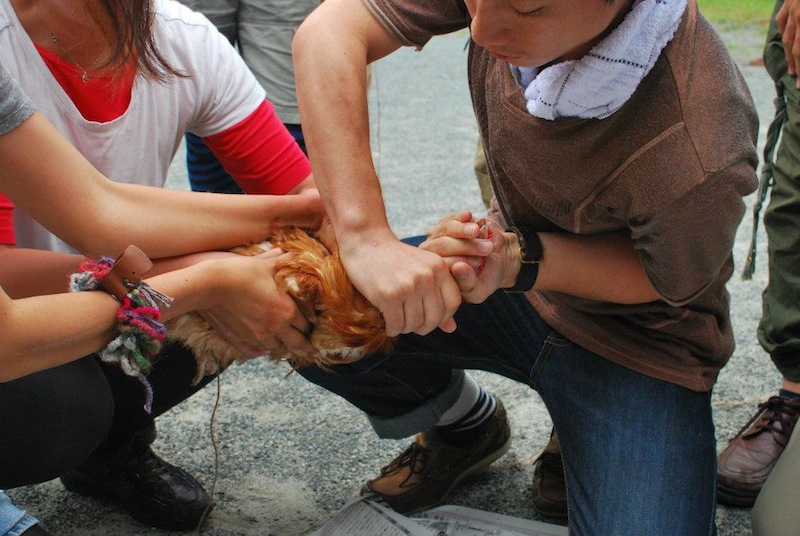
Those who take part in the workshop are required first to catch and then spend time petting the chicken that they will kill. Admittedly, this exercise is intended to tug at participants’ heart strings and make the act of killing the bird even harder than it already is for beginners, but Chiharu has included this step so as to better reflect reality. After all, those who rear animals inevitably become familiar with or sometimes even downright attached to them, having interacted with them daily for a period of weeks or months, so it stands to reason that workshop participants should be required to spend time getting to know their chicken and are even asked to name it before the deed is done.
▼ A brave volunteer wrings a chicken’s neck.
▼ Next, the chickens must be bled.
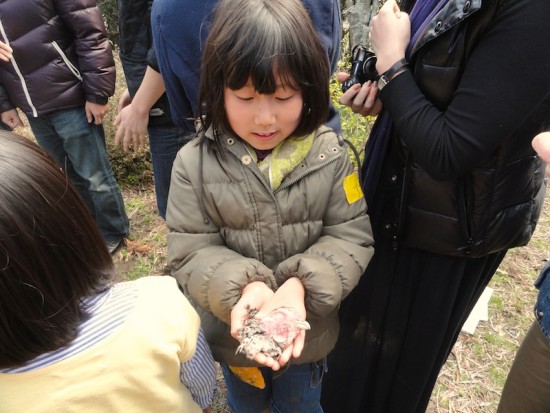
▼ A young girl holds the head of a recently killed chicken.
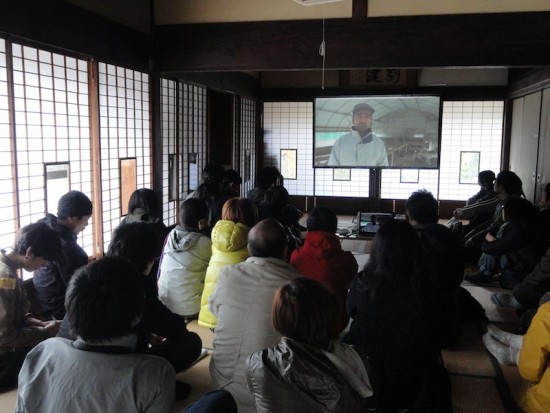
This is not, however, simply some grotesque 21st-century attraction that curious city folk can take part in for an hour before posting a photo of themselves holding a dead chicken to Facebook to impress their friends. The entire workshop lasts several hours and includes a video presentation recorded by local farmers discussing their role and the process involved in the slaughtering of livestock, the petting, killing and butchering of the birds, a cooking session which teaches how to make use of almost every part of the chicken (yes, even the feet!), and finally a discussion between participants about their experience and how it has altered their perception of store-bought produce and meat in particular. Chiharu even runs courses teaching how to make accessories using the slaughtered chickens’ feathers.
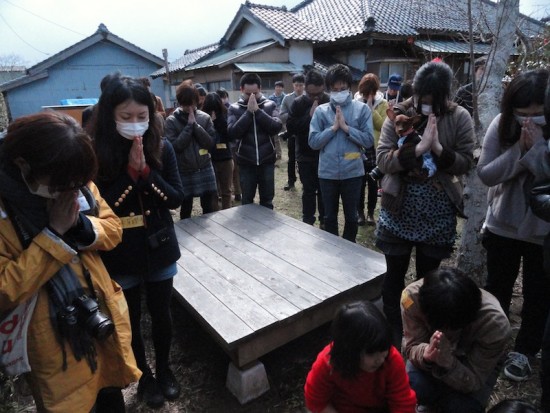
▼ Having killed the chickens, participants take a moment to be thankful.
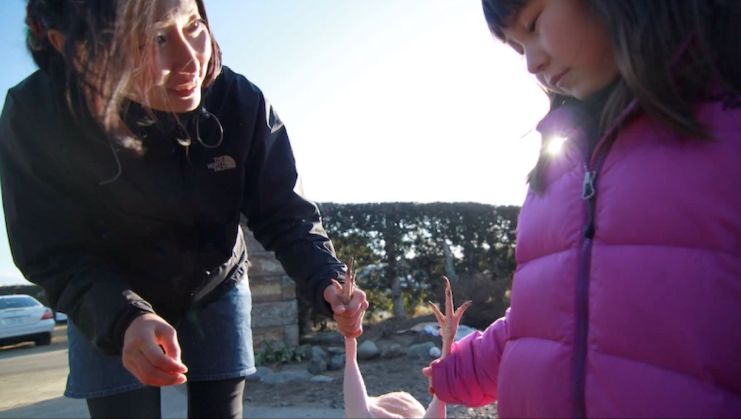
▼ Chiharu asks a young girl to help carry a plucked chicken.
▼ Cooking class.
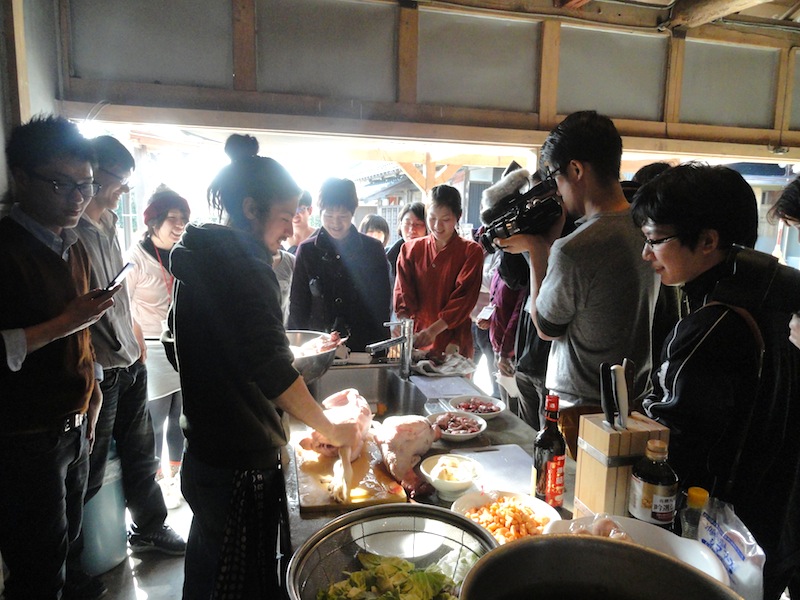
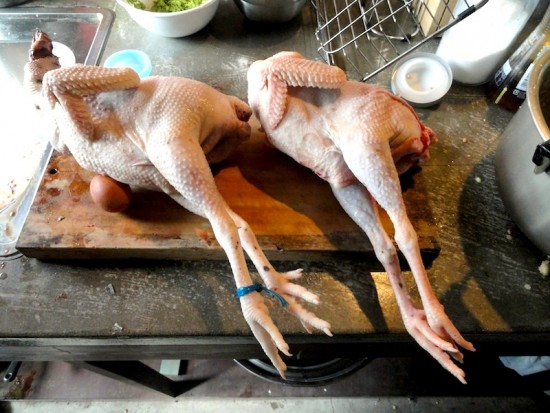
▼ A meal that few will ever forget.
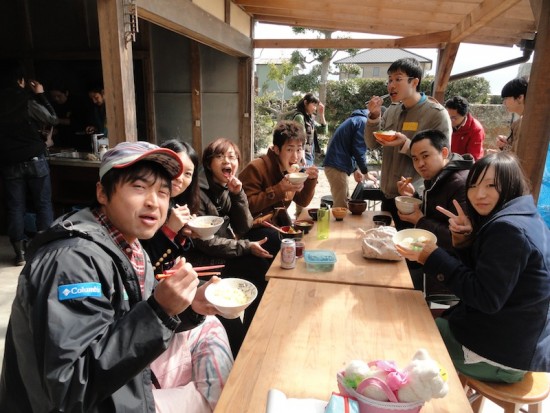
With her workshops in full swing and herself constantly studying and learning new skills from trained professionals, Chiharu is well on her way to become an expert in the field, and has even rolled out plans to open a share house that will further foster the idea of self-sufficiency, with spacious vegetable gardens and land to rear chickens, and using renewable energy to power and heat the building itself.
The life she leads may not be for everyone, and for many the switch to home-grown produce or meat butchered by their own hand may be simply impractical or too much of a challenge to undertake, but we at RocketNews24 are certainly glad that there are people in the world like Chiharu and wish her the best of luck with her personal quest from now on. The decision to take life entirely in one’s own hands is by no means one to be made without a great deal of thought, but perhaps it’s time we all took a little look at our own lives and asked: how much of what I have do I owe to the efforts of others, and more importantly, could I survive without it?
To find out more about Chiharu, visit her blog here (Japanese only), or watch her talk on YouTube.
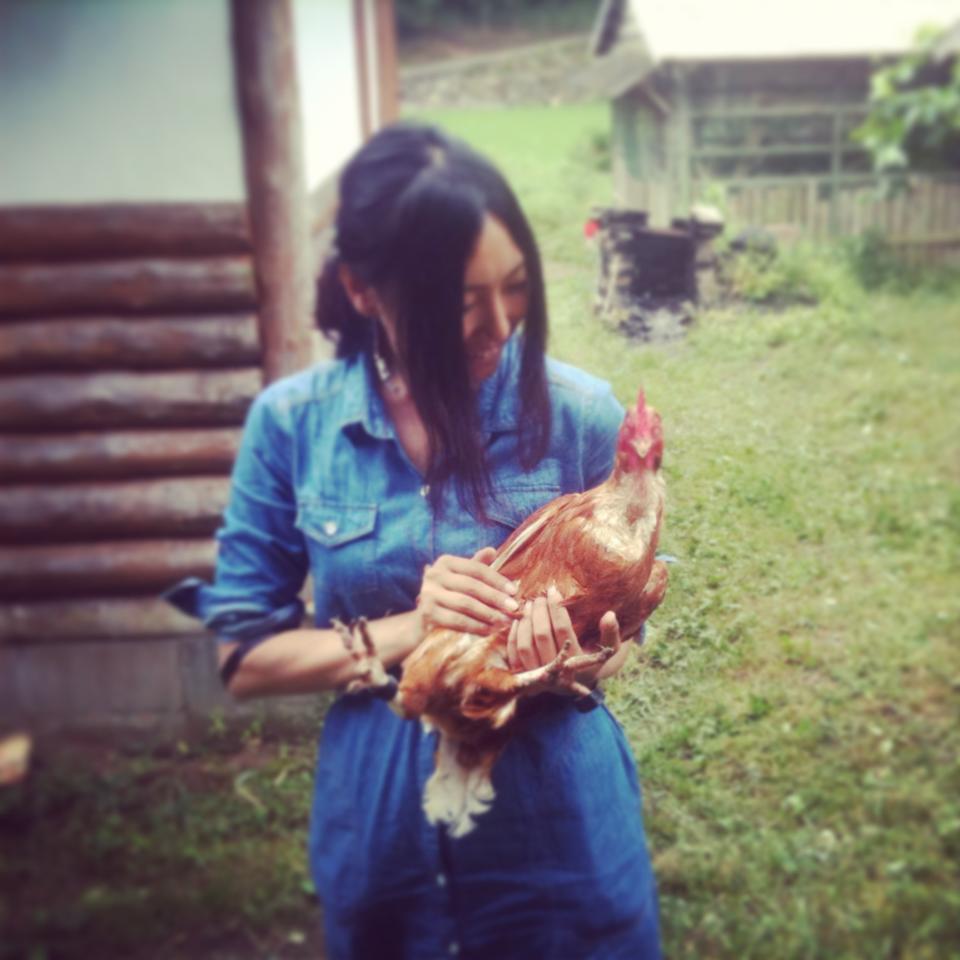
Photos used with the permission of Chiharu Hatakeyama.