
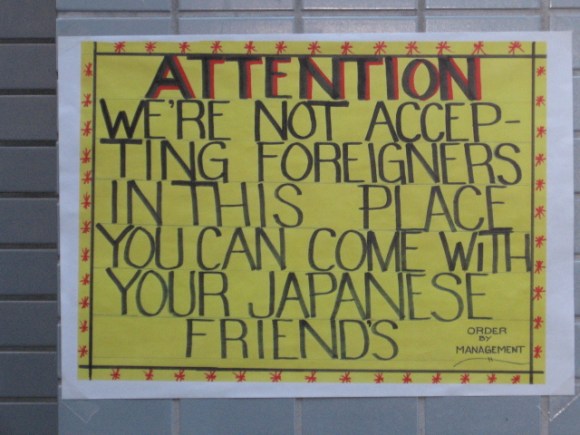
Much ink has been spilled about the supposed homogeneity of Japan and the dangerous idea of racial purity that goes along with it. Some expats have made entire careers writing — or ranting — about the problems of discrimination in Japan. And yet, the number of foreign residents has more than doubled in the last 20 years and international marriages in the country have been steadily rising, so it can’t be all that hostile either.
So how racist is Japan, really? Here’s my take—admittedly only one perspective—on where things stand.
So, let’s start with where I’m coming from. I grew up in a white, middle-class neighborhood. There were a handful of minorities at my schools, mostly Latino, but I lived my entire life as part of the majority ethnic group. Moving to Japan 10 years ago was the first time in my life that I experienced what it’s like to be in the minority.
Let me be clear. I’m not conflating my experience, which has been largely unproblematic, with the experiences of oppressed minorities. They don’t even compare. However, for the first time in my life, I was visibly “other.” For the first time, I wondered what assumptions people were making about me based on the color of my skin and the shape of my face. For the first time in my life, racial differences stopped being something I thought about abstractly and started being something I confronted daily. It got me thinking about the different forms racism takes and how they work in society.
Many Japanese make three assumptions about me before even speaking to me. One, I am an American (true). Two, I am an English teacher (nope). And three, I don’t speak Japanese or know anything about Japanese culture (the jury might still be out on this one). None of these assumptions are particularly terrible, but are nonetheless racial stereotypes.
This is the majority of racism I’ve seen in Japan, the so-called “innocent racism,” unchallenged assumptions springing from society or the social mores of the time. It isn’t motivated by animus, the notion just hasn’t been challenged or is unexamined.
That’s not to say that there aren’t more insidious varieties of racism that are driven by hate knocking around. If you’ve ever seen one of the right-wing, Japan-for-Japanese vans driving around Shibuya, you couldn’t deny that, and by some reports, this kind of hate speech is on the rise. However, it’s my impression that this is very much a fringe element, much as you can still find the KKK in the States, but no one would call it a mainstream philosophy.
▼ How do you say “douchenozzle” in Japanese?
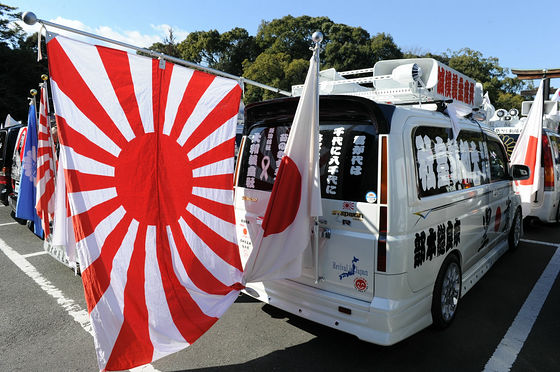
Image: Gigazine
While my experiences with racial profiling in Japan have been relatively benign, things are much more problematic for other groups. Some of the comments made in casual conversation or even in the media about Africans (or anyone black, really), other Asians (in particular SE Asians and Asians from former Japanese colonies), or minorities within Japan such as the Ainu of Hokkaido, the Ryukyu of Okinawa, ethnic Koreans and the Burakumin betray far more negative stereotypes. While it may bother me that people assume I’m a teacher (I’m not knocking the profession, I just get tired of correcting them), that seems preferable to them assuming that I’m a criminal or only married to a Japanese for the visa. The very comfort with which some people make vast generalization and throw around phrases like “all Chinese” or “we Japanese” is distressing.
There are positive signs that attitudes about race are changing in Japan, though.
There is growing recognition that Japan is in fact multi-ethnic. The government reversed its long-held policy of forced assimilation and recognized the Ainu as an indigenous people, and in 2007, it joined the United Nations Declaration on the Rights of Indigenous Peoples.
Japan doesn’t have laws banning hate speech or protecting non-Japanese against discrimination, but there have nevertheless been some positive outcomes in recent court cases. For example, a court ruled last month that an anti-Korean group that protested outside of a school for ethnic Koreans in Kyoto would have to pay damages, saying the activity “constituted racial discrimination” under the UN convention. In a similar case some years ago in Hamamatsu, a court ordered a jewelry shop that refused to serve a Brazilian resident to pay damages, citing the International Convention on the Elimination of All Forms of Racial Discrimination as the legal standard in the absence of a domestic discrimination law.
Most importantly, average Japanese, concerned about the direction their country is taking, are speaking out. General rallies were held in Tokyo and Osaka recently to protest racism and hate speech. Similarly, when an anti-Korean protest was held in Shin-Ōkubo, a neighborhood with many ethnic Koreans and immigrants, counter-protesters showed up to support their Korean neighbors.
▼ The sign reads: “No hate speech, no discrimination.” That’s my Japan!
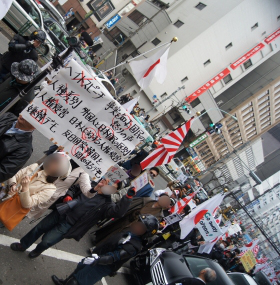
Image: J-cast News
I’m hopeful that the kind of sweeping generalizations made about entire races or nationalities that currently don’t draw much comment in Japan will one day be censured as backward and close-minded. I think it’s an inevitable result of increasing immigration and globalization. However, I think Japan could be doing a lot more to protect minorities and foster a more friendly environment for foreigners.
The first and most important step would be to codify the international commitments they’ve already made into Japanese law. There should be a law banning hate speech. There should be a law banning discrimination, particularly in employment and housing, on the basis of race or nationality. It also wouldn’t hurt to have more government engagement with relevant groups and NGOs, particularly in crafting the laws that will affect them.
What will ultimately change attitudes in Japan is more discussion, though. Particularly in the media and in education, I would love to see more diversity and more recognition of the presence and contributions of foreigners and minorities in Japan. History classes should cover the darker aspects of Japan’s history so young people will have a more nuanced understanding of lingering conflicts with their neighbors.
▼ Embracing diversity gets you more chicks.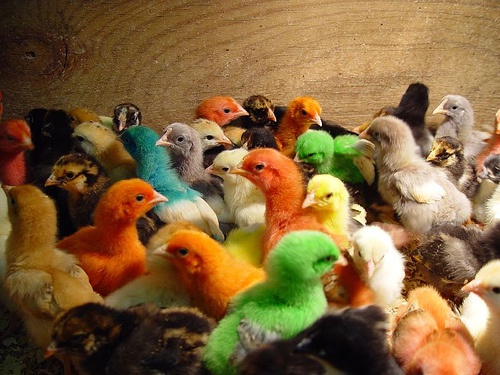
Image: The Wild Green Yonder
In a nutshell, that’s my take on racism in Japan. There are bigots here, just like in every society, but on the whole, people are friendly and open, just lacking in exposure to diversity.
So, readers, what’s your take? Am I hopelessly idealistic and naive? Do you have horror stories to tell? Let us know in the comments.
Source: RocketNews24
Image: On the Other Side: Opposition in Japan
 Hate speech may soon be punishable by a 500,000-yen fine in one of Japan’s largest cities
 Japanese-American singer Hikaru Utada opens a discussion on racism on Japanese Twitter
 Chinese ad for laundry detergent is remarkably racist
 Anti-Asian Racism Social Experiment restores our faith in humanity【Video】
 Japanese government gives examples of what qualifies as “hate speech” in anti-discrimination law
 Mt. Fuji decorated with a 500,000-flower pink carpet is Japan’s ultimate spring view
 New Travelling Bento pouches turn your luggage into a Japanese lunch box
 Family Mart unveils new Japanese bread that elevates convenience store food to mocchiri levels
 Man bites woman at cherry blossom park in Japan, dies shortly after
 Does a long line mean a sweeter deal? We compare two sweets from a Hokkaido food fair【Taste test】
 We tried out three types of men’s boxer briefs from Daiso, and one of them left us speechless
 This balding middle-aged fairy is one of Japan’s most unique mascot characters
 What’s in a Japan Disney Store Lucky Box? Our non-Disney fanatic finds out!
 Anime Spirited Away finds a new way to be beautiful with gorgeous traditional hanafuda card set
 11 things Japanese women want men to know about their breasts
 Japan reportedly adding Japanese language skill requirement to most common foreigner work visa
 Pokémon and Ikea Japan cross over into each other’s worlds with collaboration events
 Starbucks Japan closing only Shinkansen platform branch for popularity-triggered renovations
 Two food hacks take Japan’s convenience store fried chicken to amazing new sandwich heights
 You can assemble a well-balanced team of Pokémon, them eat them, thanks to Japanese cake chain
 Tokyo turns its phone booths into free Wi-Fi hotspots, and here’s how to use them
 Fading Tokyo – Searching for signs of the Showa era as local neighborhoods evolve[Photos]
 Tokyo teahouse serves up a sakura matcha dessert you won’t find anywhere else
 7-Eleven Japan’s new baked-in-store sweet treat is only available in three parts of the country
 Japan now has a special desk for people who work at home with a pet cat[Photos]
 Famous Tokyo cherry blossom spot installs view-blocking screens to fight overcrowding[Video]
 Uniqlo announces new T-shirts for One Piece, Naruto and more for manga publisher’s 100th birthday
 Train station platform ramen store closes its doors on half a century of history in Tokyo
 Starbucks Japan releases new My Fruit³ Frappuccino at only 34 stores around the country
 Studio Ghibli releases Catbus pullback keychain that runs like the anime character
 Krispy Kreme releases Super Mario doughnuts in Japan for a limited time
 Japanese onsen egg maker from 100-yen store Daiso needs to be on your shopping list
 Survey asks foreign tourists what bothered them in Japan, more than half gave same answer
 Japan’s human washing machines will go on sale to general public, demos to be held in Tokyo
 Starbucks Japan releases new drinkware and goods for Valentine’s Day
 We deeply regret going into this tunnel on our walk in the mountains of Japan
 Starbucks Japan releases new sakura goods and drinkware for cherry blossom season 2026
 Studio Ghibli releases Kodama forest spirits from Princess Mononoke to light up your home
 Japan’s newest Shinkansen has no seats…or passengers [Video]
 Major Japanese hotel chain says reservations via overseas booking sites may not be valid
 Put sesame oil in your coffee? Japanese maker says it’s the best way to start your day【Taste test】
 No more using real katana for tourism activities, Japan’s National Police Agency says
 Nike commercial addresses bullying and racism in Japan, riles up debate online【Video】
 Racism hits close to home in China as Beijing store reportedly “bans” Chinese customers
 “Is Japan racist?”: New video humorously confronts long-standing question
 Tokyo ramen shop owner sets “Japanese only” rule as countermeasure against coronavirus
 Translator at Japanese marathon under fire for calling African athletes “cute chimpanzees”
 What do Japanese people think of Black- and Asian-Americans?【Video】
 Singer Gackt claims he was victim of racial discrimination in Paris hotel, handled it with class
 Half-Japanese woman hands card to people who ask tiresome questions about her race
 “Smooth Hair” poster sparks controversy in Japan
 Another Japanese celebrity faces discrimination in France, this time netizens not so sympathetic
 Washington Post writer catches heat for “dirty Korean beer” joke
 Japanese restaurant in Paris vandalized with “coronavirus” graffiti【Photos】
 Over 2,000 people march in support of Black Lives Matter in Osaka
 Mie Prefecture to become first in Japan to ban outing LGBT individuals
 Our writer of Korean descent weighs in on using Korean names in Japan