
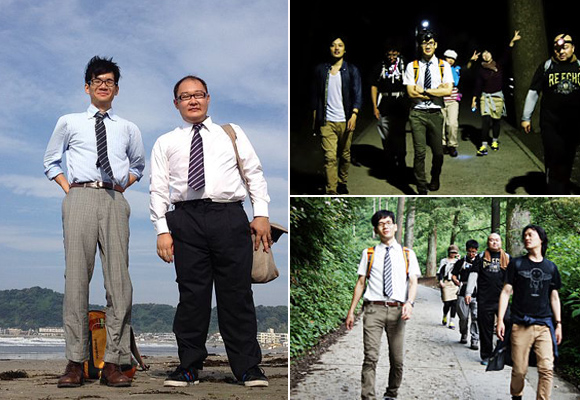
 Ever consider going having a meal with friends or watching a movie on your way to work? While many of us can’t help reaching for the snooze button in the morning, there is a growing number of people who are waking up hours earlier and having a social life before they go to work.
The movement is called Extreme Shussha (extreme going to work) and as of this summer it has been getting increasingly popular in Japan. The rules are simple: Don’t be late for work; don’t bother anyone; and don’t fall asleep when you get there. Beyond that you can do whatever your heart desires.
■ The Japan Extreme Shussha Association
Extreme shussha began a few years ago with Souta Amaya. A regular employee, Mr. Amaya was experiencing problems dealing with his boss. It got so bad that he dreaded going to work but his anxiety would also keep him up all night.
One day, unable to sleep, Amaya left for work extra early and began to take little detours here and there on his way. Surprisingly, these stops cleared up his stress considerably and he found himself feeling well at ease by the time he arrived at work. Over time, and trying new and different activities, even his problems with his boss seemed to vanish.
From there he and Takahiko Shiina (both pictured above) had established the Japan Extreme Shussha Association which works to spread awareness of extreme shussha. Here Shiina does some extreme shussha by enjoying some fish and a trip to a hot spring before going to work.
■ Bowling before work
The concept of extreme shussha isn’t totally new of course. It follows the old axiom “early to bed, early to rise” and another Japanese trend known as asakatsu (active morning). The difference is that extreme shussha should not involve anything related to working or studying. Instead participants are encouraged to go sightseeing or play a game of tetherball.
One example mentioned by Tomoyuki Miyazaki is a group of young singles saying kampai (cheers) while clinking their coffees at a 5:00am gokan (dating party). Then for the customary after-party they would partake in some bowling. Then, in the also common after-after-party, it’s down to the karaoke room. When all is said and done, it’s time to go to work!
Extreme shussha proponents might say that with the absence of alcohol women can feel safer from lecherous types who try to get them in bed. Of course without alcohol the overall healthiness and lifestyles of the participants are improved as well. It is this last point that is piquing the interest of Japanese businesses.
■ Apple picking at 6:00am good for business?
Extreme shussha advocates insist that engaging in leisure activities before works raises the overall energy of workers and creates a type of shussa’s high (pun on “runner’s high”) that results in increased focus and participation in company matters.
Members of the business community are beginning to get behind this theory. A few of them spoke out at a symposium at the Apple Store in Ginza, Tokyo this month. Kazuaki Miyamoto, Executive Vice President of HDE agreed that extreme shussha can lead to more productive thinking from staff.
“[With extreme shussha] there is a sense that in knowledge-based work, which requires using your mind rather than following a manual, performance is heightened.”
Tanita Healthcare Online President Shogo Tanita added that any improvement in the staff’s social life is beneficial to the company as a whole.
“In order to have innovation, it is important to have a network of people beyond your company to interact with. Many people don’t get out at night, so extreme shussha expands the choices and chances to meet people.”
Katsumasa Asahi of Yahoo! Japan envisions the benefits of extreme shussha beyond individual companies and creating new “early morning business” opportunities for the country as a whole.
“I think it’s nice to see more and more shops open early. I’d like to enjoy some live music or a film in the morning. If getting enough people together is a problem then it could work on a sign-up basis.”
These people don’t seem to be alone either as there are already small signs showing a move towards early business.
■ Time Market Development
The Tokyo Metropolitan Government is currently testing the Jikan Ichiba Kaihatsu Project (Time Market Development Project) until March of next year. The city has opened several facilities from earlier in the morning including the observation deck of the Tokyo Metropolitan Government Building and sport centers.
We are still far from knowing whether extreme shussha will become the new way work is done in Japan or not. But if it is successful, then Japan is well on its way to becoming the Earth’s overenthusiastic morning-person that annoys its hungover peers with clichéd motivational phrases.
Source: Blogos – Tomoyuki Miyazaki, Japan Extreme Shussha Association, Wikipedia, Tokyo Metropolitan Government (Japanese)
Video: YouTube – Takahiko Shiina
Souta Amaya: Twitter
Takahiko Shiina: Twitter
 Extreme Budget Travel! Can you do a trip to Manila with 50,000 yen (US$333)? – Part 1
 You can assemble a well-balanced team of Pokémon, them eat them, thanks to Japanese cake chain
 Can a downtown Tokyo super sento bathhouse beat a hotel for a one-night stay?
 Starbucks Japan closing only Shinkansen platform branch for popularity-triggered renovations
 Pokémon and Ikea Japan cross over into each other’s worlds with collaboration events
 Japan reportedly adding Japanese language skill requirement to most common foreigner work visa
 Support your faves and avoid oshikatsu burnout — advice from our resident otaku
 Japan’s prime minister exchanges Dragon Ball kamehamehas with president of France[Video]
 Ochanomizu Hotel Shoryukan has the perfect balance of class and convenience for your Tokyo stay
 We visit izakaya in Thailand billed as “Middle Aged Man’s Paradise”, try food that’s illegal in Japan
 Step back in time with Japanese-themed rooms at rare vintage love hotel in Osaka【Video】
 Tokyo’s best museum for foreign travelers finally reopens after being closed for four years
 Pokémon lacquerware series expands for Year of the Horse with new handcrafted design[Video]
 Two food hacks take Japan’s convenience store fried chicken to amazing new sandwich heights
 Tokyo subway and almost all Tokyo train lines now accepting credit card tap payments
 Totoro Fund line of beautiful artwork and apparel lets you help the real-world Totoro Forest
 Fading Tokyo – Searching for signs of the Showa era as local neighborhoods evolve[Photos]
 Famous Tokyo cherry blossom spot installs view-blocking screens to fight overcrowding[Video]
 Tokyo turns its phone booths into free Wi-Fi hotspots, and here’s how to use them
 Studio Ghibli adds new My Neighbour Totoro 2026 Corn Gift to its anime store for Mother’s Day
 Japan now has a special desk for people who work at home with a pet cat[Photos]
 Uniqlo announces new T-shirts for One Piece, Naruto and more for manga publisher’s 100th birthday
 Train station platform ramen store closes its doors on half a century of history in Tokyo
 Starbucks Japan releases new My Fruit³ Frappuccino at only 34 stores around the country
 Studio Ghibli releases Catbus pullback keychain that runs like the anime character
 Krispy Kreme releases Super Mario doughnuts in Japan for a limited time
 Japanese onsen egg maker from 100-yen store Daiso needs to be on your shopping list
 Nine great places to see spring flowers in Japan, as chosen by travelers (with almost no sakura)
 Survey asks foreign tourists what bothered them in Japan, more than half gave same answer
 Japan’s human washing machines will go on sale to general public, demos to be held in Tokyo
 Starbucks Japan releases new drinkware and goods for Valentine’s Day
 We deeply regret going into this tunnel on our walk in the mountains of Japan
 Studio Ghibli releases Kodama forest spirits from Princess Mononoke to light up your home
 Starbucks Japan releases new sakura goods and drinkware for cherry blossom season 2026
 Japan’s newest Shinkansen has no seats…or passengers [Video]
 Major Japanese hotel chain says reservations via overseas booking sites may not be valid
 Put sesame oil in your coffee? Japanese maker says it’s the best way to start your day【Taste test】
 No more using real katana for tourism activities, Japan’s National Police Agency says