

Ryokan are traditional Japanese hotels whose roots can be traced back to the Edo Period (1603–1868). Although nowhere near as ubiquitous as they once were, there still exist thousands of such establishments, which are most often associated with relaxation, hot spas and, of course, good Japanese food and drink. Even those who would ordinarily choose a bed over a futon would be wise to experience staying at a ryokan at least once during a visit to Japan, but there are a number of dos and don’ts that visitors – both Japanese and otherwise – really ought to know before setting foot inside one.
Trip Advisor Japan has helpfully published a list of tips, designed to look like set of cards teaching the characters from the Japanese syllabary, which instructs visitors on the right way to enjoy a Japanese inn. Some are as obvious as telling guests not to take stuff home with them, but there are others that really ought to be given your full attention.
Staying in a ryokan (which, incidentally, is pronounced ryo-kan rather than rai-o-kan as Westerners unfamiliar with the Japanese language are wont to) is a lot of fun and can be tremendously relaxing, but there are a number of potential pitfalls to watch out for. Follow Trip Advisor Japan’s advice (and our additional explanations) here to ensure your visit to a traditional Japanese hotel is faux pas-free.
- You know the drill: shoes off!

It should come as no surprise to learn that a traditional Japanese hotel should stick to the age-old practice of removing one’s shoes when indoors. In the hotel reception you’ll find pairs of slippers. These are not optional, so be sure to remove your outdoor shoes and slip them on. They might not fit or be especially comfortable, but don’t worry about it; these are only for use when moving around the hotel and are to be removed when you’re in your room (don’t walk on the tatami wearing shoes of any kind), so rest assured that you won’t have to wear these often decidedly unfashionable-looking shoes for the entirety of your stay.
- Free tea!

Inside your room, you’ll find packets of tea, chawan teacups which look like tiny bowls, a little teapot and maybe some small snacks such as rice crackers to accompany them. These are completely free and will be kept stocked by the ryokan staff, so help yourself. There will usually be a small table with zabuton cushions and zaisu (lit. “sit chairs”, which look like chairs without legs) to sit around and enjoy a relaxing cup of tea.
- I am the calm little centre of the earth
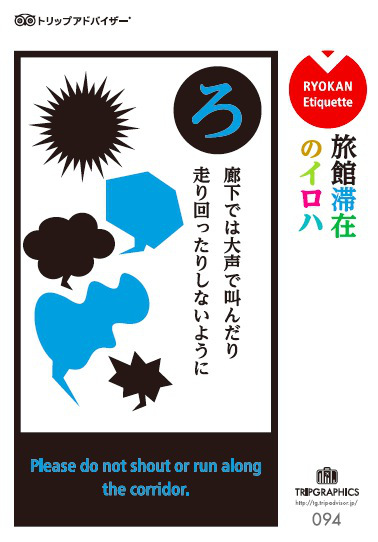
As mentioned, ryokan are often considered places to unwind rather than somewhere to crash while sightseeing (though you can of course use them for that), so it’s best to think of them more like health spas than the Holiday Inn. Be extra quiet when outside your room, move around gently and don’t be “that guy” in the hallway talking loudly on his phone or shouting to his buddies. This of course goes for any decent hotel, but boisterous behaviour is considered especially irksome at a ryokan.
- Um, where’s my bed!?
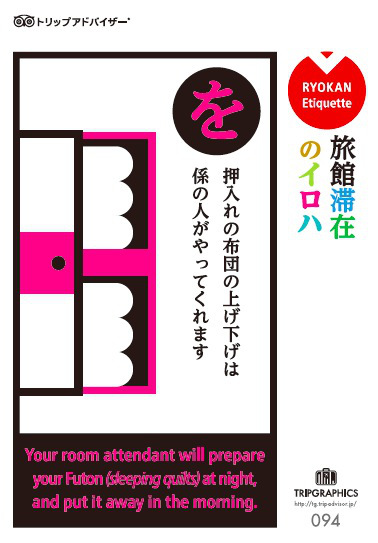
First-time visitors to ryokan may be confused when they enter their room and discover neither beds nor futons. Not to worry; the staff will come to your room (usually around dinner time) and lay the futons out for you. This may seem odd, almost servant-like even, but it means you’ll have much more space in your room during the day and is all part of the ryokan experience. Tipping is not required, and many ryokan staff will find the very idea of being offered money to do their job repugnant, so keep your yennies in your pocket.
- Tokonoma-no-no
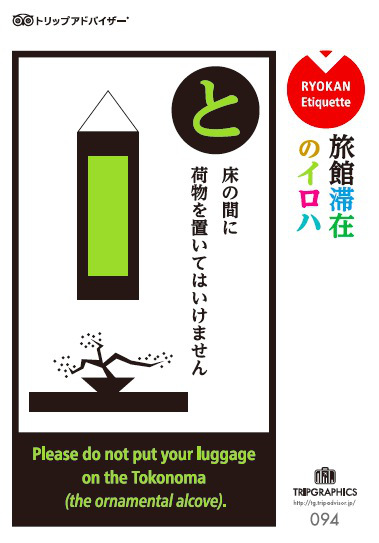
Pretty much every guest room in a ryokan will have an area called a tokonoma in it. This is purely for decorative purposes and will almost always include some form of scroll, artwork, ornate bonsai tree or flowers. It also looks like an ideal space to store a few suitcases, but is actually the worst possible place you could do so, so keep it clear at all times and soak up the Japanese ambience.
- If it’s not nailed to the floor…
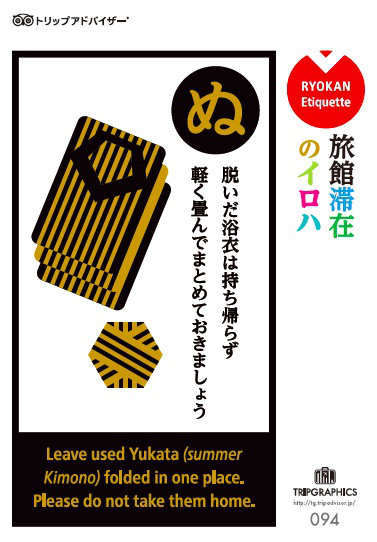
You’ll find your yukata – which guests wear when back for the evening or moving around the hotel, dining room included – in the cupboard of your room, neatly folded and complete with a small cotton belt to tie it. It may look a little flimsy, but as you may have guessed you’re only borrowing it while you’re there. When you’ve finished and are checking out, be sure to leave your yukata where you found it, no matter how attached to this piece of genuinely wonderful loungewear you become during your stay. This is probably obvious to most people, but since Trip Advisor went to the trouble of telling people not to pack their yukata in their suitcase (which should be kept off the tatami, by the way) we’re guessing some ryokan have had more than a few go missing.
- Less is more
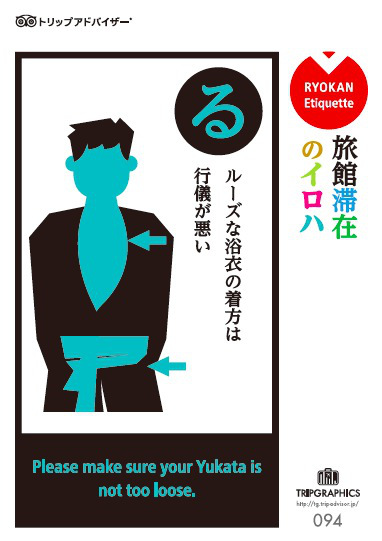
Speaking of yukata, be sure to keep it tightly closed. You’ll see a lot of Japanese folks walking around with theirs closed to the point that barely an inch of flesh below the neck is visible. It looks a bit odd, especially for somewhere you’re supposed to be relaxing, but this is actually the correct way to wear it, so keep that belt tight. (Oh and yes, you’re supposed to wear underpants beneath it!)
Last but not least, there’s the important matter of how to put on your yukata. As illustrated here, men should tie their belt at the usual hip height, women a little higher. Much more important than that, however, is that the left side should always be on top. Traditionally, corpses are dressed with their robes right-over-left, so it’s definitely not a look you’ll want to replicate. 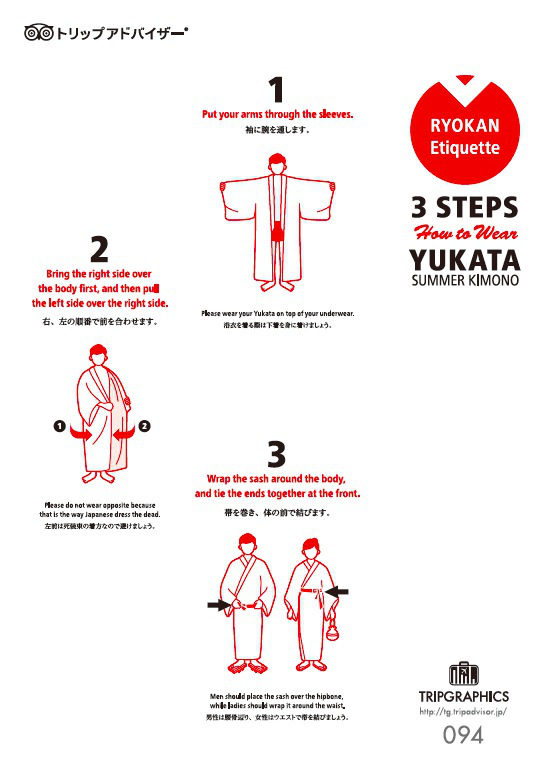
With that little lot you should be more than ready to enjoy your visit, but if you’re still curious or worried about putting your foot in it, be sure to head over to Trip Advisor Japan for more ryokan etiquette tips!
Source/images: Trip Advisor Japan
[ Read in Japanese ]
 Two things to do, and two things not to do, when leaving a traditional Japanese inn
 Japanese etiquette lesson: Should you fold up your own futon when leaving a ryokan inn?
 Stay in an eerie Japanese ryokan inn near Tokyo Tower for US$40 a night
 The 10 best ryokan inns in Japan, as chosen by travelers
 More than a capsule hotel, downtown Tokyo capsule ryokan is awesome, budget-friendly spot to stay
 Japanese manhole lid raises eyebrows with fertility god symbol that looks like… well, you know
 Foreign man arrested for walking on Shinkansen tracks, claims he was on the run from yakuza
 Man bites woman at cherry blossom park in Japan, dies shortly after
 Family Mart unveils new Japanese bread that elevates convenience store food to mocchiri levels
 Häagen-Dazs releases new Green Tea sandwich in Japan for a limited time
 Survey reveals Japan’s Generation Z dresses for social media, not for self-expression
 Tokyo turns its phone booths into free Wi-Fi hotspots, and here’s how to use them
 Naruto and Converse team up for new line of shinobi sneakers[Photos]
 Sleep next to the railroad tracks at the closest hotel to a train station platform in Japan
 This easy, camp-friendly gratin dish will keep you warm this winter with hot cheesy creaminess
 Pokémon and Ikea Japan cross over into each other’s worlds with collaboration events
 Japan reportedly adding Japanese language skill requirement to most common foreigner work visa
 Starbucks Japan closing only Shinkansen platform branch for popularity-triggered renovations
 Two food hacks take Japan’s convenience store fried chicken to amazing new sandwich heights
 You can assemble a well-balanced team of Pokémon, them eat them, thanks to Japanese cake chain
 Fading Tokyo – Searching for signs of the Showa era as local neighborhoods evolve[Photos]
 Pokémon lacquerware series expands for Year of the Horse with new handcrafted design[Video]
 Tokyo teahouse serves up a sakura matcha dessert you won’t find anywhere else
 Totoro Fund line of beautiful artwork and apparel lets you help the real-world Totoro Forest
 Japan now has a special desk for people who work at home with a pet cat[Photos]
 Famous Tokyo cherry blossom spot installs view-blocking screens to fight overcrowding[Video]
 Uniqlo announces new T-shirts for One Piece, Naruto and more for manga publisher’s 100th birthday
 Train station platform ramen store closes its doors on half a century of history in Tokyo
 Starbucks Japan releases new My Fruit³ Frappuccino at only 34 stores around the country
 Studio Ghibli releases Catbus pullback keychain that runs like the anime character
 Krispy Kreme releases Super Mario doughnuts in Japan for a limited time
 Japanese onsen egg maker from 100-yen store Daiso needs to be on your shopping list
 Survey asks foreign tourists what bothered them in Japan, more than half gave same answer
 Japan’s human washing machines will go on sale to general public, demos to be held in Tokyo
 Starbucks Japan releases new drinkware and goods for Valentine’s Day
 We deeply regret going into this tunnel on our walk in the mountains of Japan
 Studio Ghibli releases Kodama forest spirits from Princess Mononoke to light up your home
 Starbucks Japan releases new sakura goods and drinkware for cherry blossom season 2026
 Japan’s newest Shinkansen has no seats…or passengers [Video]
 Major Japanese hotel chain says reservations via overseas booking sites may not be valid
 Put sesame oil in your coffee? Japanese maker says it’s the best way to start your day【Taste test】
 No more using real katana for tourism activities, Japan’s National Police Agency says
 Learn all about enjoying a traditional Japanese-style ryokan inn from this nine-minute video!
 Survey reveals the most popular time to slip into a yukata at a traditional Japanese inn
 Hilton Japan apologizes for “disrespectful” ad disparaging traditional Japanese inns
 How should you use the small hiroen in a Japanese ryokan hotel room?
 Rakuten Travel reveals the top 5 best-rated, off-the-beaten-track Japanese ryokan inns
 “The best ryokan I’ve ever visited” – A photo tour of Akita Prefecture’s Miyakowasure inn
 Japan’s 10 best ryokan inns and top 10 hotels, as chosen by foreign visitors
 Japanese pot sticker restaurant chain also runs flat-rate hot spring inn, but is it worth staying at?
 Japanese travellers give their answers to the Hotel vs. Ryokan Japanese inn debate
 Foreign travelers’ lukewarm reactions to traditional Japanese inn food causing changes in Kyoto
 Writer’s retreat ryokan — Tokyo inn treats you like novelist on deadline, with strict “editors”
 Step into the old pleasure quarters of a former red light district at this Japanese inn
 Japanese house is actually a cheap hotel where you can stay for US$24 a night
 Japanese ryokan custom ignites debate after visitors label it sexist
 Japanese popcorn comes with collectible cards of women who own traditional ryokan inns【Photos】