
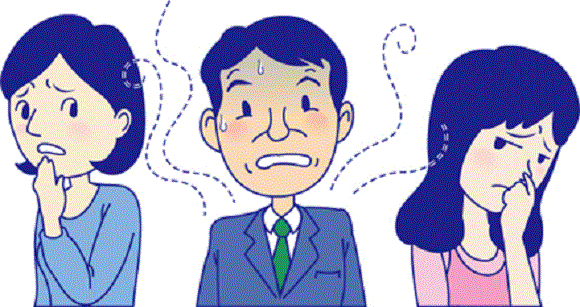
What do you dread the most about growing old? Is it the aching muscles after what used to be an easy exercise routine? The need to get up and pee multiple times during the night? Or how about that distinctive “old-person smell” that sneaks into the air whenever a senior citizen is around?
Speaking of that last one, have you ever wondered where that particular odor comes from? Although many people believe that the source of the smell is behind the ears, a team of Japanese researchers have recently disproved this theory after what must have been an excruciatingly odoriferous ordeal. You might want to plug your nose for this one, folks–things are about to smell more than a little fishy around here…
As someone who works mostly with children and teenagers, I’ve never really been in a situation where I had to endure the so-called “old-person smell” for long periods of time. But the following tweets illustrate just how finely attuned others are to the unique smell:
▼”I sat down too quickly and was overcome by the smell of the old man sitting next to me (×_×)”
https://twitter.com/07subaru/status/545738823863255040▼”The destructive power of the old-man smell shouldn’t be taken lightly (-_-)”
https://twitter.com/youkohako/status/545771055952846849▼”A women who looked to be in her late 20s/early 30s was sitting next to me, but she smelled awful–about three times as bad as the younger guy over there. What’s up with that?”
見た目20後半から30後半の女性が隣に座ってるのだけど加齢臭がやばい。そこらへんのおじいちゃんの3倍くらいなのだが…どうしたの
— 黒胡椒 (@burapetinoo) December 13, 2014
In fact, Japan’s My Navi News recently surveyed 200 of its readers about unpleasant odors. A whopping 40.9% responded that the old-person smell bothered them the most–even more than the smell of sweat or the smell of cigarettes (both ranked in at 14.6%).
So what exactly causes this bothersome scent?
Japanese scientists have recently classified naturally occurring body odors into three main types: smells caused by sweat, smells caused by the chemical compound 2-nonenal (also known as the old-person smell, or 加齢臭 in Japanese), and smells caused by the chemical compound diacetyl (which gives middle-aged folk their own unique smell; the newly coined termed in Japanese is ミドル脂臭 / midoru shishuu). This last category is the result of new research and distinguishes between the body odors of middle-aged people and the elderly.
Let’s now take a look at each of the three categories.
First of all, 2-nonenal is responsible for the distinctive smell of elderly people. Although many people (at least within Japan) mistakenly believe that the odor emanates from behind a person’s ears, it actually comes from the back and central chest areas. If you smell something fishy behind the ears, it’s probably just the smell of perspiration, which occurs when odorless sweat rises to the surface of the skin and mixes with sebum and bacteria.
In addition to those two sources of body odor, Japanese researchers have just concluded that a third type of oily odor is present in middle-aged people due to the presence of a chemical compound called diacetyl. Diacetyl reaches its peak of production when people are in their late 30s or 40s, which is why it gained the nicknamed “the middle-aged person smell.” The chemical is said to be very volatile, and is over 100 times more easily diffused in an enclosed area than is nonenal. Articles have likened this third kind of smell to an old dresser or dead grass, also stating that women may be more sensitive to the smell than men.
▼We assume that “dead grass” means this kind of grass, and not the freshly mowed variety that seems to rank high on people’s lists of most pleasant smells.

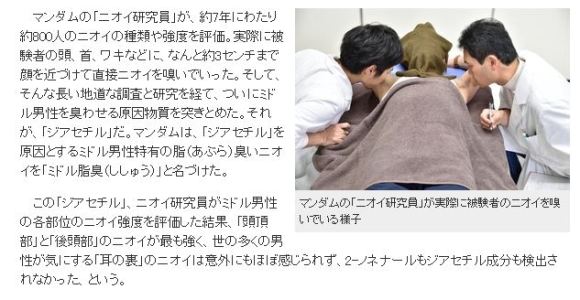
These discoveries about the middle-aged person smell came to light following the conclusion of a research study conducted by the Mandom Corporation (a Japanese manufacturer of hair care, skin care, perfumes, and deodorants), which lasted over seven years and involved approximately 800 middle-aged participants. In the study, researchers got up close (only three centimeters away!) to the participants’ heads, necks, and armpits, and took in big whiffs of body odor to try to pinpoint the source of the particular smell. Impressively, they were able to determine that the smell was strongest at the top and back of the head.
▼Don’t quit your day job, guys…err, wait, this is your day job…
Of course, people’s bodily scents can also vary depending on their individual diets and lifestyle choices. One Japanese source provides a list of tips for those self-conscious readers who wish to decrease their unpleasant natural scents:
- For protein, eat more fish than meat, and even more soy products than fish.
- Get plenty of antioxidants by eating dark-colored vegetables, sesame seeds, nuts, and citrus fruits.
- Eat more brown rice.
- Try to get at least six hours of sleep. If you don’t get enough sleep, your sebaceous glands will go into overdrive and production of the chemical 2-nonenal will increase.
We hope you’ve enjoyed this brief look at some of the science behind body odor. I’ve certainly gained an increased appreciation for the researchers who–quite literally–stick their noses into unwelcome places in the name of science!
Source: Naver Matome
Top image: Seesaa Blog
Insert images: Mayang’s Textures, Diamond Online
 Japanese cosmetic company discovers our “stress smell” is similar to a dead animal’s butt
 Why does my cat’s poop stink so much? Japanese scientists bust the myth behind feline turds
 Japanese scientists determine the source of the coveted “young woman” smell
 Over 40 percent of Japanese high school girls say their dads smell bad in survey
 Japan reportedly adding Japanese language skill requirement to most common foreigner work visa
 McDonald’s Japan adds new Hello Kitty and Pompompurin drinks to the menu for a limited time
 Japan named most sleep-deprived country for fourth year in a row, according to survey
 Starbucks Japan closing only Shinkansen platform branch for popularity-triggered renovations
 You can assemble a well-balanced team of Pokémon, them eat them, thanks to Japanese cake chain
 7-Eleven Japan’s new baked-in-store sweet treat is only available in three parts of the country
 One Piece creator has hidden secret of anime treasure’s identity in chest at bottom of real-world ocean
 New Japanese KitKats come in sakura flavour, with poetic symbolism for success
 Pokémon and Ikea Japan cross over into each other’s worlds with collaboration events
 Japan’s full-facemask Ninja Parka still lets you eat ice cream[Photos]
 Tokyo’s best museum for foreign travelers finally reopens after being closed for four years
 Pokémon lacquerware series expands for Year of the Horse with new handcrafted design[Video]
 Two food hacks take Japan’s convenience store fried chicken to amazing new sandwich heights
 Tokyo subway and almost all Tokyo train lines now accepting credit card tap payments
 Totoro Fund line of beautiful artwork and apparel lets you help the real-world Totoro Forest
 Fading Tokyo – Searching for signs of the Showa era as local neighborhoods evolve[Photos]
 Famous Tokyo cherry blossom spot installs view-blocking screens to fight overcrowding[Video]
 Tokyo turns its phone booths into free Wi-Fi hotspots, and here’s how to use them
 Studio Ghibli adds new My Neighbour Totoro 2026 Corn Gift to its anime store for Mother’s Day
 Japan now has a special desk for people who work at home with a pet cat[Photos]
 Uniqlo announces new T-shirts for One Piece, Naruto and more for manga publisher’s 100th birthday
 Train station platform ramen store closes its doors on half a century of history in Tokyo
 Starbucks Japan releases new My Fruit³ Frappuccino at only 34 stores around the country
 Studio Ghibli releases Catbus pullback keychain that runs like the anime character
 Krispy Kreme releases Super Mario doughnuts in Japan for a limited time
 Japanese onsen egg maker from 100-yen store Daiso needs to be on your shopping list
 Nine great places to see spring flowers in Japan, as chosen by travelers (with almost no sakura)
 Survey asks foreign tourists what bothered them in Japan, more than half gave same answer
 Japan’s human washing machines will go on sale to general public, demos to be held in Tokyo
 Starbucks Japan releases new drinkware and goods for Valentine’s Day
 We deeply regret going into this tunnel on our walk in the mountains of Japan
 Studio Ghibli releases Kodama forest spirits from Princess Mononoke to light up your home
 Starbucks Japan releases new sakura goods and drinkware for cherry blossom season 2026
 Japan’s newest Shinkansen has no seats…or passengers [Video]
 Major Japanese hotel chain says reservations via overseas booking sites may not be valid
 Put sesame oil in your coffee? Japanese maker says it’s the best way to start your day【Taste test】
 No more using real katana for tourism activities, Japan’s National Police Agency says