Learning a foreign language is hard. Even if you master all the vocabulary and grammar, there’s still no guarantee that you’ll ever achieve a native-like accent. For Japanese learners of English, differentiating between the “l” and “r” sounds and pronouncing the “th” sound correctly can be tricky them no matter how many years they’ve been practicing.
But have you ever wondered what it’s like the other way around? What sounds do we English speakers make that sound strange when we speak Japanese? Well it turns out the sound that we mess up the most is one you might not have expected: “fu”.
Now you might be thinking: The “fu” sound? What’s so hard about that? I pronounce it fine all the time. Like when I slept on a futon at Mt. Fuji in fuyu (winter) and woke up feeling futsukayoi (hungover).
Well if you’re pronouncing those words with an “f” sound like we have in English, then you’re actually saying them all wrong. To find out the reason why, we have to have a quick linguistics lesson.
▼ Yes there will be a test. No you haven’t studied. You haven’t even shown up to class all semester. Also you’re in your underwear and falling from a skyscraper.

The English “f” sound is, in phonetic terms, a “voiceless labiodental fricative.” Don’t worry, by the end of this article you’ll be a master of that phrase and more and will totally impress all of your friends, I swear.
Basically what that long phrase means is, the “f” sound, like most sounds humans can make, has three components that come together to make it up. First, it’s “voiceless.” That means it doesn’t vibrate your vocal cords when you say it. To feel what a “voiced labiodental fricative” feels like, hold your fingers to your throat and make the “v” sound. You should feel a lot of vibration, but nothing when you make the “f” sound.
Second, it’s a “labiodental.” That means it’s pronounced using your lips (labio) and teeth (dental). There’s a bunch of different places sounds can be made: your lips (“p”), your teeth (“t”), at different points on your tongue (“l”), in your throat (“h”), or a combination of them.
Lastly, it’s a “fricative.” This means the sound is made by the “friction” of air coming through a gap, in this case the small opening between your lips and teeth. Some other fricatives are the “s” sound, a fricative between your teeth, and the “th” sound, a fricative between your teeth and tongue.
Putting it all together, we now know that the English “f” sound is a “voiceless labiodental fricative,” meaning your vocal cords don’t vibrate, it’s pronounced using your lips and teeth, and by pushing air through the gap they make.
▼ Dee dee dee deeee!
 Flickr (Alex Gorzen)
So what does this have to do with Japanese pronunciation? Well now we have the tools to clearly see where the pronunciation has gone wrong. The English “f” may be a “voiceless labiodental fricative” but the Japanese “f” is a “voiceless bilabial fricative” – one component different.
Since the Japanese “f” is a “bilabial” instead of a “labiodental,” that means it’s pronounced using both your lips, no teeth necessary. Instead of touching your teeth to your lip and spitting out air like you just slammed your finger with a hammer, instead bring your lips together like you’re blowing out a candle (no need to stick them out like you’re kissing), then try to say “fu” without moving your lips or teeth or anything at all.
▼ I’m learning Japanese!
 Flickr (H. Michael Miley)
If you did it correctly, then you should have made a beautiful “fu” sound. If you’re still having trouble though, then let the knowledgeable Sayuri-san guide you to enlightenment.
If you’ve seen a Japanese syllabary chart like one below, you may well have noticed that ha, hi, he, and ho are all written with an “h”. Weirdly, though, only “fu” – despite being in the same column as the characters beginning with “h” – is written with an “f” when Roman characters are used.
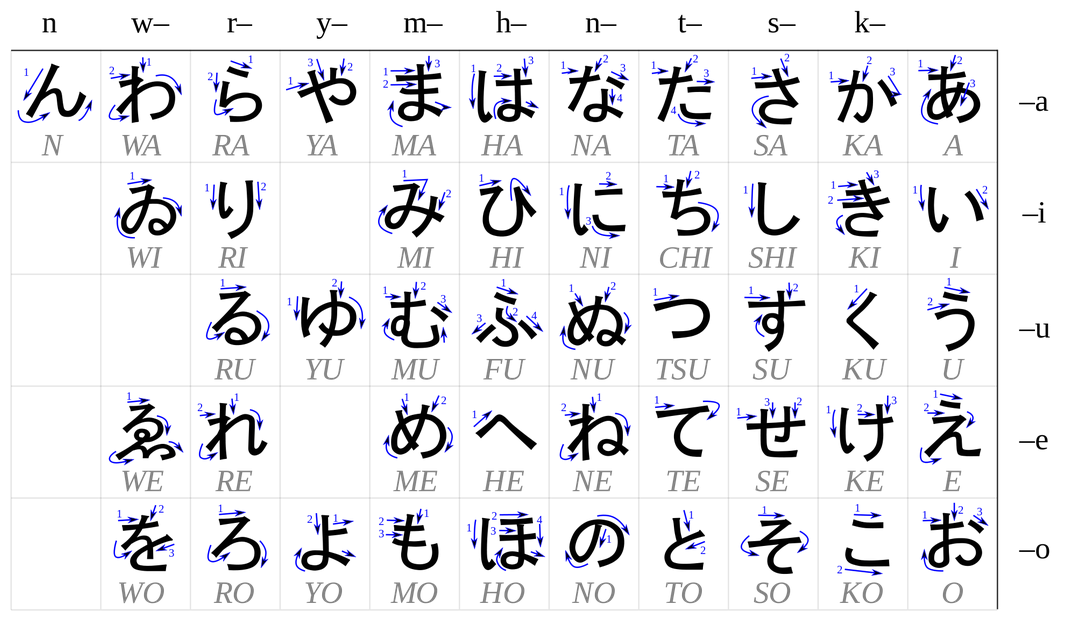
Weird, right? So if the Japanese “f” sound is different from the English “f” sound, why do we even use the letter “f” to write it in the first place? Well the answer is: because it’s close enough. It could be written with the letter “h” too (a “voiceless glottal fricative” – only one component different just like “f”), and sometimes it is. Just be thankful it’s not written with the technically correct International Phonetic Alphabet symbol: ɸ. You’d have to copy/paste that badboy into your textbox every time you want to write about how you ate fugu (blowfish) and feel perfectly futsuu (normal).
▼ You also might inadvertently open a gate to Phyrexia if you use that symbol, so stick with the “f.”
 Flickr (Do the things you cannot do)
Since the Japanese “voiceless bilabial fricative” (see, I told you that you’d get these by the end!) is actually quite rare among languages, the “f” pronunciation problem unfortunately goes both ways – it hinders Japanese speakers trying to learn English too, and so “f” can come out sounding more like “h”, leading to mix-ups between words like “food” and “hood,” “furry” and “hurry,” or the ever-dangerous “heart and “fart.”
Of course, in the end, perfect pronunciation isn’t what’s important about speaking a language. It’s about having a solid vocabulary, a good grasp of the grammar, cultural knowledge, and most importantly the confidence to actually speak, even if you have a horribly broken accent. In fact there’s probably only one conceivable time when your ability to pronounce “f” correctly might result in a life or death situation:
▼ “What if I’m working as a spy somewhere and the only way they figure out I’m Japanese because I say ‘fu’ wrong? I’d better be careful.”
https://twitter.com/tamiya2121/status/408414570261123072
Source: Naver Matome, Wikipedia
Top/featured image: Mangatop (edited by RocketNews24)