
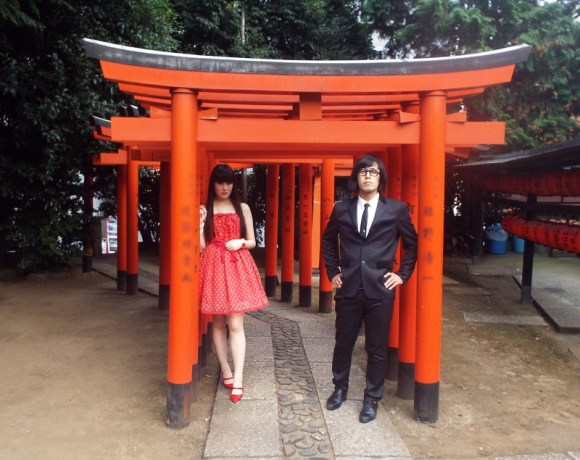
Urbangarde first caught my attention last year with the release of their video for “Sakura Memento”, a song off the 2014 album Utsukushii Kuni. I’ve been rocking out to their music and pondering their quixotic videos in the many months since then, enjoying their mix of pop, rock, and electronic music. So when a chance meeting resulted in the opportunity to sit down and talk with the band’s vocalists Yoko Hamasaki and Temma Matsunaga, I nearly popped out of my skin with excitement!
If you’ve ever wondered how they come up with lyrics, why they’re so “negative,” and whether they enjoy touring or recording more, read on. Also, be sure to check out their latest video for the new single, “Coin Locker Babies”, after the jump!
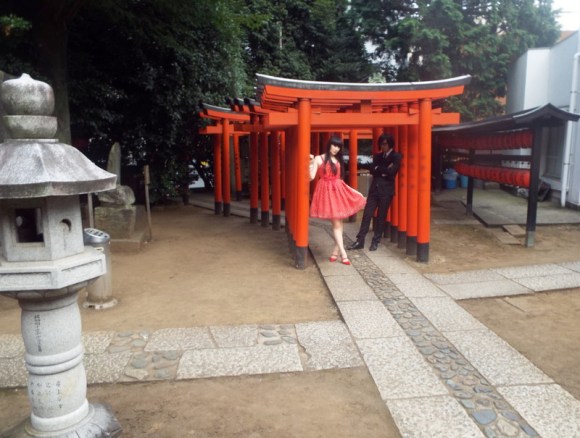
Perhaps the first thing that strikes you about meeting Temma and Yoko is how they fill the room with energy. Like a patient cat, Yoko is by far the quieter of the two, though she’s hardly reticent and is always quick to smile or laugh whenever her partner makes some quirky remark. Temma, on the other hand, bubbles with barely restrained energy, happy to elaborate and delve into any subject with the zeal of a professor.
Sitting in a small office in Shibuya, we start by discussing the history of the band. Temma and guitarist Shin Zeze, better known as Shinsama, started working together in university, and even at that early stage Temma’s vision for the band was already developing. But the band really came into its own as Urbangarde when vocalist Yoko, who sang chanson (old French songs) before joining, took on vocal duties in 2007.
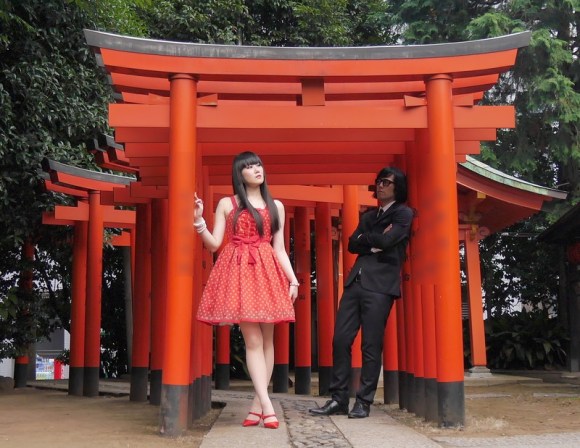
As a band with a very clear conceptual image – which Temma calls a “dark theme park,” likening it to Disneyland – I wonder if Urbangarde is the brainchild of anyone in particular or if there is a shared creative impulse driving their work. Temma explains that while he can claim credit for the lyrics and his ideas drive much of the music and imagery they use, everyone in the band shares the same vision. “It’s a group of negative people,” he adds with a laugh.
“Yeah,” Yoko adds, saying that she’s the kind of person who “want[s] to avoid people as much as possible.” She continues, “I don’t know how to deal with people – I’m never sure how much distance to put between myself and others. But I think there are a lot of people like that.”

Elaborating on the lyrical aspect of Urbangarde’s music, Temma suggests that they “sing what is in everyone’s heart,” saying in song what others wish they could say with words. Though most of the band’s music has an upbeat sound (they’ve categorized their music as “trauma techno pop”) the lyrics tend toward the macabre and the somewhat cynical. Their various videos, like “Don’t Take Off Your Sailor Fuku,” are filled with imagery that could best be described as dark and bizarre. The poppy techno sound seems as if it simply should not work with lines like “I can’t dream, so I will become a dream, touching somebody’s scar.”
▼ “Don’t Take Off Your Sailor Fuku”
There seems to be an almost compulsive need for Temma and his bandmates to push the limits and test boundaries – but they’re not just some shock rock band trying to fill seats. A certain central concept arises again and again through our hour-long conversation: Antinomy.
Niritsu-haihan in Japanese, antinomy basically refers to a paradox. But in the world of Urbangarde’s dark theme park, it is also the defining feature of nearly everything.
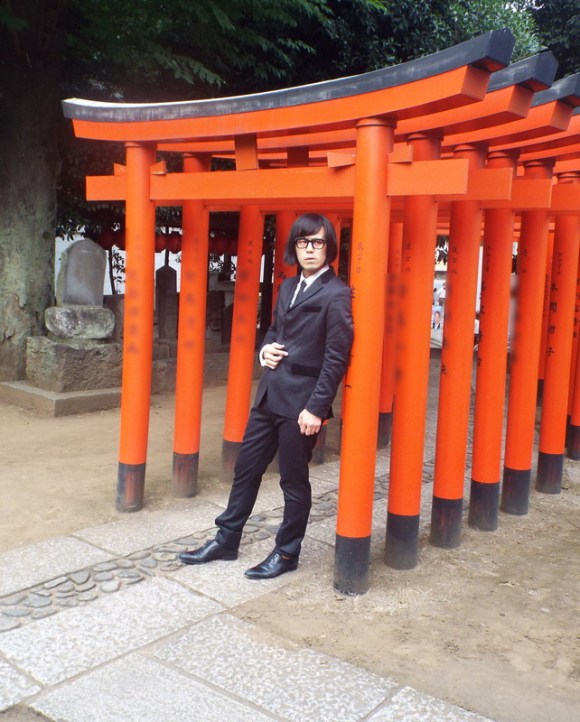
The negativity that many see in the band is a real reflection of the band’s view of the world, but it’s not a complete view. Neither is the poppy, sometimes exuberant music found on their releases. It is the combination – the acceptance that sometimes life sucks but maybe it’s not all bad – that most accurately embodies their central concept. Later, Temma tells me, “I want people to realize that they have blood flowing through their bodies.” It is a perfectly morbid and wonderfully uplifting message, one that Yoko echoes with her comment, “I think most people already understand this, but we’re only alive once. I want to make the most of my time, but I’m not sure everyone feels the same way.”
The pair go on to describe how detached society has become, focusing more on social media than the people around them. That’s not meant to be an indictment of the Internet or Twitter but a call for people to be more than just “icons,” to be wary of losing awareness of ourselves.
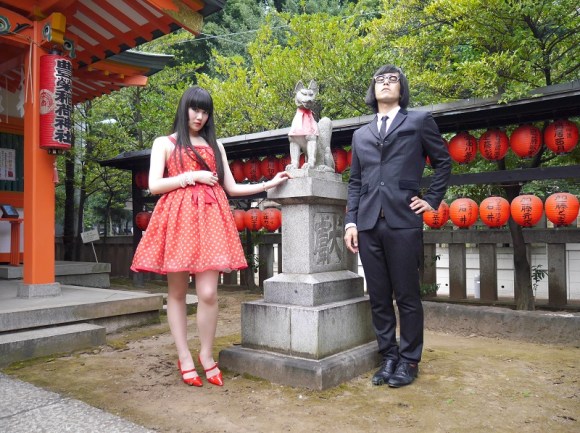
This emphasis on this message leads me to wonder what the band’s focus is on: lyrics or music? It seems that most bands tend to be more concerned abut their sound than the words they use. This seems only natural for musicians, but for Urbangarde both are essential. Temma will tell you that the lyrics are important, but they do not function alone; the words and the way they sound are both important, like the “One-pi, one-pi, one-pi, one-pi, one piece” refrain in “Onepiece Shinjuu” (“Onepiece Double Suicide”).
▼ “Onepiece Shinjuu”
Explaining the antinomy of songs like “Onepiece Shinjuu,” Temma says that it’s the result of synchronicity. “The melody will really only go with specific lyrics. Certain words just naturally go with certain sounds.” So, no one is setting out to make a poppy song with morbid lyrics because it will be weird and get attention – it’s just what sounds right to the band.
But that’s not to say the band is writing without intention, and the contradictory elements make sense from an artistic perspective. The gap makes it more interesting and stimulating. “If you just tell people ‘Don’t commit suicide!’, it doesn’t have much of an impact,” Temma points out. “So I’m always wondering if there’s another way to say something.”
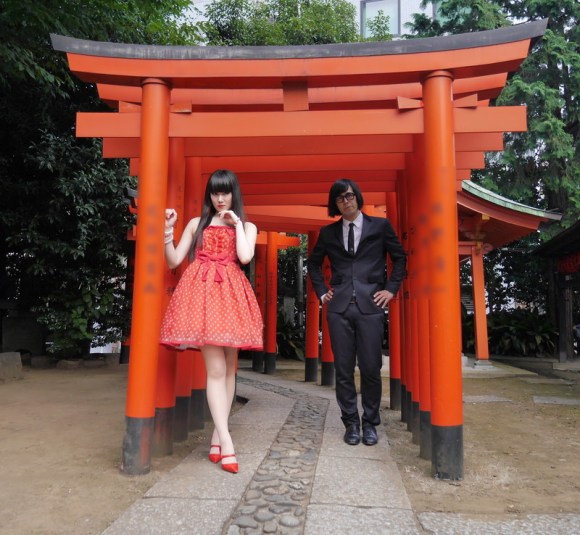
While Temma is arguably the one with the main creative vision for the band, I wonder if Yoko has taken up the pen to write any of the lyrics. When she tells me she has yet to do so, I ask if she wants to try her hand at writing. Her answer is a definitive no. “I can express myself through song, but not through words. So I rely on Temma for that.”
Nevertheless, Temma isn’t operating in a vacuum. The band often discusses the kinds of things they want to write about and approach songs collaboratively. Each song is different, of course, and sometimes they start with lyrics that Temma has composed, whereas other times everything begins with a melody. But the first thing they decide on together is the song’s title.
The titles seem to help guide the band in writing a song, like their newest single “Coin Locker Babies.” Contemporary literature fans will surely recognize this as the name of Ryu Murakami’s most famous novel, though the lyrics of the song are mostly unrelated. “We were inspired by the book,” Temma says, but the song is really about the concept of the coin locker as its own little world.
▼ “Coin Locker Babies”
With all these wildly conflicting concepts and ideas coming together in one package, it’s hard not to speculate on their influences. For Temma, one of his biggest influences was likely his study of Christianity and religion at university. Though not a Christian himself, the singer and poet notes that words are important in the religion, just like in Japan, where “[w]ords have a spirit or a soul.”
When I ask if they are intentionally mixing Japanese and European concepts, I get an emphatic yes. “We’re like Tokyo,” Temma says. Japan’s capital city is a mixture of the old and new, of Japanese and Western. It’s also an international city with two faces: an abundance of happy, poppy Harajuku culture and a high suicide rate. For Temma, Japan’s identity is essentially contradictory in everything from history to entertainment, and he offers the popularity of anime like Evangelion as an example, remarking on how it is a highly entertaining show yet has a miserable, sullen protagonist.
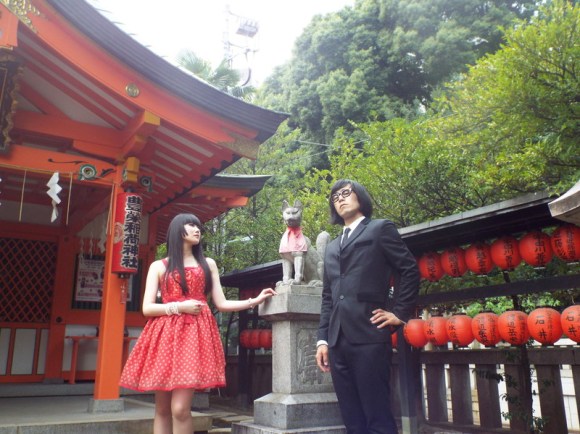
At this point, Yoko shares a thought on Japanese culture. “[Japanese people] are very concerned about not being hated. A lot of people are worried about what others think,” she says, explaining why people might act insincerely or play the fool just to avoid public scorn. And yet, this band says exactly what they want. Do the members not care what other people think?
“It’s more like, we can say what we want if it’s in a song,” Yoko explains.
“Everything I write is a lie!” Temma laughs. “I write things that I may not actually think, but which others are feeling.”
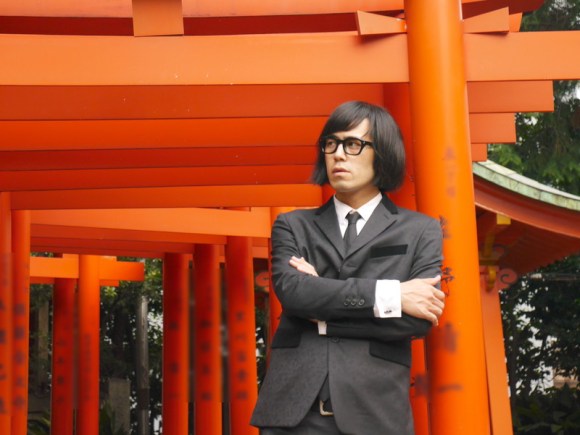
“But,” Yoko adds, “if someone hears our songs and feels like we’re singing about what they’re feeling that makes it real, doesn’t it? If someone feels it’s real, then I think it’s real.”
Though he agrees with the sentiment, Temma can’t help chiming in with another comment, saying, “We’re hustlers!” Yoko, taken aback, disagrees, however: “No, we’re not! At least, I’m not.”
“I think artists should be hustlers,” Temma explains, still laughing. “I think artists should lie.”
On this point, they both agree. Gesturing as if making origami, Temma adds that the band is just folding fake flowers, but “we want them to be real flowers. So if they seem real to the audience, that’s exactly what we want”.
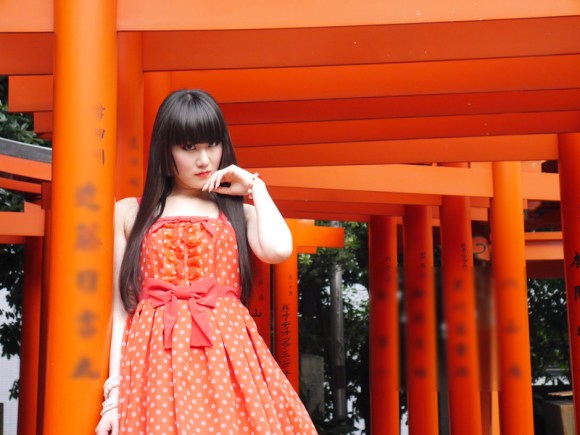
The act of creation is obviously at the heart of the band, but I wonder which they enjoy more, writing music or performing it.
“I like both, but I like writing more,” Yoko says, describing a certain anxiety she has about shows. “With performing, I end up thinking about stuff too much. At a show, you only get one chance. If it doesn’t go perfectly, I end up feeling bad. I can get kind of depressed, so it’s taxing.”
▼ “Maho Shojo To Yobanai De” (“Don’t Call Me a Magical Girl”) music video, featuring footage from a live show
Temma, on the other hand, has a completely different take on it. “For me, performing and writing are completely separate,” he says, explaining how their two “seasons” bring out different aspects of his personality. “Bands have a recording season and a performing season. They’re just always repeating. During the recording season, I’m thinking about a lot of stuff, and my communication ability just plummets. But when we’re performing and going to all these different places, I’m really good at it.”
“Really?” Yoko asks, teasing her bandmate.
“If you look at my Twitter account, it’s like two different people!” he shoots back.
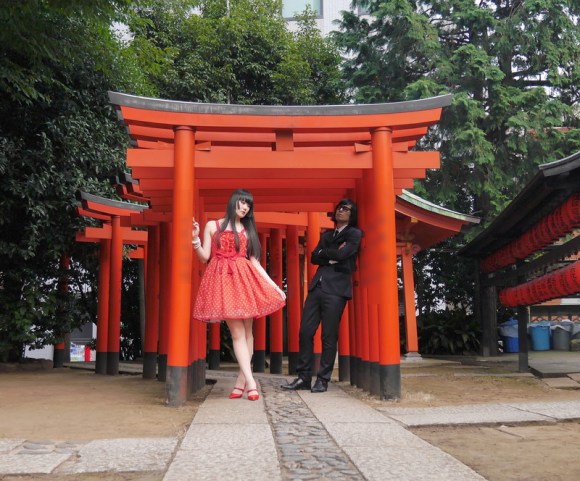
As we start to wind down, I ask the pair about their expanding fanbase overseas, which has grown significantly following Urbangarde’s performances at Japan Expo in France and A-Kon in Dallas, Texas. With a band this focused on lyrics, can people who don’t necessarily understand every word really enjoy their music? “Absolutely,” Temma answers immediately.
For one thing, there are fan translations of lyrics online, but even without understanding every word, the imagery and the videos should help anyone get the basic idea. But there’s also the music itself, which embodies their contradictory nature. For example, Yoko mentions that she tends to sing without much emotion, focusing on a very even delivery. “I actually don’t like female vocalists that much,” she tells me, saying that over-emotional deliveries annoy her. But on the other side is Temma, whose vocals are full of unrestrained energy, creating a natural tension in their music.
Finally, we asked the pair if they had any message they’d like to share with our readers. You can check it out, along with the sound of about three million cicadas who also showed up, below!
The band is hosting an upcoming event in September called Utsufest 2015 (“Depression Festival” 2015) at Shibuya O-East. To be held on September 4 and 5, the festival will feature performances from a number of artists like Ningen Isu and Kenji Otsuki (Kinniku Shojo-tai). They will also be embarking on a national tour this autumn. If you haven’t seen an Urbangarde performance, I definitely recommend trying to catch one! It will be performance unlike anything you’ve seen before.
Reference: Urbangarde, Facebook (Urbangarde), Twitter (Urbangarde)
All images © RocketNews24
 Pleated skirts, Kewpie dolls, and death: The wild music and videos of Urbangarde【J-Tunes】
 It’s a hard rock life: NINGEN ISU’s Shinji Wajima talks about songwriting, working with friends
 From the Up Up Girls to Polysics: The five weirdest Japanese music videos this year so far【Video】
 Math, art, and music: Sputniko! reimagines J-pop【J-Tunes】
 The new Wagakki Band album is out! Let’s find out what the fans think!
 Japan reportedly adding Japanese language skill requirement to most common foreigner work visa
 New picture book for the cat fanatic that loves furry balls
 Peanuts and Coke becomes a viral hit in Japan, but is it a trend worth joining?
 Man bites woman at cherry blossom park in Japan, dies shortly after
 Many foreign tourists not picking up, paying for their orders at 100-year-old Tokyo sweets shop
 New 7-Eleven sandwich goes viral in Japan, but is it everything it’s cracked up to be?
 You can assemble a well-balanced team of Pokémon, them eat them, thanks to Japanese cake chain
 How to take your home ramen to the next level by making your own chashu pork in a frying pan
 Deer that appeared in downtown Osaka gets a new home, a new name, and a lot of snacks[Video]
 7 great places to see Mt. Fuji from without having to climb it
 Pokémon and Ikea Japan cross over into each other’s worlds with collaboration events
 Starbucks Japan closing only Shinkansen platform branch for popularity-triggered renovations
 Two food hacks take Japan’s convenience store fried chicken to amazing new sandwich heights
 Fading Tokyo – Searching for signs of the Showa era as local neighborhoods evolve[Photos]
 Pokémon lacquerware series expands for Year of the Horse with new handcrafted design[Video]
 Tokyo turns its phone booths into free Wi-Fi hotspots, and here’s how to use them
 Tokyo teahouse serves up a sakura matcha dessert you won’t find anywhere else
 Totoro Fund line of beautiful artwork and apparel lets you help the real-world Totoro Forest
 Japan now has a special desk for people who work at home with a pet cat[Photos]
 Famous Tokyo cherry blossom spot installs view-blocking screens to fight overcrowding[Video]
 Uniqlo announces new T-shirts for One Piece, Naruto and more for manga publisher’s 100th birthday
 Train station platform ramen store closes its doors on half a century of history in Tokyo
 Starbucks Japan releases new My Fruit³ Frappuccino at only 34 stores around the country
 Studio Ghibli releases Catbus pullback keychain that runs like the anime character
 Krispy Kreme releases Super Mario doughnuts in Japan for a limited time
 Japanese onsen egg maker from 100-yen store Daiso needs to be on your shopping list
 Survey asks foreign tourists what bothered them in Japan, more than half gave same answer
 Japan’s human washing machines will go on sale to general public, demos to be held in Tokyo
 Starbucks Japan releases new drinkware and goods for Valentine’s Day
 We deeply regret going into this tunnel on our walk in the mountains of Japan
 Studio Ghibli releases Kodama forest spirits from Princess Mononoke to light up your home
 Starbucks Japan releases new sakura goods and drinkware for cherry blossom season 2026
 Japan’s newest Shinkansen has no seats…or passengers [Video]
 Major Japanese hotel chain says reservations via overseas booking sites may not be valid
 Put sesame oil in your coffee? Japanese maker says it’s the best way to start your day【Taste test】
 No more using real katana for tourism activities, Japan’s National Police Agency says
 Flagitious Idiosyncrasy In The Dilapidation: Japan’s awesome all-woman grindcore band【J-Tunes】
 NINGEN ISU: This Japanese literary metal band will rock your butt off【Photos & Video】
 We talk about everything except music with visual kei rock legends Fantastic Circus【Interview】
 New video from Wagakki Band “Hanabi” is an original, awesome song【J-Tunes】
 Knocking on your door: Kiyoshi Sugo’s beautiful, melodic dubstep【J-Tunes】
 Rick Rack: The teenage girl rock band that is way better than they have any right to be【J-Tunes】
 J-pop…maybe J-metal?…band Asunojokei blends genres, wins fans in Japan and abroad【Interview】
 Finally! A music video portrait orientation, perfect for the smartphone age【Video】
 ‘A Cruel Angel’s Thesis’ took just two hours to write says Evangelion lyricist Neko Oikawa
 Famikoto celebrates Nintendo with medley of game music played on traditional instruments【J-Tunes】
 Internet declares Yoko Ono’s Glastonbury festival set “the worst live performance ever” 【Video】
 Evangelion theme song lyricist shares surprising fact about her Eva-watching history
 Music video featuring the winners of blackboard art contest is “chalk” full of imagination【Video】
 Stand back, kids! 64-year-old enka singer Aki Yashiro completely nails cover of Evangelion theme