
The kanji with the most strokes – you may run out of ink before you finish writing some of these.
As a Japanese tutor, I get one question from my students more often than any other: what’s the most difficult kanji ever?
That seemingly simple question has a lot of possible answers, based on what they mean by “difficult.” Do they mean the hardest to physically write? The hardest to remember? The weirdest ones? Or the ones with the most strokes?
Well, today, we’re finally going to take a crack at the answer by looking at the kanji that have the most strokes. But if we’re going to do this, then we’re going to do it right, and that means no simple Google searches, we’re going to the source, the ultimate guide to every single kanji that has ever officially existed.
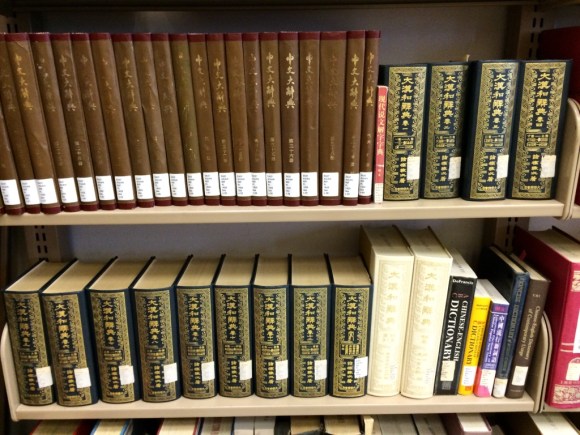
▼ The Morohashi Daikanwa Jiten, courtesy of my alma mater UMass Amherst:
a 13-volume, golden-colored beast that contains over 50,000 kanji.
So let’s get to it! Starting off with…
Honorable Mention: Biang (56 strokes)
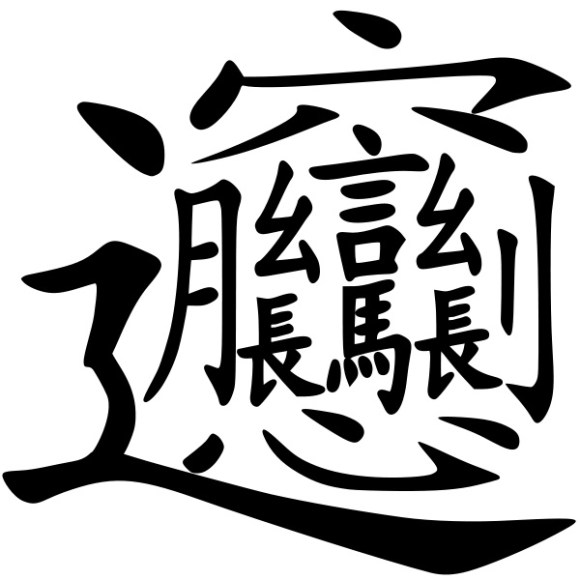
Oh god. Just look at that mess! It’s so miserable to write that it’s even used as punishment. Outside of torturing people, this character (pronounced “biang” in Chinese) is only found in one place: noodle shops in China’s Shaanxi Province that specialize in selling Biang Biang Noodles.
▼ Here’s the shopfront of one such store, where you can see the horrible truth
about this kanji: the only time you’d ever write it, you have to write it twice.
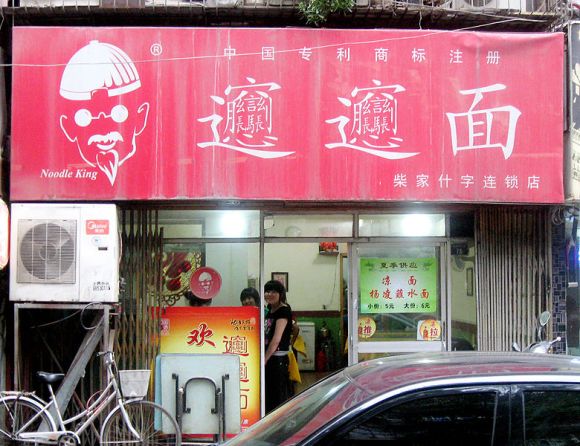
Why is this behemoth only an honorable mention? Because it’s not in the Morohashi dictionary, or pretty much any other dictionary for that matter. It was most likely created by a noodle store in some sort of publicity stunt and has stuck around to today because of its sheer insanity/hilarity.
But at an incredible 56 strokes, I’d still be remiss not to include it. With that out of the way though, let’s get to the list of officially-recognized kanji!
#5. Dō (48 strokes)
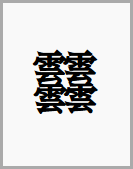
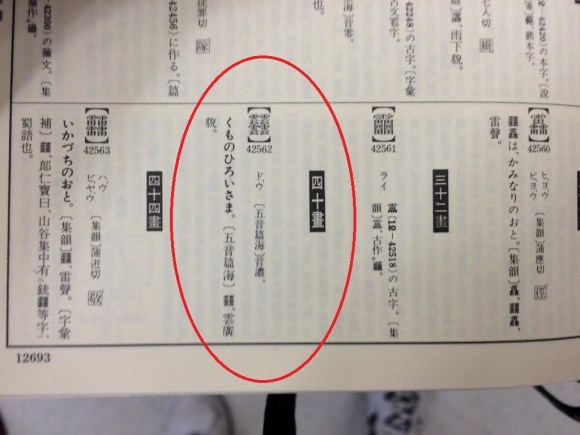
First up on the list of kanji found in the Morohashi dictionary is this 48-stroke monster: dō. This one is made up of the same kanji (“cloud” 雲) four times, and means “widespread clouds,” which kind of makes sense.
Kanji that are made up of the same kanji two, three, or four times are called rigiji (理義字), and we’ll see more of them on this list.
▼ The entry for dō in Morohashi. Here’s what it looks like when typed: 𩇔
Uh, yeah, that’s just a little hard to read.
#5. Tō (48 strokes)
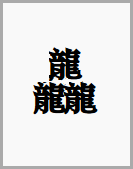
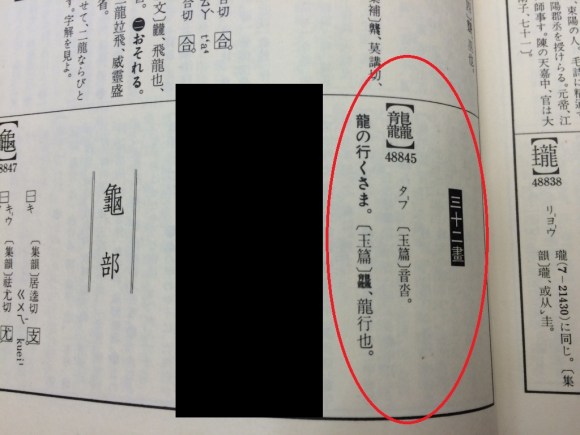
Tied for 5th place is another 48-stroke abomination: tō. Like the other #5, this one is a rigiji made up of the same kanji (“dragon” 龍) three times, and means “a dragon moving,” which also kind of makes sense.
Why there have to be three dragons, and not some other part to it that means “movement” or something, is a question for the ancient scholars who – unfortunately – have been dead for quite a while.
▼ The entry for tō in Morohashi. Here’s what it looks like when typed: 龘
I mean, I guess it kind of looks like a moving dragon?
#3. Hyō, byō (52 strokes)
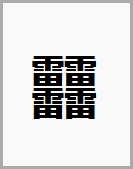
Number three on the list is this 52-stroke horror: hyō/byō. This one is a rigiji too, made up of the same kanji (“lightning” 雷) four times, and means, well, “lighting.”
It’s not entirely clear why you would write the same kanji four times instead of once if it’s just going to have the same meaning, but maybe this one is for when the lightning/thunder is really intense. No, like, even more than that.
▼ The entry for hyō/byō in Morohashi. Here’s what it looks like when typed: 䨻
You could probably cause a storm just trying to write it.
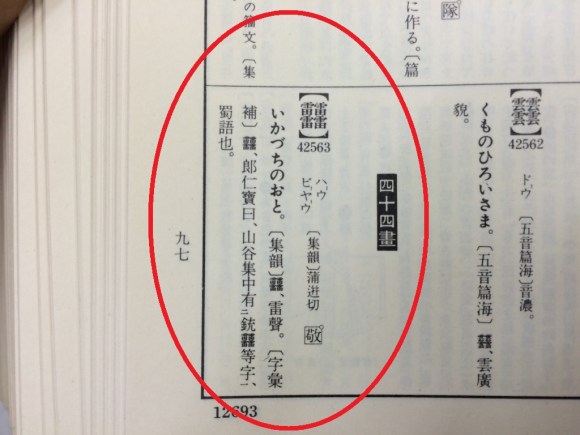
#2. Sei (64 strokes)
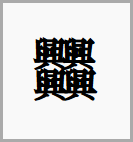
Number two and number one also have the same number of strokes at a whopping 64, but I’m using a tiebreaker here, and sei comes in second for having no meaning. Yep, that’s right; you can go through all the trouble of writing this monstrosity, and it doesn’t even mean anything.
But maybe we can deduce its meaning. Sei is yet another rigiji, made up of the same kanji (“interested” 興) four times. According to Morohashi, there’s another kanji that uses 興 three times and means “to burn”, so sei is essentially just the two put together. Maybe it means “to burn something you’re interested in?” Probably not, but you might feel like burning things you’re interested in if you ever try to write this.
▼ The entry for sei is circled, and the one that means “to burn” on the right.
Here’s what sei looks like when typed: 𠔻 …shudder

And the #1 most difficult kanji is…
.
.
.
.
.
.
.
.
.
.
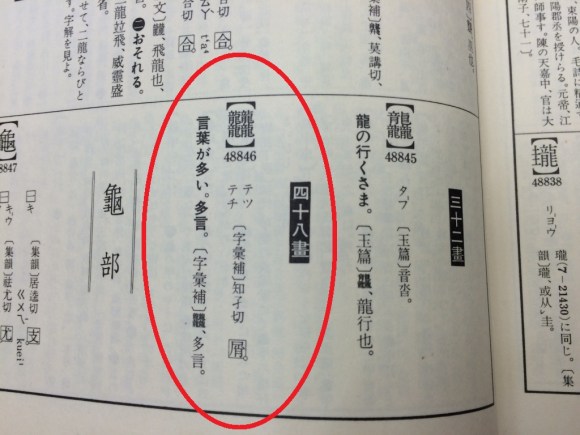
1. Testu, techi (64 strokes)
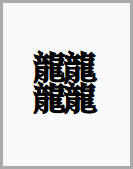
Oh geez. Oh no. I can feel my hand cramping just looking at that thing.
Say hello to testu/techi, the other 64-stroke demon kanji, which actually has a definition: “many words, verbose.” We have to say that’s a pretty fitting definition, seeing as just this one kanji alone already has way too many words inside it.
Just like the others in the top 5, tetsu/techi is a rigiji too, made up of the same kanji (“dragon” 龍) four times. I have no idea why adding a single dragon to #3, which meant “a dragon moving,” suddenly changes the definition so drastically, but we’ll just have to trust the ancient scholars, who presumably knew dragons way better than we do.
▼ The entry for tetsu/techi. Here’s what it looks like when typed: 𪚥
Yup, that’s not a kanji anymore, it’s just a black box.
So there you have it, the top five most difficult kanji ever by stroke count. All of them being rigiji was a little surprising, but that just means we’ll have to venture even further into the Morohashi for more insane kanji discoveries.
What kind of kanji should we look at next? Top five most complex kanji? Top five ugliest ones? Let us know in the comments!
Featured/top image: ©RocketNews24
Insert images: Wikipedia
In the meantime, let me know on Twitter if there’s any topics you’d like to see covered on W.T.F. Japan. See you next week!
 W.T.F. Japan: Top 5 strangest kanji ever 【Weird Top Five】
 W.T.F. Japan: Top 5 kanji with the longest readings 【Weird Top Five】
 W.T.F. Japan: Top 5 most ridiculous kanji handwriting shortcuts【Weird Top Five】
 W.T.F. Japan: Top 5 most insane kanji place names in Japan【Weird Top Five】
 W.T.F. Japan: Top 5 kanji with ironic meanings【Weird Top Five】
 Ramen restaurant in top Tokyo tourist neighborhood skips price gouging, but how does it taste?
 Uniqlo announces new T-shirts for One Piece, Naruto and more for manga publisher’s 100th birthday
 Japan’s ministry of economy reminds us to “use sound judgment” before buying toilet paper
 How many doughnuts can you pack in a Mister Donut all-you-can-pack deal?
 Japanese fast food chain serves up burgers with Camembert “buns”
 Ghibli Museum building becomes a cuddly cushion
 “Online streamer” tops dream job poll for young Japanese kids, older kids not so interested
 Japan now has a “for foreign tourists only” Mt. Fuji sightseeing train[Video]
 Krispy Kreme releases Super Mario doughnuts in Japan for a limited time
 Umamusume food and drinks dash into real world at Family Mart convenience stores[Taste test]
 Japanese onsen egg maker from 100-yen store Daiso needs to be on your shopping list
 Starbucks Japan releases new My Fruit³ Frappuccino at only 34 stores around the country
 Tokyo government organizes food truck event to clear out delinquent/homeless teen gathering area
 Cherry blossoms begin blooming in Japan with record-early starts for sakura season
 Nine amazing off-the-beaten-path cherry blossom spots in Japan for yaezakura and shidarezakura
 Stunning central Japan wisteria festival is like a purple fantasy straight out of a Ghibli movie
 Create a tiny Ghibli anime world on your bookshelf with new miniature papercraft art kits
 Studio Ghibli releases the My Neighbour Totoro tea caddy, with a magical self-closing lid
 When will the cherry blossoms reach full bloom in Japan this year?[Forecast]
 Starbucks Japan unveils new sakura cherry blossom collection for hanami season 2026
 Train station platform ramen store closes its doors on half a century of history in Tokyo
 Studio Ghibli releases Catbus pullback keychain that runs like the anime character
 Nine great places to see spring flowers in Japan, as chosen by travelers (with almost no sakura)
 Starbucks Japan releases first-ever Hinamatsuri Girls’ Day Frappuccino
 Studio Ghibli adds new Mother’s Day gift sets to its anime collection in Japan
 Virtual idol Hatsune Miku redesigned with look that adds new elements and brings back old ones
 Survey asks foreign tourists what bothered them in Japan, more than half gave same answer
 Japan’s human washing machines will go on sale to general public, demos to be held in Tokyo
 Starbucks Japan releases new drinkware and goods for Valentine’s Day
 We deeply regret going into this tunnel on our walk in the mountains of Japan
 Studio Ghibli releases Kodama forest spirits from Princess Mononoke to light up your home
 Starbucks Japan releases new sakura goods and drinkware for cherry blossom season 2026
 Japan’s newest Shinkansen has no seats…or passengers [Video]
 Major Japanese hotel chain says reservations via overseas booking sites may not be valid
 Put sesame oil in your coffee? Japanese maker says it’s the best way to start your day【Taste test】
 No more using real katana for tourism activities, Japan’s National Police Agency says
 W.T.F. Japan: One year anniversary special! Top 5 W.T.F. Japan articles 【Weird Top Five】
 W.T.F. Japan: Top 5 most confusing Japanese compound words【Weird Top Five】
 W.T.F. Japan: Top 5 myths about learning Japanese【Weird Top Five】
 W.T.F. Japan: Top 5 most confusing Japanese counter words【Weird Top Five】
 W.T.F. Japan: Top 5 most difficult Japanese tongue twisters (with videos!) 【Weird Top Five】
 W.T.F. Japan: Top 5 best Tamagotchi releases 【Weird Top Five】
 W.T.F. Japan: Top 5 most famous pet dogs in Japan【Weird Top Five】
 W.T.F. Japan: The top five “sora” references of all time! 【Weird Top Five】
 W.T.F. Japan: Top 5 nicest sounds in Japan【Weird Top Five】
 W.T.F. Japan: Top 5 most hilarious Japanese euphemisms 【Weird Top Five】
 W.T.F. Japan: Top 5 most annoying sounds in Japan 【Weird Top Five】
 W.T.F. Japan: Top 5 craziest Japanese certification exams 【Weird Top Five】
 W.T.F. Japan: Top 5 confusing Japanese Internet slang words 【Weird Top Five】
 W.T.F. Japan: Top 5 Japanese words with cool ancient origin stories【Weird Top Five】
 W.T.F. Japan: Top 5 most perfectly translated Pokémon names【Weird Top Five】