
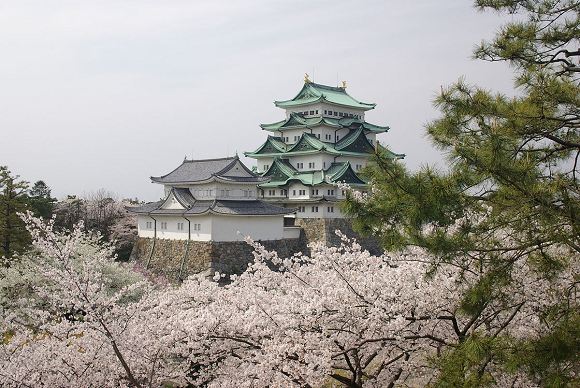
Desire for historically faithful reconstruction clashes with accessibility for wheelchair users.
As is the case in many cities in Japan, Nagoya Castle is a modern, concrete reconstruction. Originally, Japan’s castles were made out of wood, which meant they frequently ended up ravaged by flames when invaded by hostile samurai forces or when lightning fell from the sky during thunderstorms. Add in a post-feudal era decree that each region of the country could retain only one castle, plus some of the remaining castles becoming targets during World War II when they were used as Imperial Japanese Army garrisons and administration buildings (the latter being Nagoya Castle’s role during the war), and today few wooden castles remain.
But while concrete reconstructions can look beautiful from the outside, historical purists argue that walking inside the structure to find it outfitted like a modern museum mars the experience. And so last spring Nagoya announced that it will be tearing down its castle’s five-story keep and rebuilding it with a wooden one that more closely mirrors its original design. However, that commitment to maintaining historical accuracy has drawn complaints from the Aichi Disability Forum, an organization operating in the prefecture of which Nagoya is the capital.
On November 21, the Nagoya Castle General Office, which oversees management of the building and its grounds, said that it does not intend to install an elevator in the new, wooden keep (the current concrete keep, which was erected in 1959, does have an elevator). “We want to restore the keep very, very faithfully. We are restoring it to how it was in the Edo Period [1603-1868], and want to avoid additional elements to the extent possible,” said Nagoya Castle General Office head Katsuyuki Nakano.
Instead, the plan is to install chair-like apparatuses that would transport mobility-challenged visitors up and down the staircases connecting the levels of the keep, from the basement to the fifth, uppermost floor. However, the potential lack of an elevator drew concern from Aichi Disability Forum Executive Director Naoya Tsuji. In speaking with Nagoya Castle General Office representative Shinichi Nishino, Tsuji pressed the castle management on the issue, expressing doubt that the stairway apparatuses are a viable alternative. “Have you looked into whether or not all wheelchair users will be able to use them?” he asked, following up with his assertion that the machines are not universally usable and adding “You knew there would be people who would be opposed to this, didn’t you?”
Demolition of the current keep is not expected to begin until the fall of 2019 at the earliest, and so the debate comes at seemingly an early enough point for modifications to be made to the elevator-less plans. The Aichi Disability Forum has asked the Nagoya Castle General Office to reconsider its stance, and Nagoya mayor Takashi Kawamura has expressed his intention to work with private enterprises and educational research institutions in developing a way for disabled visitors to navigate the stairs comfortable and with ease.
Source: CBC News via Hachima Kiko
Top image: Wikipedia/名古屋太郎
Follow Casey on Twitter, where he’ll take a concrete castle over no castle.
 Nagoya Castle’s concrete keep to be demolished and replaced with traditional wooden structure
 The 10 best castles in Japan, as chosen by experts and fans
 Top 20 most popular castles in Japan revealed for 2016
 You can assemble a well-balanced team of Pokémon, them eat them, thanks to Japanese cake chain
 30 Pikachus want to share a Tokyo hotel room with you that has separate Grass, Water, Fire spaces
 New Travelling Bento pouches turn your luggage into a Japanese lunch box
 New Japanese KitKats come in sakura flavour, with poetic symbolism for success
 Our writer of Korean descent weighs in on using Korean names in Japan
 Bear attack shelters going on sale in Japan as country experiences record-high number of incidents
 Japanese curry chain in Thailand has a surprisingly Japanese dish not found in Japan
 We visit the Paris branch of Muji in search for some minimalist products only found in France
 Japan’s prime minister exchanges Dragon Ball kamehamehas with president of France[Video]
 Princess Mononoke Ghibli accessory line returns with all-natural dagger pendant and more【Photos】
 Japan reportedly adding Japanese language skill requirement to most common foreigner work visa
 Pokémon and Ikea Japan cross over into each other’s worlds with collaboration events
 Starbucks Japan closing only Shinkansen platform branch for popularity-triggered renovations
 Two food hacks take Japan’s convenience store fried chicken to amazing new sandwich heights
 7-Eleven Japan’s new baked-in-store sweet treat is only available in three parts of the country
 Man bites woman at cherry blossom park in Japan, dies shortly after
 Peanuts and Coke becomes a viral hit in Japan, but is it a trend worth joining?
 Can a downtown Tokyo super sento bathhouse beat a hotel for a one-night stay?
 Japan now has a special desk for people who work at home with a pet cat[Photos]
 Famous Tokyo cherry blossom spot installs view-blocking screens to fight overcrowding[Video]
 Uniqlo announces new T-shirts for One Piece, Naruto and more for manga publisher’s 100th birthday
 Train station platform ramen store closes its doors on half a century of history in Tokyo
 Starbucks Japan releases new My Fruit³ Frappuccino at only 34 stores around the country
 Krispy Kreme releases Super Mario doughnuts in Japan for a limited time
 Studio Ghibli releases Catbus pullback keychain that runs like the anime character
 Japanese onsen egg maker from 100-yen store Daiso needs to be on your shopping list
 Survey asks foreign tourists what bothered them in Japan, more than half gave same answer
 Japan’s human washing machines will go on sale to general public, demos to be held in Tokyo
 Starbucks Japan releases new drinkware and goods for Valentine’s Day
 We deeply regret going into this tunnel on our walk in the mountains of Japan
 Starbucks Japan releases new sakura goods and drinkware for cherry blossom season 2026
 Studio Ghibli releases Kodama forest spirits from Princess Mononoke to light up your home
 Japan’s newest Shinkansen has no seats…or passengers [Video]
 Major Japanese hotel chain says reservations via overseas booking sites may not be valid
 Put sesame oil in your coffee? Japanese maker says it’s the best way to start your day【Taste test】
 No more using real katana for tourism activities, Japan’s National Police Agency says
