He got his start in tuna wholesale when he was just 16, and today we’re learning from his experience.
Tuna, or maguro, as it’s called in Japanese, is one of Japan’s very favorite kinds of fish. It’s most popular raw, either sliced as sashimi, placed atop blocks of vinegared rice as sushi, or used as the topping for a maguro rice bowl.
Because it’s such a staple of the Japanese diet, you can find blocks of sashimi-grade tuna in any grocery store in the country. That’s definitely something to be happy about, but it also presents a puzzle: Which block should you choose for maximum deliciousness?
To find out, we took a trip to Tsukuda Takisaburo, a sushi restaurant in Tokyo’s Toyosu neighborhood, not far from the city’s massive fish market. The restaurant is part of the company Nariichi Sakahama, a fish wholesaler, and they’d set up a meeting between us and Makoto Nosue, their special advisor.

The 84-year-old Nosue first started working in the tuna wholesale business when he was just 16 years old, and he’s been in it ever since. He made a name for himself when Tokyo’s main fish market was still located in Tsukiji, and even now he regularly gets up at 3 a.m. to head to the new facility in Toyosu to pick out tuna for Nariichi Sakahama and their restaurant.
▼ Nosue (right) in his younger days, posing with actor Bunta Sugawara
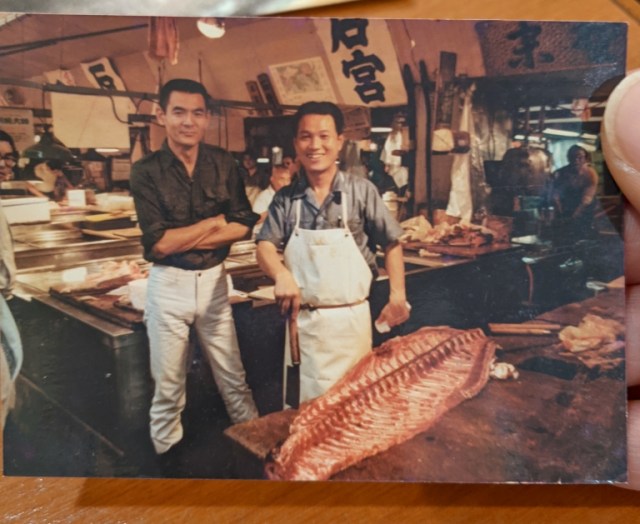
Our Japanese-language reporter Mr. Sato was eager to glean what knowledge he could from this maguro master with 66 years of experience, and wasted no time in asking the question that’s been captivating his mind and stimulating his appetite.

Sato: “Mr. Nosue, thank you for taking the time to talk with me today. I’ll get right to it. I want to eat good tuna, but when I go to the supermarket there are so many different kinds, so are there any hints for picking a good block?”
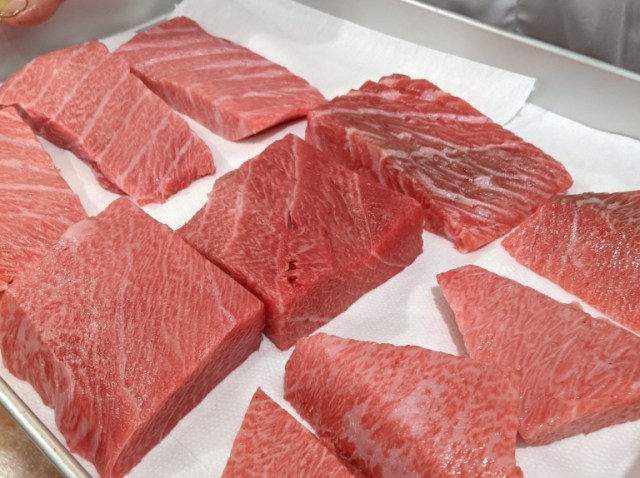
Nosue: “Well, it’d probably be hard to understand if I just explained it in words, so I’ve prepared a selection of maguro cuts, some from our wholesaling business, and some from the supermarket.

Sato: “So, I’m guessing this is like the most basic of basic things, but between wild-caught and farm-raised tuna, wild tuna tastes better, right?”

Nosue: “Actually, we can’t just say that wild tuna tastes better, because it depends on how you’re going to prepare and eat the fish. Farm-raised tuna just has a bit of an image problem, in that there’s a tendency for people to assume that wild tuna is better.”
“For example, farm-raised tuna goes extremely well with vinegared rice, so many sushi restaurants use it instead of wild tuna.”
Sato: “Oh wow I had no idea! I’d just always kind of figured wild must be better…”
Nosue: “You can even find expensive sushi restaurants in Ginza that use farm-raised maguro. Between the two, farm-raised tuna tends to have more fat. Wild tuna is leaner, which makes it the better choice if you’re going to broil or stew it. So really the thing to do is consider how you’re going to eat the tuna, and use that to determine whether you should go for wild or farm-raised.
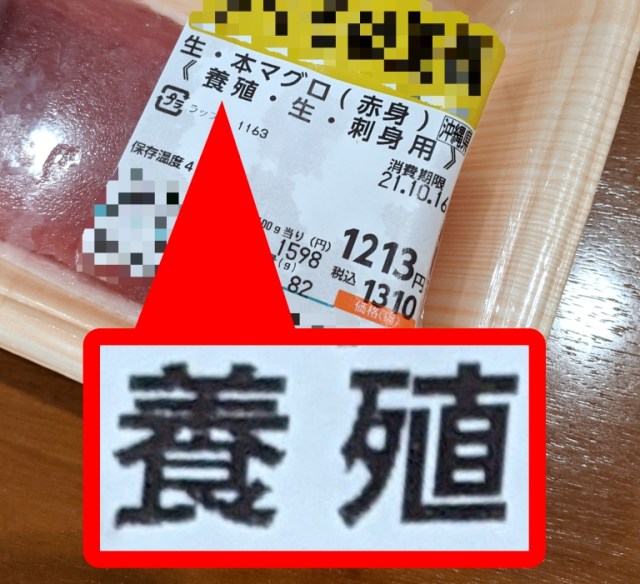
▼ 養殖, the kanji for youshoku/“farm-raised,” as opposed to 天然/tennen/”wild”
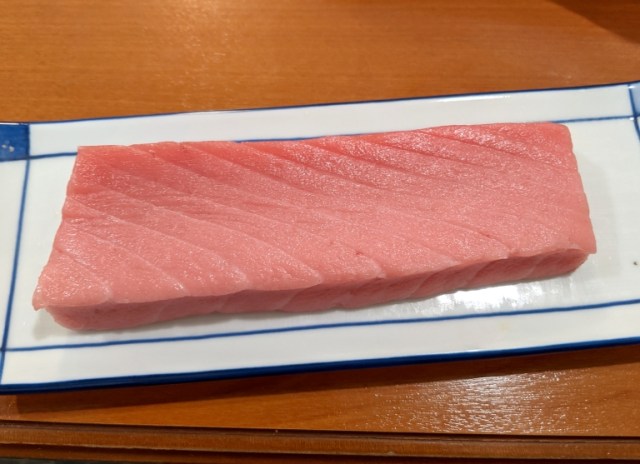
▼ As proof of the potential of farm-raised maguro, Nosue brought out a stunningly beautiful farm-raised tuna block from their wholesale business, and it took all of Mr. Sato’s willpower to not just start gnawing on it right then and there.
Sato: “Okay, but between frozen and non-frozen maguro, the non-frozen kind has got to be better, right?”
Nosue: “That’s also a misconception. Frozen maguro is quite tasty, and it actually has the fresher flavor, since they freeze it right after it’s caught.
Sato: “Ah, that makes sense! But then why do people think frozen maguro doesn’t taste as good?”
Nosue: “Yes, people do often say ‘Frozen maguro doesn’t taste as good.’ But really, the problem is with how the fish was defrosted before they purchased it.”
“What often happens is that the fish hasn’t been completely thawed while they’re eating it. There are still ice crystals inside the fish, and ones that have just recently melted, so they’re not just eating maguro, they’re eating water too, so naturally the flavor of the fish gets watered down. So the important thing to do is to make sure you get rid of that unwanted moisture.”
Nosue then demonstrated how to do just that. First, wrap the cut of tuna in paper towels or butcher paper.

Then, press against the fish gently but firmly with the palms of your hands. This should draw out some of the water and moisten the towel.

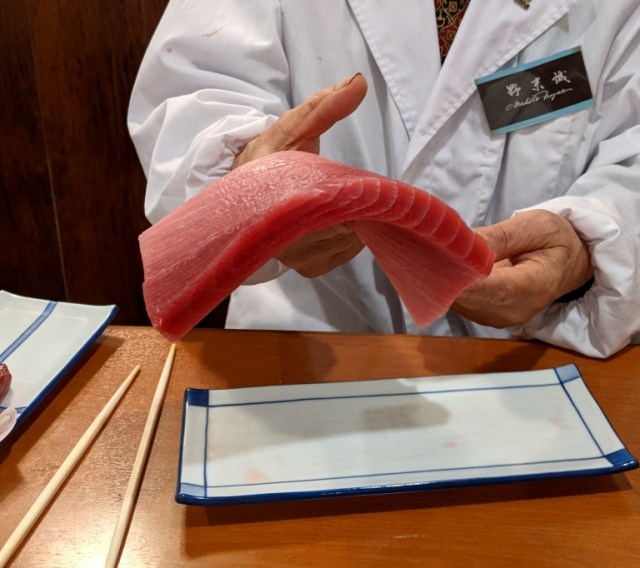
Repeat this two or three times, then remove the towel, cover the fish with plastic wrap, and put it in the refrigerator until you’re ready to eat it. And if you want to double-check if your fish is frost-free, Nosue says to pick it up by the middle part and balance it atop your fingers. If the block of fish shows a natural-looking curve, like in the photo below, then it’s good, but if it’s stiff and resists bending, it probably still has ice crystals or excess water in it.
Okay, so now we know farm-raised tuna (養殖) can be just as good as wild (天然), if not better, and maguro that’s been shipped frozen (冷凍) actually has advantage over non-frozen (生), provided we make sure it’s thoroughly thawed. Anything else we should be aware of?
Nosue: “It might be unkind of me to say this, but this block of tuna, which I bought at the supermarket, is the kind you should probably avoid.”
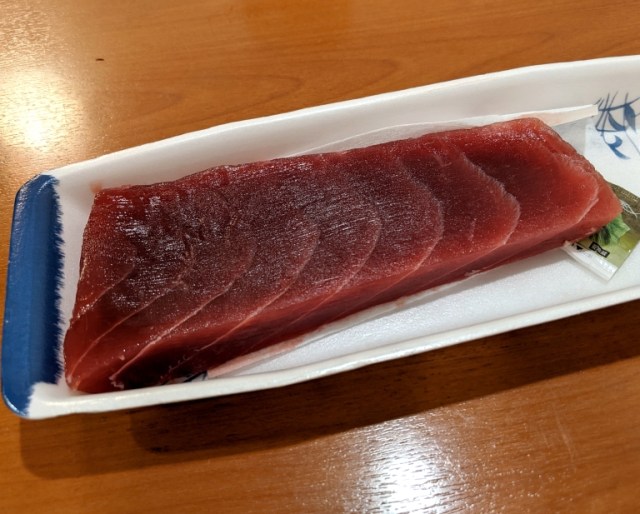
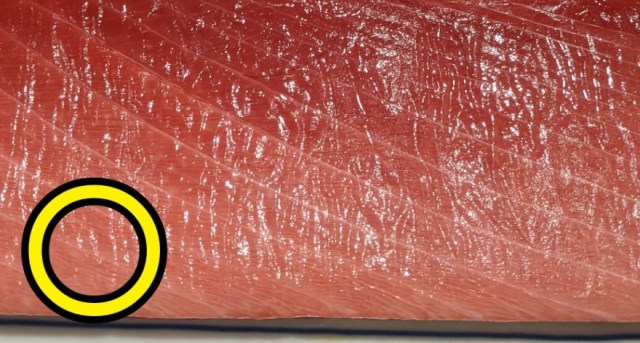
According to Nosue, the problem is how the tendons (the white lines in the fish) are oriented. Because they’re going lengthwise across the block, if you just start making vertical cuts, which would seem to be the most natural way to slice the fish, you’re going to get a lot of tough, stringy texture in each mouthful. When you have a choice, a block where the lines go diagonally across, like in the photo below, will make for a smoother texture and more pleasant chewing sensation, he says.
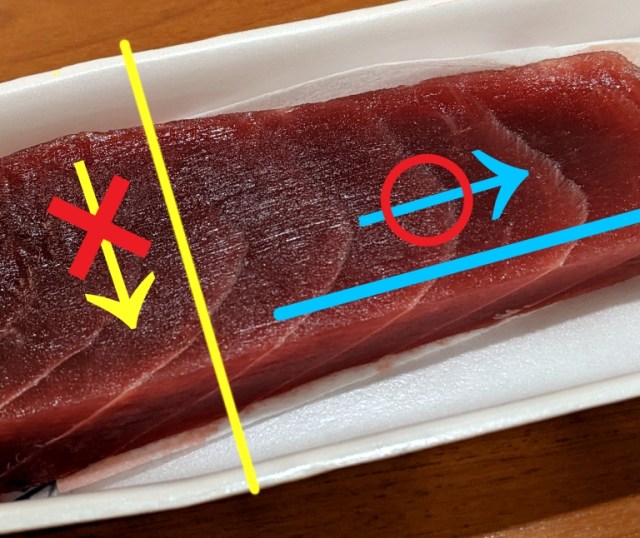
That said, it’s not like all hope is lost if you have a block of tuna with horizontal tendon lines. You just need to slice it a little counterintuitively, making lengthwise cuts. You’ll might still need to make one or two cuts across the fish in order to keep the pieces bite-sized, and so a little toughness at the edges isn’t going to be something you can completely avoid, but still, it’ll come out better than making nothing but vertical cuts.
▼ Cut like blue arrow, not the yellow one.
Speaking of slicing, Nosue says that a thickness of one centimeter (0.4 inches) is ideal for sashimi that’s being eaten by itself, say, as a snack with a glass of beer or cup of sake. For actual mealtime maguro, he recommends a thinner slice of three to four millimeters. He’s got some serving temperature suggestions, too, saying that 12 degrees Celsius (53.6 degrees Fahrenheit) will give you the best flavor in the summer, and 15 Celsius (59 Fahrenheit) is the best in the winter.
▼ Presumably spring and autumn maguro should be somewhere in between those temperatures.
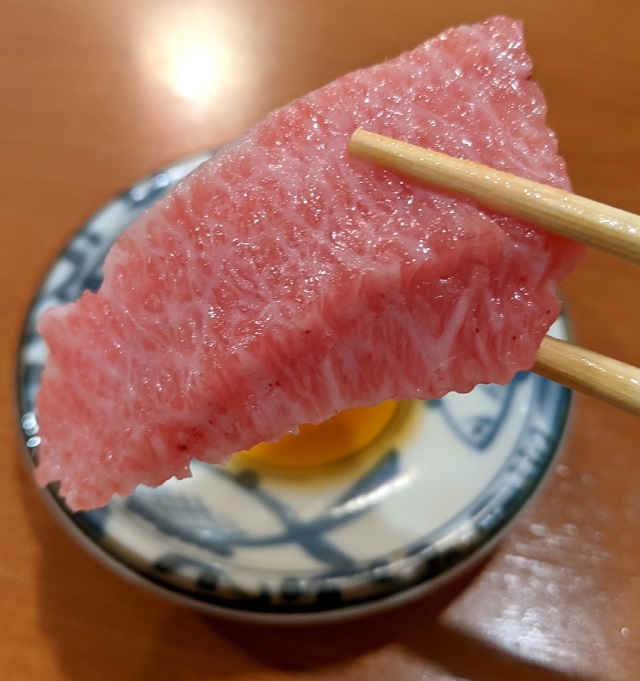

That’s a lot of numerical advice, but then again, the guy’s been in the maguro game for an impressive number of years, and with all of his pointers being pretty easy to follow, even following just a few of them sounds like it’ll make our home sushi/sashimi sessions better than ever.
Photos ©SoraNews24
● Want to hear about SoraNews24’s latest articles as soon as they’re published? Follow us on Facebook and Twitter!
[ Read in Japanese ]