
Turns out failure is an option.
Recently, I had decided to try something that almost everyone I talked to in Japan said was impossible: get a Japanese driver’s license. What made it impossible was that I didn’t go about it the way many foreign residents do, such as transferring licenses from their home country or attending driving school. I instead started from scratch and went straight to the police to request a driver’s license exam.
Although drastically cheaper and faster than driving school, my chosen method of getting a license is almost legendary in Japan for its difficulty. Still, I was among the lucky 50 percent or so in my group to pass the first written test, and next had to tackle the first driving test in order to get a temporary license, also known as a “learner’s permit” in some areas.
After passing the written test I was handed a booklet by the police that outlined the driving test procedure. By the way, although the written test was made available in English and other languages, everything from here on out was done entirely in Japanese. The booklet was small, but seemed surprisingly comprehensive and touched on every section of the closed course where the test would take place.
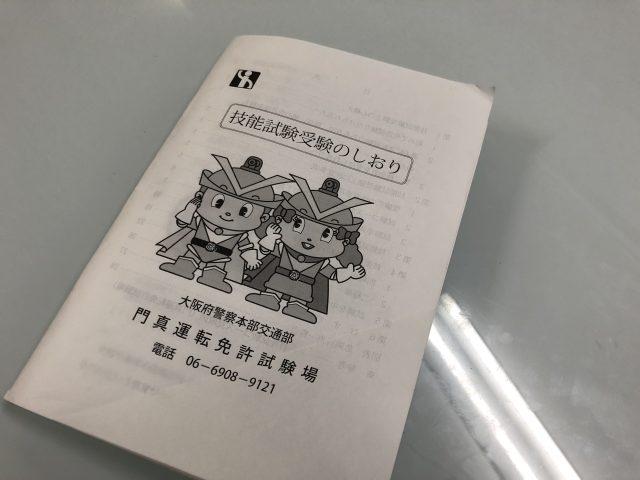
That was part of the problem though, the book explained every conceivable skill examinees were expected to do, but didn’t say which ones were required for which test. In my case, I was going to take the test for a “normal temporary license (automatic transmission)” or “futsu karimen AT” (普通仮免AT), but that was one of about ten different types of tests, each with their own set of required skills.
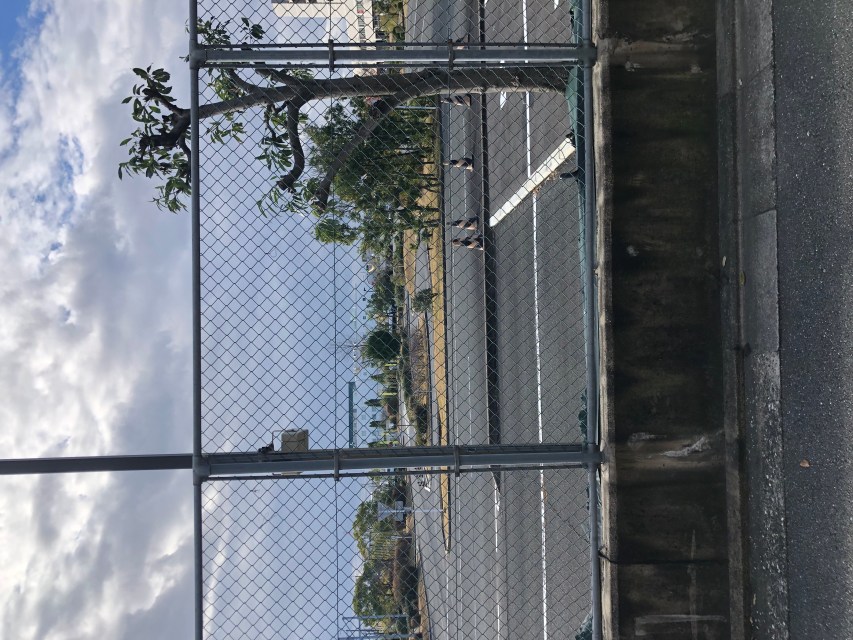
This was actually a recurring problem I encountered in trying to prepare. There are lots of blogs and videos out there giving tips and advice on “how to pass the test on the first try,” but they never seem to go into specifics on which test they’re talking about. So, I made sure to go to the police department a few hours in advance, and tried to learn more by casing the joint.
▼ You’re not allowed to take photos inside the course, but there’s no law against creeping around the perimeter and peering through the fence. None that I’m aware of at least.
The other reason was that according to the book, an explanatory video is shown twice a day in the Skill Test Waiting Hall (Gino Shiken Machiai Hall / 技能試験待合ホール), followed by a period of time where anyone can walk freely around the course to get a feel for it.
Probably my biggest rookie mistake was not immediately going to this room after passing the written test, because in addition to the video and course walk, maps of the routes for each type of licenses are posted on the walls. Anyone can go in this room at any time during the hours of operation and study these maps, which more clearly explain each of the stages that each license needs to clear.
Photos aren’t allowed in the room either, but the booklet conveniently comes with a blank map of the course that you can draw the route on. Each license’s exam has two or three different routes that change depending on the day but pass through all the same checkpoints. Luckily the book also has multiple maps for you to jot them all down on.
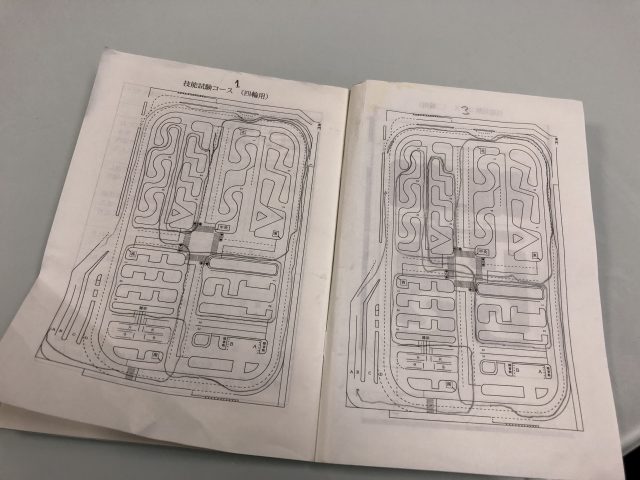
Having known all this way back when I first passed the written exam would have saved me a lot of meaningless study, but luckily since I had arrived so early on the test day, I could pretty much get it all down by the time it was scheduled to start.
By the way, here’s what is required of those attempting to get a normal temporary license:
Changing Lanes
You’ll need to simulate overtaking another car by changing lanes around a group of pylons.
Drive at Speed
On the far side of the course is a relatively long, straight stretch where the instructor will tell you to drive at a certain speed to make sure you can handle a car going fast.
The S-Curve
You must carefully navigate the car through a very narrow and winding path.
The Crank
This is like the S-Curve but the bends are all right angles, which may require you to back up in order to get around them. This is permitted as long as you constantly check your blinds spots and signal while doing so.
The Uphill Stop
Here you’ll be asked to stop the car on an incline and start it again without it rolling backwards. It’s more designed for those trying to get a manual transmission license, but those attempting an automatic transmission license will also have to perform it by manipulating the handbrake and possibly even putting it in first gear in order to clear it.
The Railroad Crossing
The final specific challenge of the course is to stop at a simulated railroad crossing that occasionally sounds off like a real one would. This might seem simple, but don’t forget that in Japan motorists are required to stop at railroad crossing regardless of whether or not there’s a train coming at the time. Also, for the purposes of the test, while stopping at this open crossing you are expected to roll down the window and “listen” for any incoming trains, even though since it’s a closed course, there never are any actual trains coming through.
And of course examinees will also need to regularly make left and right turns and drive through pedestrian crossings. Since it’s a closed course, there’s no need to worry about actual pedestrians, but you should demonstrate awareness by driving through crossings with your foot off the gas and ready to make a sudden stop. Be warned that this is at least the case for the Osaka Prefectural diving exam, and it is possible that other prefectures might do things somewhat differently.
Having acquired all this information, I was starting to feel a little confident about my chances of passing despite the test’s reputation. There were certainly some tricks like the railroad crossing routine, but nothing that seemed especially challenging.
At the beginning of the reservation time, an officer gave an overview of the test, explaining the rules and routes of the day. They also pointed out that each examinee begins the test with 100 points and missing certain details will result in a deduction of points. Different licenses have different passing limits, but for me it was 70 points. However, this is all completely meaningless since no one except the examiners has any idea how the points are deducted.
After the opening spiel, the order of examinees was displayed on the monitors hanging in the waiting hall. In these tests one examinee drives while the next in line rides in the back seat. I was very happy to hear this because even though I knew what to do in theory, at this point it was still my first time and watching another person would really help get me in the groove. As long as I wasn’t first, it was all gravy.
And so, when the speech concluded, the names appeared on the screen.
▼ “F#$k…”
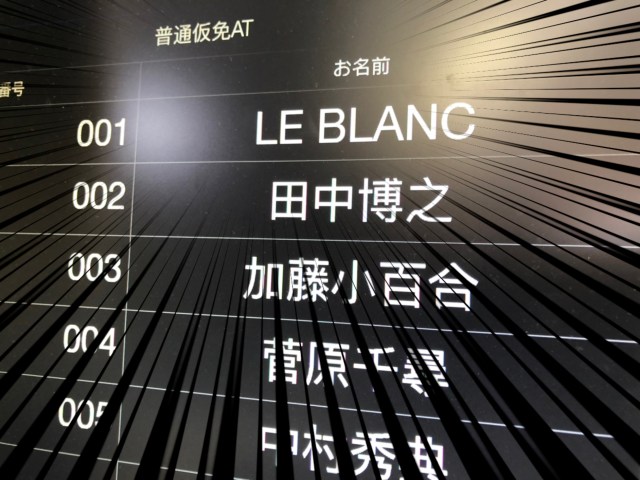
Next, each license group was taken for another eye test that’s exactly the same as the one prior to the written test. Then they were asked to return to the waiting hall until their turns comes up. I, however, was to report directly to the motor pool.
While waiting for the examiner, I asked my passenger if this was her first time taking the test, to which she replied “No.” I then told her it was my first time and she looked at me with a sympathetic gaze as if to say “you poor bastard,” and simply told me, “Good luck.”
The examiner arrived and told me to get in the car. I had read online and in the handbook that you should first search all sides and underneath the car for animals, children, or any other problems. On the other hand, the pre-test speech and video said that the test begins “the moment you enter the car” and ends “the moment you exit the car.” Those were kind of conflicting rules, but I figured better safe that sorry and checked around the car first anyway. I also looked both ways before opening the door, and only opened it wide enough for me to just slip through, as recommended by many in my online reading.
After that I had to give my name and date of birth to the examiner, and then prepared to drive. Of course, putting on seatbelts, adjusting the seat and mirrors, and disengaging the handbrake are all essential at this point. It’s a little tricky adjusting mirrors in a car I’ve never been in before, but he seemed to give me some leeway with it.
Then it came time to start moving. For this segment I’ll try to reenact the driving test in which the part of my instructor will be played by our own Mr. Sato, and cast in the role of myself will be none other than a photo of Matt Damon.

“Okay let’s begin.”

“Okay.”
“Change lanes up ahead.”
“Sure, changing lanes.”
“Go up to 40 kilometers per hour.”
“40, okay.”
“Turn right here.”
“OK, right.”
“Turn left at the intersection and then immediately turn right.”
“Left then right. Got it.”
“Go into S-Curve lane number one.”
“Yes.”
“Turn left when you exit.”
”Roger.”
“Okay, now turn left at the intersection.”
“Su–“

“No! Wrong! The test is over.”

“Wai….Wha?”
“Please return to the motor pool.”
In fairness to the examiner, he didn’t really sound all that angry, but he was quite animated and crossed his arms while telling me “wrong.” This, combined with it being my first time and at that point having absolutely no idea what I did wrong, left me feeling pretty shook.
Once we returned to the end of the course, the examiner politely explained the things that I did well and what went wrong during the test. He said I had done a good job of checking my mirrors and blind spots, but the way I had made my right and left turns was incorrect.
What I’m about to explain is probably strange to people who drive in other countries, and quite frankly it was even a newsflash to the licensed Japanese drivers I spoke to afterward, but before beginning a left or right turn it is imperative that you bring the car up to the edge of the lane.
▼ For example if you turn left you must bring the car right up to the curb and really hug the turn
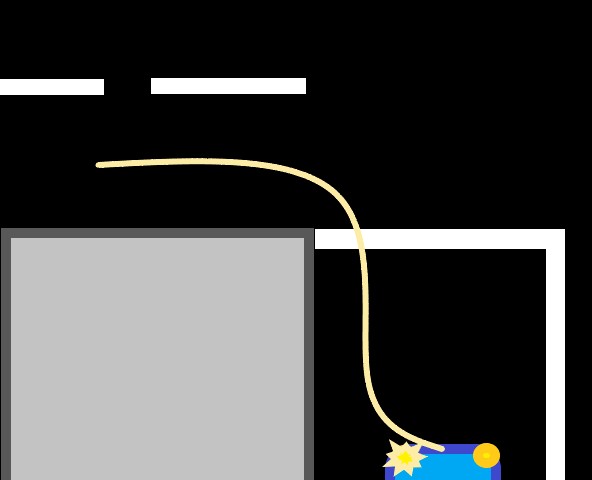
The examiner explained that while waiting to turn in the middle of a lane, it’s very easy for a bike or scooter to slide into your blind spot. By not giving them any space to enter the blind spot, the driver is ensuring a safe turn. It did make sense and I remember reading about that technique in my textbook, but it seemed just casually mentioned as a good idea rather than iron-clad rule that would make or break your driving exam.
At the very least I would assume that points would be deducted for it but not to have the whole test called off – and herein lies the rub.
The test booklet and video both mentioned a list of reasons that the test would be immediately called off. Mostly they’re common sense things like running a red light or hopping a curb, but among them is the condition of “driving unsafely,” which, when you think about it, could include pretty much anything that would also be cause for point deduction in the test. Not using your turn signal early enough, forgetting to check your sideview mirror once, and pretty much any incorrect action could easily be deemed “unsafe” and thus trigger the end of the test right then and there. In other words, it’d seem pretty hard, if not impossible, to complete the full course at all without doing everything perfectly the way they want it.
Afterward, I returned to the main building to make a reservation for my next attempt. One by one, all of the other examinees came out to make their next reservations too, and it was easy to see that not a single person in the group had passed that day. It bears repeating at this point that this is the case for a very specific type of test, in that it’s a test primarily taken by people who aren’t currently attending driving school. Those who do go to driving school can generally take an alternate temporary license test on the school’s own course, and often can do the same for their final, permanent license too.
My confidence was shattered at that point, but I had a week to compose myself before trying it all over again. At least I knew what I was up against and would be ready for it next time, because knowing really is half the battle when it comes to a driving exam in Japan.
Top image: Pakutaso
Insert images: ©SoraNews24
● Want to hear about SoraNews24’s latest articles as soon as they’re published? Follow us on Facebook and Twitter!
 Getting a driver’s license in Japan the hard way: The first driving test again
 Getting a driver’s license in Japan the hard way: The first driving test a few more times
 Getting a driver’s license in Japan the hard way: The End
 Getting a driver’s license in Japan the hard way: The first written test
 Getting a driver’s license in Japan the hard way — Part 5: The second written test
 Japan now has a special desk for people who work at home with a pet cat[Photos]
 Uniqlo announces new T-shirts for One Piece, Naruto and more for manga publisher’s 100th birthday
 Fatal stabbing at Pokémon Center in Tokyo reignites concern over rising stalking cases in Japan
 Japanese kindness restores our faith in humanity after a highway bus accident in Tokyo
 Japan now has a “for foreign tourists only” Mt. Fuji sightseeing train[Video]
 Japan’s Sleep Shelter is here to help gamers play all night and sleep all day【Photos】
 The 2023 Sanrio character popularity ranking results revealed
 Totoro and Calcifer become little light-up lanterns for Ghibli-style excursions or at-home decor
 What exactly is the treat known as a “kougnané” that’s sold outside Tokyo’s Yurakucho Station?
 Famous Tokyo cherry blossom spot installs view-blocking screens to fight overcrowding[Video]
 Krispy Kreme releases Super Mario doughnuts in Japan for a limited time
 7-Eleven Japan releases a crazy new viral sandwich: Chocolate Sprinkles and Whipped Cream
 Starbucks Japan releases new My Fruit³ Frappuccino at only 34 stores around the country
 Nine amazing off-the-beaten-path cherry blossom spots in Japan for yaezakura and shidarezakura
 Stunning central Japan wisteria festival is like a purple fantasy straight out of a Ghibli movie
 Studio Ghibli releases the My Neighbour Totoro tea caddy, with a magical self-closing lid
 Create a tiny Ghibli anime world on your bookshelf with new miniature papercraft art kits
 Studio Ghibli unveils new Rollbahn notebook in honour of Howl’s Moving Castle
 Starbucks Japan unveils new sakura cherry blossom collection for hanami season 2026
 Train station platform ramen store closes its doors on half a century of history in Tokyo
 Studio Ghibli releases Catbus pullback keychain that runs like the anime character
 Japanese onsen egg maker from 100-yen store Daiso needs to be on your shopping list
 Nine great places to see spring flowers in Japan, as chosen by travelers (with almost no sakura)
 Starbucks Japan releases first-ever Hinamatsuri Girls’ Day Frappuccino
 Cherry blossoms begin blooming in Japan with record-early starts for sakura season
 Survey asks foreign tourists what bothered them in Japan, more than half gave same answer
 Japan’s human washing machines will go on sale to general public, demos to be held in Tokyo
 Starbucks Japan releases new drinkware and goods for Valentine’s Day
 We deeply regret going into this tunnel on our walk in the mountains of Japan
 Studio Ghibli releases Kodama forest spirits from Princess Mononoke to light up your home
 Starbucks Japan releases new sakura goods and drinkware for cherry blossom season 2026
 Japan’s newest Shinkansen has no seats…or passengers [Video]
 Major Japanese hotel chain says reservations via overseas booking sites may not be valid
 Put sesame oil in your coffee? Japanese maker says it’s the best way to start your day【Taste test】
 No more using real katana for tourism activities, Japan’s National Police Agency says
 Japan to make foreign driver’s license conversions more difficult, exclude tourists from eligibility
 Foreign driver’s license conversion test passes plummet from over 90% to 33% in Japan
 Chinese drivers flocking to Japan for quick and easy route to international licenses
 Japan government mulling more restrictions on foreign driver’s license conversions
 Driver’s licenses? More and more Japanese youths don’t need no stinkin’ licenses
 Drunk cycling can result in an instantly suspended driver’s license in Japan
 Aichi Police: Surrender your driver’s license and get up to $1 off at McDonald’s!
 City in Nagano offers super cheap taxi fares to seniors who give up licenses and disabled people
 Woman charged for driving suitcase without a license in Osaka
 82-year-old Japanese man arrested for driving without license, says he had one 60 years ago
 Aichi Police refund over a million yen in fines to drivers who violated a misplaced traffic sign
 Handsome Japanese cosplayer finds renewing driver’s license hard after huge transformation【Pics】
 Fukuoka woman drives through front of convenience store because she really needed to pee
 69-year-old Tokyo man arrested for driving without a license for over 50 years
 Elderly motorists in Japan given option to “graduate from driving” to prevent accidents
 Kobe man arrested after threatening driving school with 1,500 origami cranes
 Mystery “nail house” discovered in Japan