
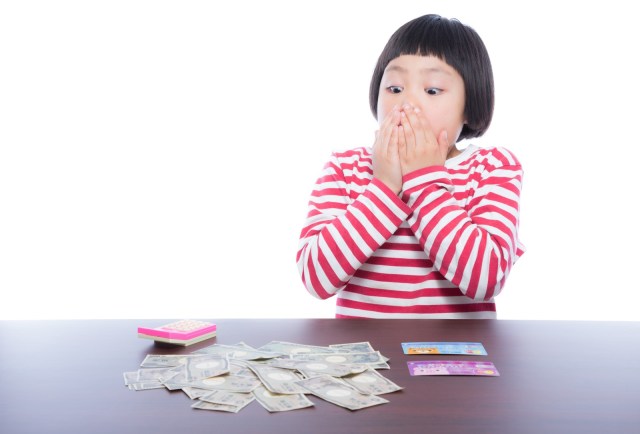
Grown-ups dish on the appropriate amounts of New Year’s money to gift depending on the age of a child.
With all of Japan now in the holiday lull that accompanies the biggest holiday of the year, New Year’s, it’s a rare opportunity for many Japanese people to kick back under the kotatsu, watch special TV programming, and spend their days eating, eating, and more eating. The younger crowd also has something to look forward to in the form of otoshidama, or New Year’s gift money that they may receive from various relatives.
While there’s no clear consensus on the age at which children should stop receiving otoshidama, there do seem to be some generally accepted practices for the giving of it–namely in terms of monetary amounts. To find out how much money adults think is appropriate to give to children of all different ages, All About News surveyed 335 people nationwide between December 11 and 20. Respondents ranged in age from their 20s through 70s with the majority in their 30s and 40s.
▼ For a young child, the sweetest sight is an envelope filled with cold, hard cash.

Here are the most common survey responses regarding how much money should be given to different age groups based on year in school.
● Preschool
1. 1,000 yen (US$8.69): 31.04 percent of respondents
2. Less than 1,000 yen: 27.16 percent
3. Don’t give any money at all: 20.3 percent
Over half of survey respondents agreed that children who haven’t yet reached elementary school age were still deserving of a small 1,000 yen-or-less gift. They backed up their reasoning by writing, “I think this amount is appropriate since they don’t have a solid understanding of money yet,” and “It’s enough for them to buy some candy.” One respondent even shared a helpful tip to maximize their happiness: “I think they’re more excited if you give them ten 100-yen coins as opposed to one 1,000-yen bill.”
Among those who don’t give any otoshidama to the preschool crowd at all, many wrote that they opt to purchase small presents such as toys and candy instead.
● Lower elementary school (grades 1-3)
1. 1,001-3,000 yen: 44.48 percent
2. 1,000 yen: 23.28 percent
3. 3,001-5,000 yen: 17.91 percent
● Upper elementary school (grades 4-6)
1. 3,001-5,000 yen: 44.78 percent
2. 1,001-3,000 yen: 28.66 percent
3. 5,001-10,000 yen: 16.72 percent
Elementary school in Japan is comprised of grades 1-6. For the purposes of this survey, elementary school-aged children were split into two groups–those in the lower grades and those in the upper grades. Otoshidama between 1,001-3,000 yen was the most common response for the lower grades while 3,001-5,000 yen was the most common for the upper. Regarding their thinking, one respondent stated, “I give 3,000 yen because they should finally be able to understand the concept of money,” while another wrote, “5,000 yen. That’s enough for them to buy one video game.”
In general, there seems to be an unofficial elementary school rule that you should multiply a child’s year in school by 1,000 yen. This system also serves as a sweet incentive for them each year as they progress through school.
▼ If I hide half my face do I look a teensy bit older?

● Junior high school
1. 5,001-10,000 yen: 45.67 percent
2. 3,001-5,000 yen: 34.03 percent
3. 1,001-3,000 yen: 8.66 percent
The cash prizes just keep rising for junior high school students. Almost half of respondents stated that they give this age group somewhere in the range of 5,001-10,000 yen for otoshidama. Once these children add up all of their money from various relatives, many of them probably make out pretty darn well for themselves.
● High school
1. 5,001-10,000 yen: 51.04 percent
2. 10,001-15,000 yen: 21.79 percent
3. 3,001-5,000: 13.43 percent
Just over half of respondents wrote that they shell out 5,001-10,000 yen for high school students, followed by an impressive bump up to 10,001-15,000 yen from the next biggest group. “It’s got to be 10,000 yen once they’re above junior high school based on what clothes and entertainment cost these days,” wrote one respondent. “I think I’d give otoshidama to them up until they finish high school, so I want them to be able to really enjoy it at the end,” wrote another.
On the other hand, in some cases the monetary amount seemed to plateau out for this age group since high school students are eligible to work part-time and can earn money on their own. Too bad for those hard workers…
● University
1. Don’t give any money at all: 42.99 percent
2. 5,001-10,000 yen: 24.78 percent
3. 10,001-15,000 yen: 19.4 percent
Survey responses were all over the place in regards to university students, with wildly varying opinions on whether they should even receive otoshidama at all, let alone how much is appropriate. “I consider university students to be adults so I wouldn’t give anything,” one person wrote. Others seemed to consider 20 years old, which is the age of adulthood in Japan, as the main cutoff criteria. All in all, it seems to depend strongly on each particular family’s customs for this age group.
▼ What do you mean I might not get any more money once I graduate high school?!
One other fun question on the survey addressed the question of unique family traditions related to otoshidama. Example responses to this question included one person who doesn’t fork over any money until the child gives them a proper New Year’s greeting, one person who throws in an extra 1,000 yen if the child answers quiz questions correctly, and one person who gives otoshidama in the form of a lottery ticket until the child has completed the lower grades of elementary school.
If you’re curious to learn more about things on the receiving end of otoshidama, read about the kinds of things that children spend their New Year’s money on here.
Source: All About News via My Game News Flash
Top image: Pakutaso
Insert images: Pakutaso (1, 2, 3)
● Want to hear about SoraNews24’s latest articles as soon as they’re published? Follow us on Facebook and Twitter!
 How much should we give in a New Year’s otoshidama without looking like a jerk?
 At what age should parents stop giving kids New Year’s otoshidama money? Japanese netizens answer
 Japan’s otoshidama tradition of giving kids money at New Year’s gets a social welfare upgrade
 Otoshidama: How kids in Japan get rich once a year
 Cha-Ching! Kids in Japan Receive Up to $1,500 During New Year’s
 Japan’s best conveyor belt sushi restaurant of seven years ago has now, finally, come to Tokyo
 Japanese trains in Sapporo might be better than those in Tokyo, thanks to one special feature
 Lawson convenience store at popular tourist site is one of the most unusual in Japan
 Wisteria season starts early with blooming of Japan’s Great Wisteria in its beautiful garden
 Which Japanese conveyor belt sushi chain has the best salmon sushi?【Taste test】
 Japanese fashion company’s modernized haori half coats will keep you warm and samurai chic
 A look back on 40 years of Japanese schools banning stuff
 Japan Extreme Budget Travel! A trip from Tokyo to Izumo for just 30,000 yen [Part 2]
 Swapping seats on Japan’s bullet trains is not allowed, Shinkansen operator says
 Cosplayers visiting Japan, this is your wonderland! Over 40 realistic backdrops in one place!
 Japan reportedly adding Japanese language skill requirement to most common foreigner work visa
 Mt. Fuji decorated with a 500,000-flower pink carpet is Japan’s ultimate spring view
 Pokémon and Ikea Japan cross over into each other’s worlds with collaboration events
 Starbucks Japan closing only Shinkansen platform branch for popularity-triggered renovations
 You can assemble a well-balanced team of Pokémon, them eat them, thanks to Japanese cake chain
 30 Pikachus want to share a Tokyo hotel room with you that has separate Grass, Water, Fire spaces
 Man bites woman at cherry blossom park in Japan, dies shortly after
 7-Eleven Japan’s new baked-in-store sweet treat is only available in three parts of the country
 Peanuts and Coke becomes a viral hit in Japan, but is it a trend worth joining?
 Japan now has a special desk for people who work at home with a pet cat[Photos]
 Famous Tokyo cherry blossom spot installs view-blocking screens to fight overcrowding[Video]
 Uniqlo announces new T-shirts for One Piece, Naruto and more for manga publisher’s 100th birthday
 Train station platform ramen store closes its doors on half a century of history in Tokyo
 Starbucks Japan releases new My Fruit³ Frappuccino at only 34 stores around the country
 Krispy Kreme releases Super Mario doughnuts in Japan for a limited time
 Japanese onsen egg maker from 100-yen store Daiso needs to be on your shopping list
 Survey asks foreign tourists what bothered them in Japan, more than half gave same answer
 Japan’s human washing machines will go on sale to general public, demos to be held in Tokyo
 Starbucks Japan releases new drinkware and goods for Valentine’s Day
 We deeply regret going into this tunnel on our walk in the mountains of Japan
 Starbucks Japan releases new sakura goods and drinkware for cherry blossom season 2026
 Studio Ghibli releases Kodama forest spirits from Princess Mononoke to light up your home
 Japan’s newest Shinkansen has no seats…or passengers [Video]
 Major Japanese hotel chain says reservations via overseas booking sites may not be valid
 Put sesame oil in your coffee? Japanese maker says it’s the best way to start your day【Taste test】
 No more using real katana for tourism activities, Japan’s National Police Agency says
 Flush with New Year’s present cash, Japanese kids can now look forward to…saving it
 Supporting anime/idol crush tops Japanese teen girls’ New Year’s cash spending targets【Survey】
 How much money are Japanese people willing to lend their romantic partners?【Survey】
 Survey reveals how Japanese people plan to spend the 2023 New Year’s holiday
 How much do fans of boys’ love spend every year on homoerotic comics? The amount may surprise you