
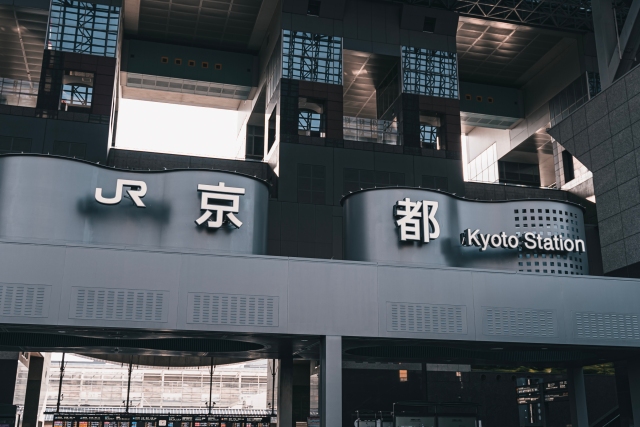
How true is the left-in-Tokyo, right-in-Kyoto standing rule?
There are plenty of differences that set the Kansai region, in and around Osaka, apart from the Kanto region, in and around Tokyo, and one of those differences is which side people stand on.
The difference in sides is most commonly seen when using escalators, with people in the Kansai area standing to the right and people in the Kanto area standing on the left. However, on a recent trip to Kyoto, our Tokyo-based reporter Egawa Tasuku found that this oft-spoken about standing etiquette isn’t as clear-cut as many assume it to be.
As soon as Egawa stepped off the train at Kyoto Station, he headed to the escalators, reminding himself to stand on the right when he got there, seeing as he was now in the Kansai region. However, when he glanced up at the line of people on the escalators, he found that…
▼ …they were all standing on the left, Tokyo-style.
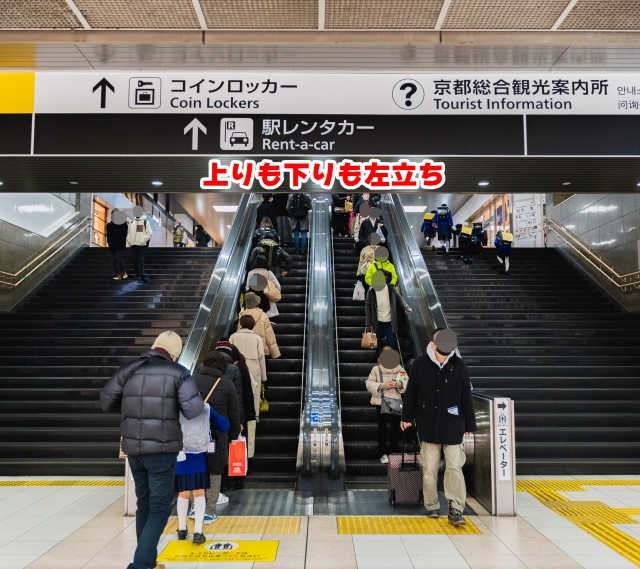
People on the ascent and descent were both standing to the left, which Egawa wasn’t expecting, so he just stepped in line and followed suit. But then, after only a few minutes, he decided to return to the same set of escalators, and that’s when he found something even more peculiar.
▼ People on the up-escalator were still standing to the left, but people on the down-escalator were now standing to the right.
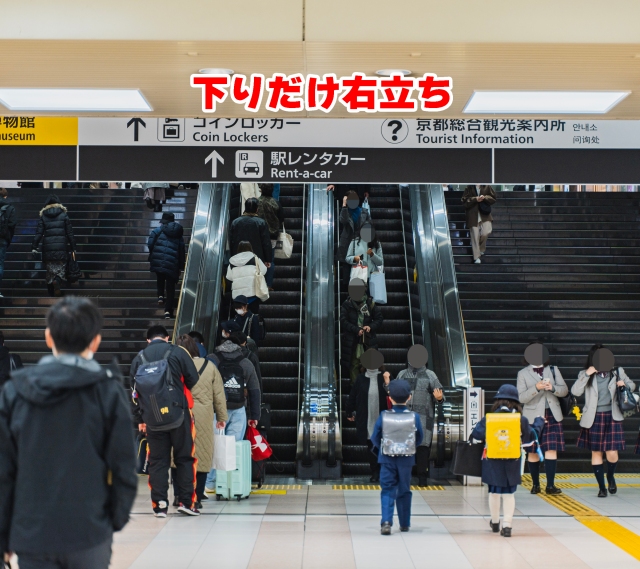
This was the first time in his life to see this type of standing arrangement, and making it even more bizarre was the ease with which it had changed in such a short amount of time. Nobody seemed fussed about it either, which made Egawa wonder if people in Kyoto were used to this fluid style.
Egawa continued his investigation, seeking out other escalators at the station, where he found that this one followed Kanto-style etiquette….
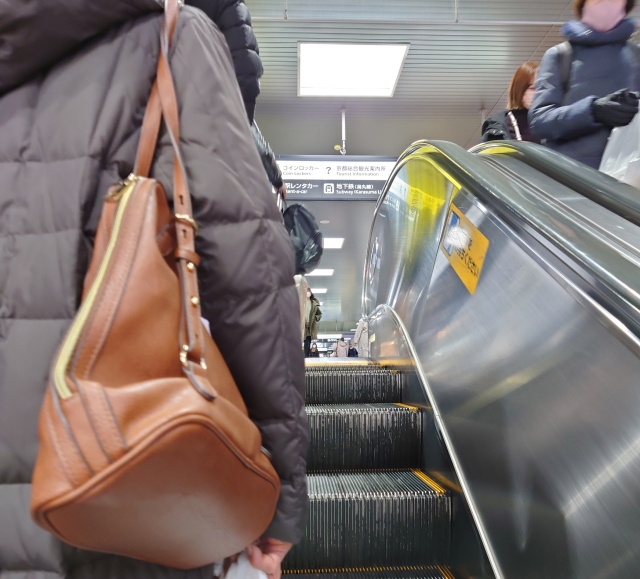
▼ …but this one close by conformed to the Kansai way of doing things.
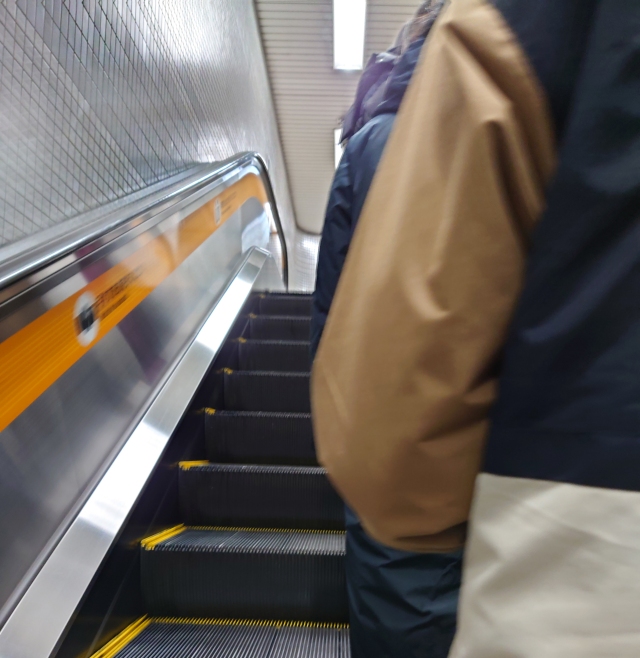
As he travelled from floor to floor throughout the immediate area, he discovered that the escalator etiquette appeared to be a mix of east and west styles.
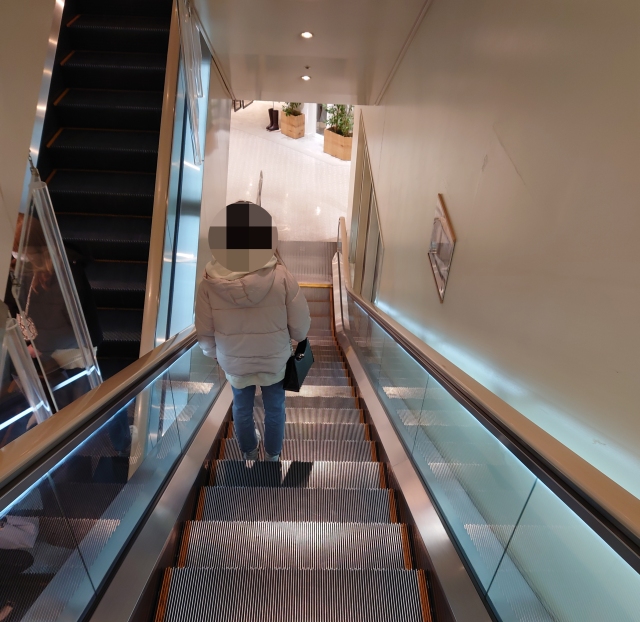
This certainly wasn’t what our Tokyo reporter had been expecting, as he’d grown up hearing the rules about standing to the right in the western region of Kansai. So when he got back to the office, he decided to ask his Kyoto-born colleague, Yuuichiro Waza, whether he’d noticed that the rules were actually more relaxed than rigid in his home city.
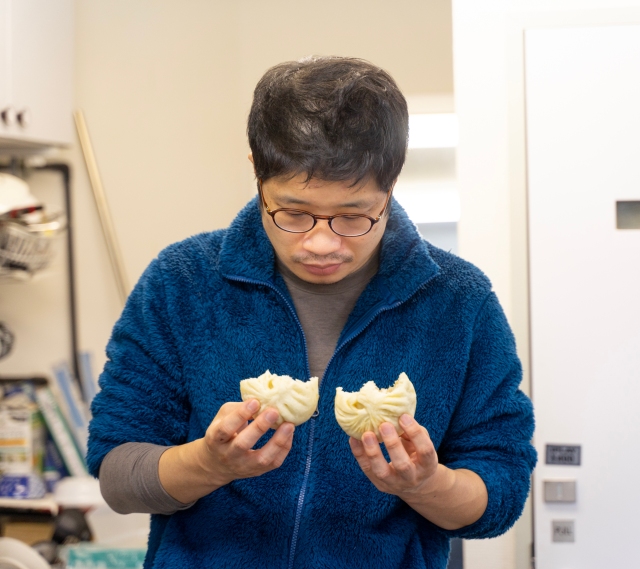
Yuuichiro, who, as the above photo shows, is generally more interested in the differences between steamed buns than the etiquette between Tokyo and Kyoto, said he’d never really paid much attention to what was happening on the escalators in his hometown.
However, after Egawa grilled him about it further, Yuuichiro gave the matter some more thought, and said:
“In Kyoto, like Osaka, there is the unwritten rule that you should stand on the right. However, Kyoto Station and Gion Shijo Station are frequented by a lot of tourists, so people from countries where it’s the norm to stand on the left will probably just naturally do that there.”
Egawa immediately piped up to challenge this point-of-view, saying that a lot of the people he’d seen standing on the left looked like locals, including young elementary school children, who obviously weren’t tourists.
Without missing a beat, Yuuichiro replied with:
“Kyoto people living in tourist areas may not know which side to stick to anymore because they’ve encountered so many people standing to the left. As a result, the culture of standing to the right may be gradually declining as left-standing culture infiltrates the area.”
Yuuichiro backed up his argument about rules being more relaxed in tourist areas by saying:
“In my hometown area of Kyoto, not a lot of tourists visit and almost 100-percent of people stand to the right.”
After chatting to Yuuichiro about it, Egawa realised that Kyoto Station and the surrounding downtown area is unlike a lot of other areas in Japan. It’s not just a place where traditional culture and architecture coincide with the modern — it’s a place where people from east and west Japan come into contact with each other frequently.
Because of that, it’s no wonder the culture and etiquette has become so mixed as well. While the region’s right-hand traditions still exist, it appears that locals will generally get in line behind the person in front of them, regardless of what side they’re standing on.
Egawa likes to respect and support local traditions, though, so he told Yuuichiro he would try his best to stand on the right when possible next time he visits the area, in the hopes that people will follow suit behind him. And he’ll remember another rule of etiquette that applies to escalators all around Japan — that walking up them is becoming more taboo.
Images © SoraNews24
● Want to hear about SoraNews24’s latest articles as soon as they’re published? Follow us on Facebook and Twitter!
[ Read in Japanese ]
 Six People Injured by Escalator in Akihabara, Once Again Proving that People in Tokyo Use the Wrong Side of the Escalator
 Japanese city pays people to stand on escalators for six hours a day【Video】
 Tokyo taking a stand on walking up and down escalators
 Kyoto has had enough of rude tourists, created an infographic to show how to visit politely
 Japanese readers rave about new book illustrating differences between Kanto and Kansai regions
 Wisteria season starts early with blooming of Japan’s Great Wisteria in its beautiful garden
 Japan’s best conveyor belt sushi restaurant of seven years ago has now, finally, come to Tokyo
 Starbucks Japan releases FIVE new Frappuccinos in a day, and we try them all in 90 minutes
 Japanese bento shop sells croquettes for 13 cents, but are they any good?
 Japanese sandals dyed with real Uji matcha are here to whisk you off your feet
 Japanese trains in Sapporo might be better than those in Tokyo, thanks to one special feature
 Mt. Fuji decorated with a 500,000-flower pink carpet is Japan’s ultimate spring view
 No, that’s not French bread, it’s Japan’s crazy-big gobo!
 Pokémon store character meet-and-greet events to resume in May
 History’s largest force of Samurai Colonel Sanders deploying to KFC Japan branches
 Japan reportedly adding Japanese language skill requirement to most common foreigner work visa
 Lawson convenience store at popular tourist site is one of the most unusual in Japan
 30 Pikachus want to share a Tokyo hotel room with you that has separate Grass, Water, Fire spaces
 You can assemble a well-balanced team of Pokémon, them eat them, thanks to Japanese cake chain
 Man bites woman at cherry blossom park in Japan, dies shortly after
 7-Eleven Japan’s new baked-in-store sweet treat is only available in three parts of the country
 Starbucks Japan closing only Shinkansen platform branch for popularity-triggered renovations
 Pokémon and Ikea Japan cross over into each other’s worlds with collaboration events
 Japan now has a special desk for people who work at home with a pet cat[Photos]
 Famous Tokyo cherry blossom spot installs view-blocking screens to fight overcrowding[Video]
 Uniqlo announces new T-shirts for One Piece, Naruto and more for manga publisher’s 100th birthday
 Train station platform ramen store closes its doors on half a century of history in Tokyo
 Starbucks Japan releases new My Fruit³ Frappuccino at only 34 stores around the country
 Krispy Kreme releases Super Mario doughnuts in Japan for a limited time
 Japanese onsen egg maker from 100-yen store Daiso needs to be on your shopping list
 Survey asks foreign tourists what bothered them in Japan, more than half gave same answer
 Japan’s human washing machines will go on sale to general public, demos to be held in Tokyo
 Starbucks Japan releases new drinkware and goods for Valentine’s Day
 We deeply regret going into this tunnel on our walk in the mountains of Japan
 Starbucks Japan releases new sakura goods and drinkware for cherry blossom season 2026
 Studio Ghibli releases Kodama forest spirits from Princess Mononoke to light up your home
 Japan’s newest Shinkansen has no seats…or passengers [Video]
 Major Japanese hotel chain says reservations via overseas booking sites may not be valid
 Put sesame oil in your coffee? Japanese maker says it’s the best way to start your day【Taste test】
 No more using real katana for tourism activities, Japan’s National Police Agency says
 Saitama begins plans to regulate how to use escalators, prohibit walking up and down
 Temple-heavy Kyoto presenting a unique challenge for travelers looking for Muslim prayer rooms
 Escape the Kyoto crowds at these lesser-known spots in Arashiyama
 Beautiful Starbucks in Kyoto blends into its traditional landscape in more ways than one
 Kyoto sightseeing tour: exclusive temple tours, meditation lessons, and incense making
 Kyoto sightseeing tour: The most amazing old bathhouses in the city
 Nine things that may shatter your dreams of living in Kyoto
 Cosplayers invade the Kyoto subway system to promote upcoming event!
 Kyoto in summer: A special trip to Kifune shrine recharges the soul
 Kyoto karaoke joint is like a dystopian city
 1,032 statues, and one thing too many people miss, at this Kyoto temple
 Should you place miso soup on the right or the left?
 A first-time visit to Kyoto’s Gion Festival becomes a night to remember
 Kyoto planning surprise late-night inspections of Airbnb-style rentals to fight overtourism
 Kyoto Station partially evacuated as bomb squad finds sweet but unwanted surprise
 Kyoto City planning to sell cremated people’s precious metal fillings for millions of yen