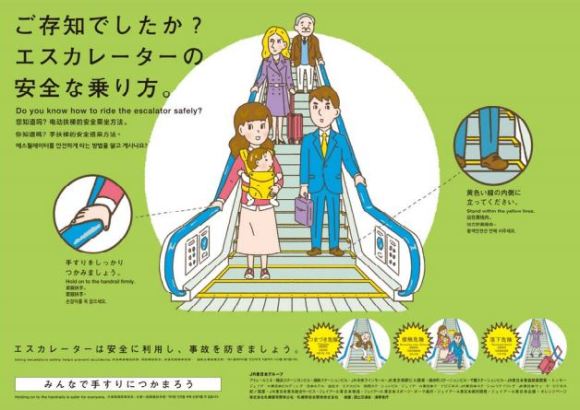
But are people willing to undo the long-running social custom of only standing on one side of an escalator?
Like many countries, Japan has an unwritten rule that those who are willing to ride an escalator by standing still should keep to one side, while people in a rush who want to climb the moving steps are allowed access on the other side.
This is a rather mysterious custom that some say began during the 1970 Osaka Expo, but no one knows for sure. Interestingly enough, different parts of the country have come to designate either the left or the right for standing, making it really easy to spot tourists.
But now, the Tokyo Metropolitan Physical Therapy Association and Japan Elevator Association want to put an end to all of this, citing safety and inefficiency as major flaws in the system.
By putting up posters in Tokyo’s Nerima Station this summer they have tried to raise awareness to the benefits of standing on both sides of an escalator.
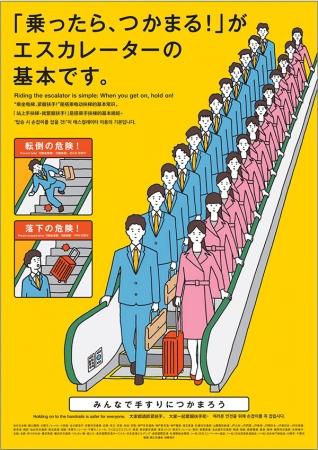
While the posters highlight the dangers of walking on escalators and the nuisance it can cause by hitting people you walk past, these groups are hoping people will appreciate that standing actually makes more people get to the top faster than the current method.
They cite London’s Holborn Station Experiment in which escalators where made to be standing only on both sides so that passenger flow could be analyzed. As a result they found that about 30 percent more people could pass through when people stood on both sides compared to having only standing people on one side.
On the surface it makes sense, by putting the majority of standing escalator riders to one side, a lot of valuable space is wasted. However, these results depend on various factors such as the size of the escalator and flow of people. In cases of shorter escalators, standing both sides can turn out to be less efficient.
Also, even though everyone is getting to the top faster when standing on both sides, those who either want or need to get to the top faster to catch a train, get to a restroom, or whatnot are greatly slowed down. This means that the people who benefit from this efficiency aren’t necessarily the ones who are looking for it.
During the Nerima Station campaign, passengers were asked how they felt about standing on both sides of an escalator, with greatly mixed responses. Those opposed to it tended to frequent busier stations while those in favor of it tended to have elderly or physically challenged family members.
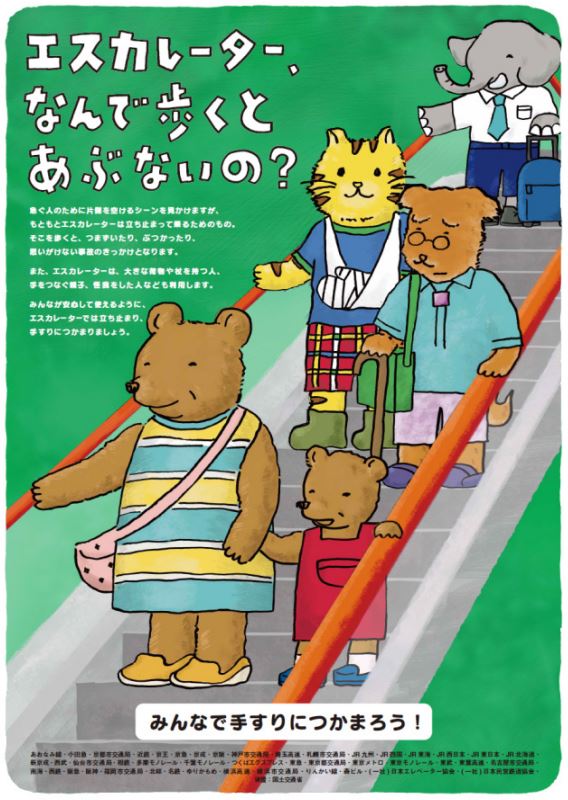
This brings us to the most important motivation for this campaign and the reason standing on both sides should be mandatory everywhere. Some people can’t easily stand on one side only due to injuries or paralysis from strokes, Parkinson’s disease or a variety of other reasons. Being forced to stand on a side that requires them to use the affected parts of their body while other people constantly brush past them can turn a simple ride into a stressful nightmare.
This is sure to be a problem when the 2020 Paralympics comes to Tokyo, and with it a wide range of differently abled people hoping to get around in relative peace. So, if you want to help, get out there and be that “jerk” who blocks the walking lane on your local escalator. In doing so you can combine the fun of anti-social behavior with the joy of helping improve accessibility in your community!
Especially in Japan, where train schedules can be brutally precise, it’s hard not to sympathize for people who are in a hurry at stations. But for those people, stairs are usually available and a great way to get a quick work-out. Meanwhile, those who can’t take advantage of the free exercise can still get to where they’re going a little faster and much more comfortably, and then everyone wins.
Source: Norimono News, Londonist
Top image: JR East
Insert Images: PR Times, Mori


Saitama begins plans to regulate how to use escalators, prohibit walking up and down
Saitama officially forbids walking up and down escalators
Japanese city pays people to stand on escalators for six hours a day【Video】
Six People Injured by Escalator in Akihabara, Once Again Proving that People in Tokyo Use the Wrong Side of the Escalator
Do people in Kyoto really stand to the right on escalators?
New Tokyo sweets shop offers 648 different mochi ice cream dumpling combinations

Japanese rice cooker recipe gives us a tasty new way to enjoy vegetables and wieners
Even at twice regular Daiso price, this handy item is still great for summer travel in Japan
Body of missing American college student found in Kyoto mountains
Colour Hunting: The hot new street photography trend changing how we see Japan
Ghibli’s No Face continues to demonstrate his generous character growth by dispensing soy sauce
Fukushima City on edge as resourceful and violent bear still not found
Japan’s cheap beef bowl chain Matsuya opens gourmet Premium Matsuya with Kobe beef…inside Matsuya
Japanese convenience store shows us how to dress for the rainy season
What’s it like to join Tokyo’s walking-and-talking-with-strangers club for a day?
Uniqlo reveals third round of massive 100-year-anniversary manga T-shirts for Jump’s Shueisha
Kyoto public junior high school becomes first in Japan with a hoodie school uniform
New official Ghibli anime food cookbook will teach you how to make Ponyo’s ramen and more
Starbucks Japan unveils new Frappuccino showcasing “mottainai” culture
Osaka is hosting a “hentai” event, but it’s probably not what you think
Tokyo’s Pokémon Cafe reopens this month with brand-new sweets and Pikachu show
Tourists brave Typhoon Jangmi to queue at two famous sites in Tokyo
Tokyo’s life-size Gundam anime mecha statue will be removed this summer
Ichiraku Ramen-inspired ramen sets from Naruto anime pay homage to Naruto, Sasuke, and Sakura
Kanji ice cream becomes a sell-out hit in Japan
Japanese convenience store Lawson launches new “mini supermarket” chain, L Minimart
Japan’s real-world Pokémon hot spring’s first photos are here![Photos]
Japan’s human washing machines will go on sale to general public, demos to be held in Tokyo
Starbucks Japan releases new drinkware and goods for Valentine’s Day
We deeply regret going into this tunnel on our walk in the mountains of Japan
Starbucks Japan releases new sakura goods and drinkware for cherry blossom season 2026
Japan’s newest Shinkansen has no seats…or passengers [Video]
Major Japanese hotel chain says reservations via overseas booking sites may not be valid
Put sesame oil in your coffee? Japanese maker says it’s the best way to start your day【Taste test】
Japan reportedly adding Japanese language skill requirement to most common foreigner work visa
Japan’s 5.3 million beautiful Hitachi Nemophila flowers are now in full bloom[Photos]
Pokémon and Ikea Japan cross over into each other’s worlds with collaboration events
South Korea establishes special task force to combat escalators and elevators
Tokyo farewells Japan’s only double-decker Shinkansen with a special escalator at the station
Unusual curved escalators are the crowning jewel of this shopping mall in Osaka
The golden escalator hidden at a Tokyo train station
We take a giraffe nap in a standing sleep pod at a cafe in Tokyo
Why did this stand-and-eat soba noodle shop in Tokyo open in the middle of the pandemic?
Do Tokyo natives get lost in Shinjuku and Shibuya too? We ask our in-office Tokyo-ites
Japan’s Minister of Digital Affairs catches attention by skipping escalator and using stairs【Photo】
Tokyo station becomes first in the city to install an inclined elevator
Tokyo train passengers team up to take down thief who stole sleeping man’s wallet【Videos】
Tokyo Olympics organizers offer to pay volunteers 125 yen 【US$1.13】 an hour, critics unimpressed
New sushi restaurant hidden inside Tokyo Station is a secret gem
Official 2020 Tokyo Olympic logos possess a little secret you might not have noticed
We serve a hot dish of the five best stand-and-eat soba restaurants in one area of Tokyo
Tokyo Olympic committee comes up with clever way to let blind children help select Games’ mascots