
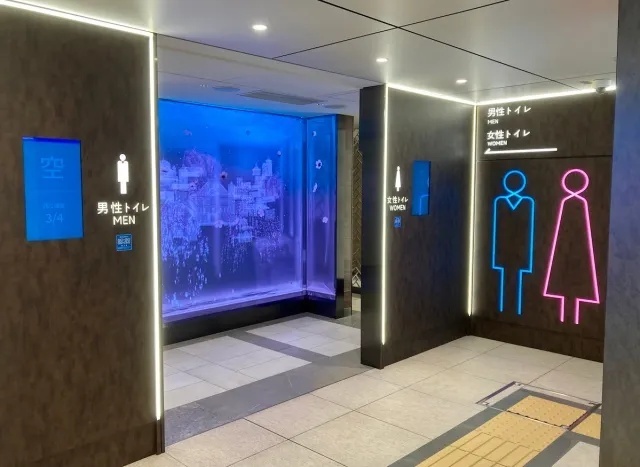
Even if the number of men and women using a building are the same, the number of toilets shouldn’t be, government’s guideline drafts say.
As its name suggests, Japan’s Ministry of Land, Infrastructure, Transport and Tourism has a pretty broad focus, and right now it’s turning its attention to toilets. Specifically, the government entity is turning its attention to the number of toilets in women’s restrooms in Japan, and it says there aren’t enough.
On March 13, the ministry released its preliminary guideline drafts following a study of restroom facilities in train stations, shopping centers, airports, stadiums, and other such facilities, declaring:
“In order to equalize waiting times for men and women, the throughput capacity of men’s and women’s restrooms must be balanced. As a general rule, the standard should be that when the number of male and female restroom users in a facility are roughly equal, a larger number of women’s toilets than men’s should be installed.”
Note that for the purpose of this statement, the ministry is counting both urinals and sit-down toilets as “men’s toilets,” meaning that it’s stance is that for facilities with an equal number of men and women using their restrooms, the number of women’s room toilets should be higher than the combined number of men’s room toilets and urinals. The ministry says its recommendation is based on women’s increased participation in the workforce and other aspects of outside-the-home society, and reflects women’s tendency to need a longer amount of time to use the bathroom than men do.
In a study of 190 train stations, as well as dozens of expressway rest stops, airports, bus terminals, shopping centers, and other facilities, researchers found that men’s room toilets/urinals often outnumber women’s room toilets, though not in all categories.
Number of women’s toilets per men’s toilet/urinal
● Train stations (190 examined): 0.63
● Expressway rest stops (52 examined): 1.07
● Michi no eki/roadside souvenir shops (50 examined): 0.96
● Airports (35 examined): 0.66
● Cruise ship/ferry terminals (28 examined): 0.77
● Bus terminals (14 examined): 0.71
● Shopping centers (22 examined): 1.19
● Stage theaters/concert halls (13 examined): 1.93
● Sports stadiums (12 examined): 0.98
● Movie theaters (5 examined): 0.89
● Museums (4 examined): 1.02
However, even though women’s toilets outnumber men’s at expressway rest stops, shopping centers, museums, and theaters/concert halls, it’s only the last category that the ministry thinks actually has enough. In its guideline drafts, the ministry says that if a facility has an equal 50/50 split between men and women patrons or passengers, then it should have 1.67 women’s toilets for every men’s toilet/urinal. It’s not until the split in restroom users shifts to 62.5 percent men/37.5 percent women that the ministry believes a 1:1 ratio of men’s to women’s toilets is deemed acceptable.
It’s worth keeping in mind that these are recommendations that the ministry is asking facilities to voluntarily comply with, nor legal requirements with penalties if they’re not followed. In addition, it’s not only women whose restroom experience the ministry wants to improve. The guideline drafts also call on facility operators to increase their number of restroom toilets if they have a large number of elderly patrons, who will also need more time to do their business, or if the facility attracts many families with young children. As a matter of fact, the report calls for building managers to consider increasing the ratio of stalls to urinals in men’s restrooms as well, pointing especially to expressway rest areas’ having twice as many urinals as men’s room stalls as being potentially insufficient in meeting patrons’ pooping needs.
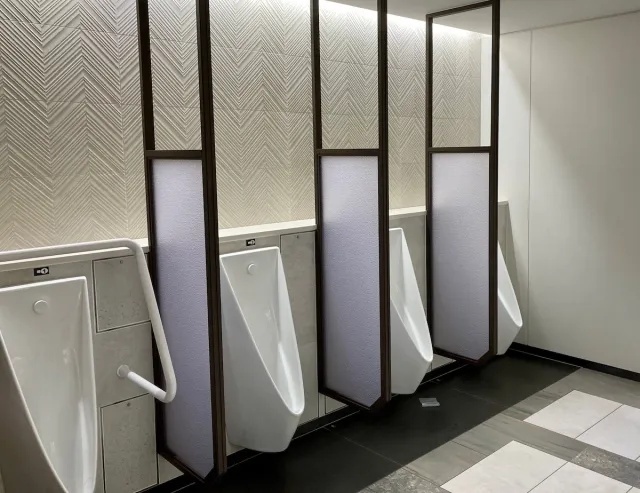
▼ Though it is physically possible to poop in one of these, it’s not at all socially acceptable.
However, simply adding more toilets, to either the women’s or men’s room, isn’t always so easy to do. Particularly in Japan’s urban centers, facilities tend to be densely designed, often with little to no space left for outward expansion. Because of that, increasing the number of stalls may require a complete redesign of the bathroom, an expensive undertaking that would only make the shortage of toilets worse while the renovations are taking place. The draft guidelines do, however, also suggest that facility managers implement real-time digital signage or other means by which to direct patrons to restrooms with open stalls, even on other floors or in other sections of the building, to help reduce waiting times.
The ministry will be soliciting public comments on its guideline drafts this month, with its final recommendations to follow.
Source: Ministry of Land, Infrastructure, Transport and Tourism via Yahoo! Japan News/Kyodo, Asahi Shimbun
Photos ©SoraNews24
● Want to hear about SoraNews24’s latest articles as soon as they’re published? Follow us on Facebook and Twitter!
 Majority of Japanese men say they feel some discomfort seeing female janitors in men’s restrooms
 The day our male reporter used a women’s restroom with other dudes and they learned about otohime
 Tokyu Kabukicho Tower backtracks on its gender-neutral toilets, rejigging them to appease public
 Is it OK for men cosplaying as women to use the women’s restroom in Japan? Twitter debates
 Japanese bathroom has a clever countermeasure for guys who pee on the floor at the urinal【Photos】
 Japan reportedly adding Japanese language skill requirement to most common foreigner work visa
 Starbucks Japan closing only Shinkansen platform branch for popularity-triggered renovations
 You can assemble a well-balanced team of Pokémon, them eat them, thanks to Japanese cake chain
 Japan’s full-facemask Ninja Parka still lets you eat ice cream[Photos]
 Visiting Evangelion’s Tokyo-3 anime locations in real-life Hakone【Photos】
 Sailor Moon’s Artemis is part of the Artemis II NASA mission control team[Video]
 Small Hokkaido bookshop’s unique service is getting business from all over Japan
 Kobe University study reminds us that Japan could be one volcanic eruption away from annihilation
 Disney princess cakes from Ginza Cozy Corner are as pretty and sweet as the characters themselves
 Picturesque Tokyo park plays host to millions of flowers and soap bubbles this spring
 Pokémon and Ikea Japan cross over into each other’s worlds with collaboration events
 Tokyo’s best museum for foreign travelers finally reopens after being closed for four years
 Pokémon lacquerware series expands for Year of the Horse with new handcrafted design[Video]
 Two food hacks take Japan’s convenience store fried chicken to amazing new sandwich heights
 Tokyo subway and almost all Tokyo train lines now accepting credit card tap payments
 Totoro Fund line of beautiful artwork and apparel lets you help the real-world Totoro Forest
 Fading Tokyo – Searching for signs of the Showa era as local neighborhoods evolve[Photos]
 Famous Tokyo cherry blossom spot installs view-blocking screens to fight overcrowding[Video]
 Tokyo turns its phone booths into free Wi-Fi hotspots, and here’s how to use them
 Studio Ghibli adds new My Neighbour Totoro 2026 Corn Gift to its anime store for Mother’s Day
 Japan now has a special desk for people who work at home with a pet cat[Photos]
 Uniqlo announces new T-shirts for One Piece, Naruto and more for manga publisher’s 100th birthday
 Train station platform ramen store closes its doors on half a century of history in Tokyo
 Starbucks Japan releases new My Fruit³ Frappuccino at only 34 stores around the country
 Studio Ghibli releases Catbus pullback keychain that runs like the anime character
 Krispy Kreme releases Super Mario doughnuts in Japan for a limited time
 Japanese onsen egg maker from 100-yen store Daiso needs to be on your shopping list
 Nine great places to see spring flowers in Japan, as chosen by travelers (with almost no sakura)
 Survey asks foreign tourists what bothered them in Japan, more than half gave same answer
 Japan’s human washing machines will go on sale to general public, demos to be held in Tokyo
 Starbucks Japan releases new drinkware and goods for Valentine’s Day
 We deeply regret going into this tunnel on our walk in the mountains of Japan
 Studio Ghibli releases Kodama forest spirits from Princess Mononoke to light up your home
 Starbucks Japan releases new sakura goods and drinkware for cherry blossom season 2026
 Japan’s newest Shinkansen has no seats…or passengers [Video]
 Major Japanese hotel chain says reservations via overseas booking sites may not be valid
 Put sesame oil in your coffee? Japanese maker says it’s the best way to start your day【Taste test】
 No more using real katana for tourism activities, Japan’s National Police Agency says
 How old is too old for a boy to go into the women’s hot spring bath in Japan?
 Japanese women show overwhelming resistance to unisex bathrooms in survey
 Not-guilty verdict for man in women’s restroom, he had to go so bad it clouded his judgement
 Nagoya City Council debates: Is toilet paper really needed in public restrooms?
 Sapporo supermarket’s women’s restroom becomes unusually popular with guys last Sunday night
 Seoul’s Stunning Sky-High Urinals
 Open-air public toilet at Sensoji temple in Tokyo is waiting to be discovered by foreign tourists
 Is that a public toilet or a performing arts hall? In Tokyo, you never know
 Toilet rubber theft baffles, grosses out Japan
 Sapporo lowers age at which kids are barred from opposite sex’s bath at hot springs, public baths
 Japanese defecation survey says kids struggle with Japanese toilets, contributing to constipation
 Tokyo changes age limit for kids going into opposite sex’s bath at hot springs and sento
 Tokyo Station Waterscape Toilet looks more like an aquarium than a bathroom
 Morons caught blasting adult-video audio inside one of Tokyo’s busiest train stations
 Tokyo Medical University accused of dropping women’s entrance exam scores 10-20 percent each year
 Sapporo police arrest 50-year-old man for entering women’s public bath