Whichever way you look at it, life in Japan is expensive.
As well as Japan’s food, drink and fuel ranking among the world’s most expensive, compared to many western countries, land in particular is sold at a premium, meaning that accommodation can be costly, and even those with enough capital to consider purchasing a car often abandon the idea when they realise that they cannot afford to buy or rent the necessary parking space.
CNN’s “World’s Most Expensive Places to Live 2012” placed Tokyo and Osaka first and third, respectively, and thanks to the strong yen and weak dollar/euro/everything, coming to live in Japan has never been more financially challenging.
With this in mind, budgeting expert Yoko Hanawa at Yahoo! Japan shares some ways in which Japan’s businessmen and women tackle everyday life in this tough financial climate, and introduces a few ideas of her own that are worth paying attention to.
According to a recent survey conducted by Shinsei Banking Corporation, the average salary-man’s daily spending money is now almost half of what it was during Japan’s economic golden age in the 1990s, coming in at around US$500 per month.
In many Japanese households, the wife is in charge of the finances, and doles out her husband’s “pocket money” that he must use for small, day-to-day expenses like lunch, snacks, drinks, cigarettes and the like.
According to the bank’s data, the average amount spent on lunch, social drinks, snacks and day-to-day necessities has fallen almost 50% in 20 years. While in the past, salary-men and women would duck in and out of taxis on a regular basis and dine out sometimes up to six times a month, the average city worker now treats themselves to an evening meal in a restaurant just once or twice every four weeks, and relies on the, thankfully, ever-punctual rail network to get around town.
As a man who spent the entire of 2011 as a full-time student living in Tokyo, I can say from personal experience that life on a budget here is tough. Rent, utility bills, groceries, a mobile phone and commuting costs soon add up, and at one point I was getting by on around $1000 a month, so it’s a shame that Ms. Hanawa’s sage advice hasn’t cropped up until now!
All the same, for those of you planning on moving to Tokyo, or simply interested in how the average city-dweller gets by, there are some genuine gems of info here, so listen up…
“The average businessman spent an impressive 746 yen on his weekday lunch in 1992, compared to just 500 yen today,” tells Ms. Hanawa. “As a result, today’s businessperson has to be incredibly frugal if they want to make their allowance stretch.”
While 746 yen (US$9.50) might not sound like all that much, bear in mind that this amount would have been spent five or six days a week, and this figure is taken from the 1990s, at which point the yen was worth much more than it currently is.
It’s interesting to think that, with salary-men spending so little on their workday lunch, stores like Yoshinoya and Sukiya have, in the hope of improving sales, recently introduced new items to their menus that cost more than this amount. Will the average salary-man take to them, or simply stick to regular-old gyūdon in an effort to save the pennies?
So how do people save money these days? Are they simply cutting the amount they spend on their lunch, much to the detriment of their health?
“Nowadays, people carry personal water bottles or tumblers,” comments Ms. Hanawa. “By doing so, they avoid the need to buy soft drinks from convenience stores and vending machines.”
Although vending machines are part of what makes Japan, and stories of machines selling everything from drinks to underwear have been told so often that they’ve seemingly become fact, it’s true that Japan has seen a sudden boom in personal drinks bottles, with a whole host of sizes and designs hitting store shelves in the last couple of years.
In addition to being marketed as “eco” and kinder to the environment than one-use plastic bottles, personal drinks bottles no doubt help cut small expenses. With the average bottled drink costing 120 yen, at a rate of one purchase per working day, the average person could be spending anything up to US$450 a year on beverages alone.
The little things really do make a difference, don’t they!?
According to the expert, while economising is essential in today’s society, it’s important that we judge how and when to save money, warning that the way we economise today will shape our life tomorrow…
“Lots of young people target their daily lunch allowance or try to control the amount they spend on going for social drinks with colleagues, but this could have an adverse effect on us. If we rely on nothing but cheap junk food every day, we put our health at risk. On the other hand, if we remain at our desks eating a meagre packed lunch while everyone else going out to eat or buy a snack, we risk cutting ourselves off from our peers and missing out on important information.”
So while we should be careful of how we spend our money, we should be equally focused on how budgetary cuts affect our social and work lives?
“Everything in moderation; have lunch out twice a week, bring a packed lunch the other days, but don’t be merciless since it will ultimately have a negative effect on your health.”
The lady makes a good point; after all, what’s the point of saving money every day if it means we wear ourselves down and get sick because we’re fuelling our bodies with little more than salt, carbohydrate and fat? And if we do get sick, who will show sympathy or pick up the slack at the office while we’re out when we no longer socialise with our workmates? It’s a vicious circle…
Some other tips that Ms. Hanawa has for readers include shaving unnecessary costs by removing additional services our mobile phone providers offer like call waiting or voicemail, or those additional “lifestyle” applications that we’re tempted to sign up for for just a couple of hundred yen a month. They all add up…
“Make use of store point cards,” advises the mistress of money. “If you frequently go to a convenience store, use their card; it’s free, and you rack up points that you can redeem later on things that you need.”
That last tip might be a little trickier than it sounds. While point cards are certainly very useful, and places like large electronics stores offer as much as 10% in loyalty points of the value of any item bought, it’s not unusual for everywhere from cafes to convenience stores to offer their own unique card, so keeping track of them all or finding the correct one in a stack of 20 can become something of a headache.
That said, the rewards with these cards are genuine, and it’s a great feeling to be able to say “I’ll pay for it with my points” every so often.
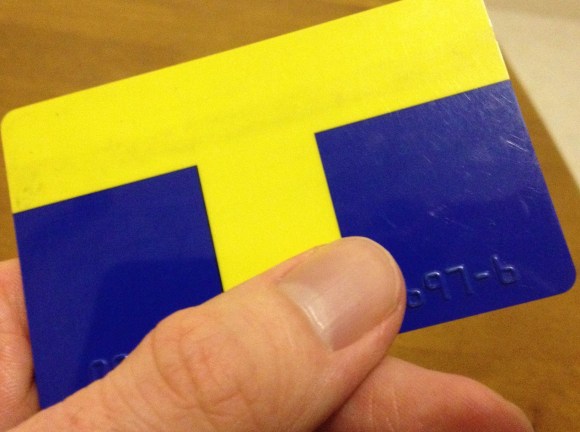
▼My faithful T-Point card. Six years and still going strong.
For all her sensible advice, though, Ms. Hanawa’s last few tips came as a bit of a surprise to this writer, as she paints a– shall we say “traditional”– image of the typical household, in which the man goes out to work while his wife stays at home with the child, buying expensive things with his money…
“The man alone shouldn’t bear the financial burden; while things like imported strollers, shoes and livingroom water dispensers look nice and convey the image of being well-off, they are often the cause of financial trouble.”
A living-room water dispenser!? Does anyone have one of those? I must not have rich enough friends…
Source: Yahoo! Japan