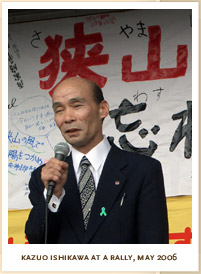
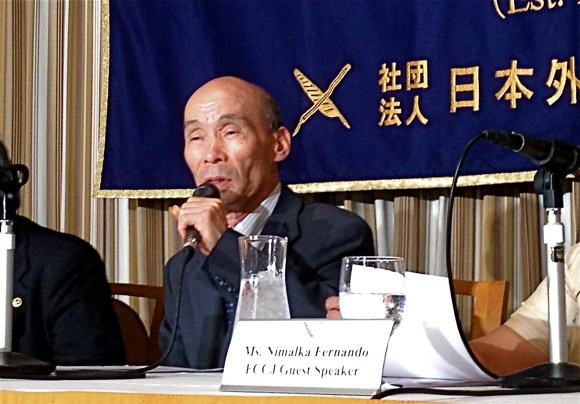
In 1963, Kazuo Ishikawa was convicted of the murder of a high school girl in Sayama City, Saitama Prefecture. A member of the Buraku, Japan’s historical untouchable caste, Ishikawa grew up poor and uneducated, and the police built the case against him by taking advantage of his naivety, by capitalizing on social prejudices, and by manipulating an already unfair legal system to their advantage. Now 74, he is still fighting to clear his name and to make sure others have access to a fair trial.
The Case
On May 1, 1963, a female high school student disappeared on her way home from school. That evening, a ransom note was delivered to her home, but soon after a botched attempt to deliver the money allowed a possible culprit to escape, her body turned up in a nearby field, the girl having been raped and murdered. After a team of 40 police investigators failed to make an arrest, public pressure was mounting.
The police decided to investigate a local Buraku area on the off-chance the criminal was there. The burakumin as they are sometimes called in Japanese are not an ethnic minority, but a social one. In the feudal era, people who were cast out from society or engaged in professions considered unclean, like undertakers or tanners, lived in separate villages or ghettos. Even in modern times, they are negatively stereotyped as especially criminal and lazy.
The police picked up Ishikawa on an unrelated charge, as well as a few other youths from the Buraku district. Ishikawa was released on bail, but then they decided to go after him for the murder and took him into custody again.

The Substitute Prison System and Forced Confessions
Ishikawa was held in police detention for a total of 47 days, with access to his lawyer limited to five minutes at a time and subjected to 16-17 hour interrogation sessions.
This treatment is actually permissible under Japanese law. Detainees can be held under the direct police management for up to 23 days before formal charges are laid. After a warrant is issued, the police can hold a person for 72 hours without laying charges. If they deem that is not sufficient, they can apply for two 10-day extensions. However, if the person faces multiple charges, the charges can be dealt with separately and the process repeated over and over.
Keeping a suspect in direct custody makes things much easier on the police. In comparison with the rules governing a state detention center run by the Ministry of Justice, in police detention lawyers cannot be present in an interrogation, nor can it be videotaped or tape-recorded. There is no legal limit on the length of the interrogation sessions, nor is there a law stipulating that matters raised during interrogation have to be related to the charges. The ‘confessions’ are not actually written or dictated by the detainee but composed by the police and simply signed by the detainee.
During this time, the suspect is not legally guaranteed access to a lawyer, except in cases involving the death penalty–a provision that wouldn’t have helped Ishikawa anyway, as it was enacted in 2006.
While he was in custody, the police intimidated Ishikawa, threatening to arrest and prosecute his brother, the sole breadwinner in the family at that time, if he did not confess to the crime. They also misleadingly assured him that if he did confess, he could plea out to 10 years instead of getting the death penalty. Eventually, broken down by the long interrogations sessions and thinking he was protecting his family, Ishikawa agreed to confess.
“Things didn’t turn out the way the police had told me,” Ishikawa says. “I was sentenced to death, and my brother lost his job anyway, because people refused to employ someone related to a confessed murderer. My younger sister was harassed out of school. Those years in prison were really tough for me.”
Appeal After Appeal
Ishikawa was sentenced to death on March 11, 1964. On appeal at the Tokyo High Court in 1974, they confirmed his guilty verdict on the weight of his confession, although he had retracted it. They did, however, reduce his sentence to life. That case then made it to the Supreme Court, but no effort was made to investigate how Ishikawa’s confession was obtained or to look into unreleased evidence, and they upheld the verdict again.
In fact, there may have been exonerating evidence all along. Japanese law only requires that evidence used in court by the prosecution be disclosed to the defense. All other evidence can be withheld.
In Ishikawa’s case, a large amount of evidence remains undisclosed, as evidenced by missing sequential numbers in the evidence list. The defense has stated that they are willing to have any sensitive data in the documents blacked-out to protect the privacy of concerned parties and that they would be willing to examine this evidence only in the prosecutor’s office, but the prosecution continues to deny them access or even release a list of the types of evidence they hold.
A Prison Education
Ishikawa would eventually serve 32 years of hard labor in prison, but he says the time was not completely wasted. In prison, a guard taught him how to read and write, and this opened up a whole new world for him.
“My parents never told us anything about Buraku issues. I don’t even know if they ever even mentioned the word. They had to have known it, had to have some idea that they were from a Buraku, but they never told us anything about it,” he says.
“It was only after those years of study in jail that I learned that the things I had experienced as a child were something happening all over Japan. I learned that I was from a Buraku and that’s why my family faced such poverty and that’s why I went to jail for a crime I didn’t commit.”
Parole, but Not Freedom
In 1994, Ishikawa was released on parole, but still continues to suffer the stigma of a murder conviction as well as the restrictions of a parolee. He continues to make public appearances to talk about the case and to advocate for judicial reform and minority rights. Over 1 million people have signed a petition asking the government to retry his case.
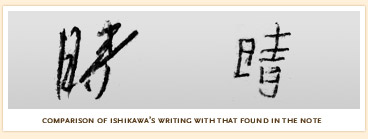
In 2006, he and his defense team launched a third appeal for retrial. Focusing on exculpatory evidence such as the lack of any similarity between the handwriting on the ransom note and Ishikawa’s handwriting and the the fact that his fingerprints do not appear anywhere on it or the envelope, the team hopes that this final appeal will be successful.
“I am actually not asking the court to quickly give me a not-guilty verdict because I am innocent. I am only asking that the court review the evidence, and the truth will reveal itself in the process,” he said at the time.
Yet, it is now the 50th anniversary of the crime and nearly seven years after this most recent request for an appeal, but the court has not yet issued a decision. For Ishikawa, time is running out, but he says he will keep fighting.
“My time in prison was difficult, but… I connected with a movement that extends beyond me and affects the lives of thousands of people all over Japan. It is for these people as much as for myself that I fight for recognition of my innocence.”
Photos: RocketNews24, Buraku Liberation and Human Rights Research Institute, IMADR