
Workers in Japan are often perceived by the rest of the world as possessing an extremely strong work ethic, which drives them to daily acts of unpaid overtime, selfless sacrifice of rightfully accrued holiday time, and occasionally even to karoushi, or death by overwork. So pervasive is this perception that the image of the exhausted salaryman splayed out across train carriage floors after a hard day’s work has become a sort of unofficial symbol of Japanese working life.
But what people who have actually worked in Japanese offices will tell you is that, while simply existing in the strict hierarchical system of a Japanese workplace can be an exhausting feat in and of itself, it doesn’t necessarily mean that everybody’s getting loads of work done. In fact, Japanese workers may be just as lazy as the rest of us. So how come everybody still thinks they work so hard?
To try to break down the reasons why Japanese people aren’t actually doing as much work as we in the west think they do, we’re going to talk about three misconceptions about Japanese working life, and the ways in which they are kinda false.
- Misconception 1: Japanese workers never take holiday, therefore they must work hard
It’s common in Japan to only get around 10 days paid holiday a year to begin with, but most of those paid holidays end up going unused, not because people are denied when they try to take them (they’ve earned ’em, after all) but because in general nobody ever even asks to take them.
- Why it’s false:
The perception is that Japanese workers voluntarily give up paid vacation days because they would much prefer to work. Not only is this not true, it gives too much credit to workers’ dedication and fails to address the real reason why nobody wants to take paid holiday – peer pressure.
Taking paid holiday means leaving coworkers to pick up your slack, which is a total no-no in Japan’s group-oriented society. Also, since getting ahead at a company in Japan relies so much on how you behave, nobody wants to look like a slacker who would rather be sipping beers on a couch somewhere than hard at work. There’s also the fact that asking to take paid holiday usually means directly petitioning your supervisor, who only has to raise an eyebrow to let you know in no uncertain terms that they consider your request to be the ultimate in bare-faced cheek. Also, Japan actually has a hefty amount of public holidays. There’s a week at the end of the year, Golden Week, Obon, and numerous stand-alone national holidays which pop up practically every month. With another tantalising national holiday always just around the corner, it’s easier to just hang on until then rather than specifically ask for paid holiday. Basically, while it’s true that people aren’t taking their paid holidays the way they probably ought to be able to do, it’s not necessarily because they’d rather be at work or don’t wish they could use them.
▼ Tumbleweeds in the office? Not in Japan!
 Wikimedia Commons, EU-Japan Centre
- Misconception 2: Japanese workers do loads of overtime, therefore they must work hard
“I would never want to work in Japan, because Japanese office workers don’t get home until midnight!” is something I hear a lot from friends back home. Certainly the Japanese seem to be doing quite a bit of overtime, and the last train is usually stuffed full of near-comatose salarymen and office ladies.
- Why it’s false:
Working more hours doesn’t necessarily mean working harder, especially in Japan where it’s a common sight to see people stretching out small tasks and generally faffing around in order to try to spread the normal amount of work they have across a full day and into the overtime hours. This can be attributed to two factors: peer pressure again, and, secondly, wanting more money.
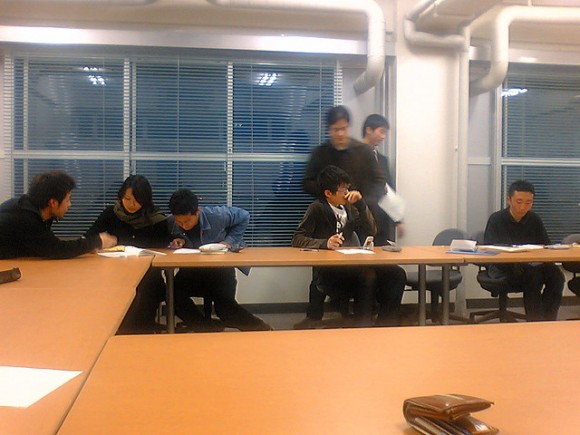
Companies that offer paid overtime usually find that their employees take them up on it, every single day. After all, that’s extra money you could be bringing home in today’s tough economy, and since nobody seems to actually care if you’re working or not as long as you’re on the clock, then why not spend the evening goofing around at your desk and making bank for it? Unpaid overtime is a whole different kettle of fish, and is usually undertaken for simple reasons such as “everybody else is doing it” and “I couldn’t possibly go home before the boss without bringing shame upon my entire family and getting daggers from my workmates.” While the Japanese might well be spending more time at work than people in other countries, it’s not necessarily true that they’re being more productive. With the average day including endless, pointless meetings, verging on voluntary bureaucracy, filing of entirely unnecessary paperwork, and sneaking naps at your desk, it’s amazing that some people in Japan get any work done at all…
▼ Meetings are a great way of killing a few hours of work time (and a few brain cells…)
- Misconception 3: Japanese workers are exhausted all the time, therefore they must work hard
Those poor salarymen slumped on street corners, so exhausted they’ve somehow lost control over their own bodies and on occasion a few articles of clothing too. That poor office lady snoring and drooling on everyone’s shoulders on the last train of the night. They must just be run ragged at work!
- Why it’s false:
As we mentioned above, it’s pretty common for workers in Japan to try to conserve energy during the day by not getting especially stuck into their work. Then, in the evening, it’s all nomikai, or drinking parties, and schmoozing, a vital part of staying part of the work group and getting to know the right people in order to further one’s career and be looked upon favourably by the boss. Maybe those people on the train aren’t tired out from working – maybe they’re tired from compulsory socializing. That’s not to mention the huge quantities of booze that are required to lubricate these post-work social engagements. Conbini shelves are stuffed full of supplement drinks in order to keep exhausted post-work partiers going longer, and to help alleviate the inevitable hangover symptoms. We can’t deny that long days full of work-stretching and drinking with the higher-ups isn’t exhausting, but does it result in hard work and getting things done?
▼ Otsukaresama, gentlemen. Now let us get down to the real business… of drinking!
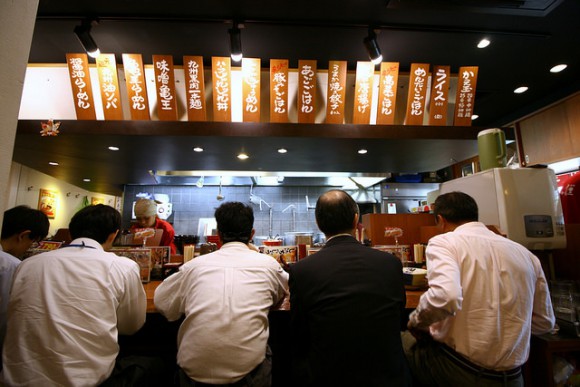 Flickr
With evidence now suggesting that it’s actually the Americans who are working the hardest in the world (as reported last year by ABC News), is it perhaps time for the myth of the hyper-diligent Japanese worker to be debunked, once and for all?
Source:Yurukuyaru
Main Image: Flickr © karendesuyo