

Japan is often perceived as a safe country. The nation of 127 million people boasts some of the lowest rates in the world for serious crimes such as murder, robbery, and rape. In addition, Japan continually ranks high on the Global Peace Index. And while it may sometimes seem like stalking and crime against children is rampant in Japan (the stalking rate hit a record high of 22,823 this year, up from 21,000 in 2013), this perception comes largely from widespread media exposure. In the U.S., for example, it is estimated that 6.6 million people are stalked per year.
While serious crime may not rank as high as in other developed countries, there are plenty of the other offenses that Japan excels at, and the country has its share of unscrupulous nationals. These are the things you probably haven’t heard so much about. Today we look at five crimes, some of them strangely Japan-specific.
Here is our list, in no particular order, of some of the most common crimes in Japan. And don’t miss number six, the bonus crime, which we’re sure you’ve never even heard of before.
1. Sagi

Sagi means fraud or scam, and is very visible in Japan in the form of door-to-door sales to ore-ore phone calls where the perpetrator poses as the victim’s relative (ore-ore means “It’s me, it’s me!”) and asks the victim to send money urgently in order to help them out of a scrape. ATMs in Japan often have signs positioned beside them, questioning people’s motives for taking out cash, asking “You didn’t receive an ore ore phone call asking for money, did you?” or “Are you sure it’s not a scam?” Longer ago, deceptive scams were carried out by door-to-door salesmen who would sell 300,000-yen (US$2,500) futons to mostly elderly people. On the small island of 550 people where I live, there are few households that have been immune to high-pressure salesmen at some point, including scam roof repairs, massage chair purchases and, yes, futons.
It seems odd that so many people would fall for such scams, but when the national television broadcaster endorses products featured in their daytime TV shows and solicits telephone sales after the program, and when at 7 p.m. other Japanese TV stations start airing advertisements for miracle pills and exercise equipment with toll-free numbers, it’s no wonder that many people can’t tell the difference between genuine and speculative advertising.
2. Enjokosai
 YouTube Screenshot (Wiltord Davids)
Enjokosai, or compensated dating, is a concept that originated in Japan but has since spread to other Asian countries such as Taiwan and South Korea. In short, enjokosai usually involves high school girls dating much older men in exchange for cash, gifts, or simply being spoiled rotten during their time together. The tricky part here is that, in a uniquely Japanese twist on something as mundane as prostitution, enjokosai doesn’t always involve sexual intercourse. Consider that you could go to Tokyo’s Kabuki-cho and see men holding signs advertising the opportunity to touch women’s breasts for 30 minutes for just a few thousand yen, and that in the ’80s there were “no panties cafes” (no-pan kissa) where the waitresses walked on mirrored floors wearing skirts but no underpants. Okaaaay. While many school girls do go all the way (illegal), just as many don’t and simply enjoy being taken to fancy establishments on dates with men who are over 40 years old (legal). While some receive cash, others prefer being showered with luxury goods (status symbols in Japanese society) instead.
3. Recycle trucks

Anyone who has lived in Japan will recognize the sound of the recycle trucks with speakers mounted on them, cruising the neighborhood bellowing out a canned recording saying they’ll take your unwanted computers, CD cassette players, refrigerators, air conditioners, TVs, washing machines off your hands–for a price. Readers in the west may wonder why anyone would pay to throw their old junk away, but, particularly for those living in the city, disposing of larger items like these can actually be quite the hassle in Japan, and not as simple as driving them to the dump.
According to the Home Appliance Recycling Law that went into effect in 2001, consumers must pay a recycling fee when they take appliances to a retail outlet for disposal. (I recently paid 6,900 yen – that’s about $55 – to dispose of a refrigerator). These high recycling fees have prompted unscrupulous people to start recycle businesses–charging people less for pick-up than the retail outlets and then dumping the goods in the countryside, onto an abandoned private lot somewhere, or even into the sea.
Others may ship the goods overseas to a developing country where someone can resell the used but still functioning products. Others still will send the appliances to China where they’ll salvage the metals out of it. These ships are often illegal and create their own hazards (safety, chemical spills, fires, etc) as a result. This is part of a wider, illegal dumping problem in Japan which includes the illegal disposal of industrial waste.
4. Crime committed by the elderly
▼ Criminal statistics from the National Police Agency.
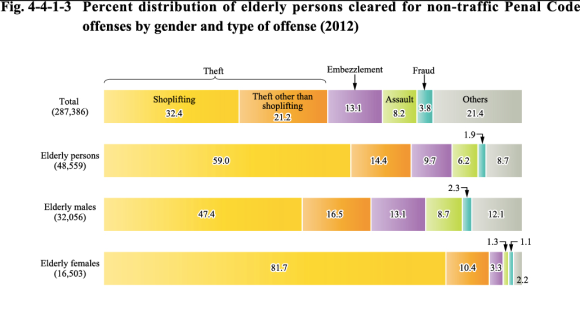
According the criminal statistics of the National Police Agency and a government White Paper on Crime, petty infractions such as shoplifting are increasingly carried out by Japan’s rapidly aging population (65 and older). Out of 48,559 crimes committed by the elderly in 2012, 59 percent involved shoplifting with a significantly higher proportion of elderly women initiating the thefts.
Debunking the widely accepted theory that crimes decrease with an individual’s age, Japan indicates that its own societal changes are a contributing factor to the proliferating crime by senior citizens. While seniors are living well beyond retirement age, they are also increasingly isolated from their social networks such as family and friends and face decreased prospects of living with their children.
5. Fetish Crimes
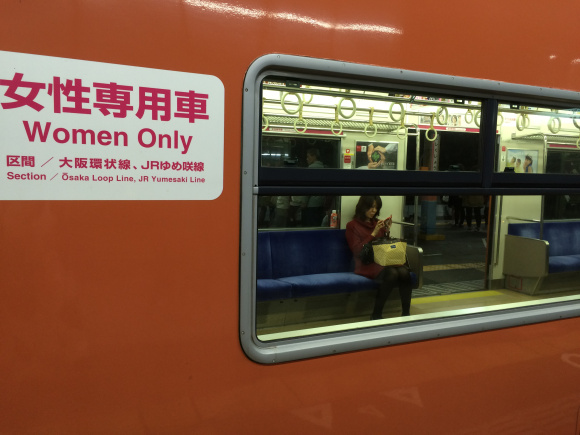
Japan seems to be the land of fetishes. Groping, especially on trains, has become such a problem that women-only carriages are now offered during peak commuting hours. Panties are a big fetish too, as well as stealing them which is perhaps one of the reasons in Japan you always hang up your underwear to dry inside away from prying eyes. Sometimes the panties don’t even make it to the clothes line. Once on a sailing trip, I went to a coin-operated laundry near the port in Miyazaki, Kyushu. I went to get a bite to eat while my clothes were washing and by the time I came back to retrieve them, my panties were already gone, snatched from the machine.
Some people blame Japan’s anime and manga industries for highlighting and spreading a plethora of the more wretched fetishes, from urinating while still in your clothes to the more futuristic menstruating boys. Of course, fetishes in themselves are not necessarily criminal, but unfortunately, some people just don’t know where to draw the line.
Of course, Japan has many more fetishes, some of which you probably know much more about than we do. If you feel you absolutely must, you can inform us in the comments section.
6. Bonus crime–Dogs driving
▼ These police station mascots indicate another crime peculiar to Japan: dogs driving. Keep your wits about you, folks!

RocketNews24
 People in Japan can now earn 10,000-yen bounties for scamming scammers
 Pensioner pretends to be deceived by telephone fraud, helps catch criminals
 Ibaraki Police warn against fake warnings by the police
 Foreign-born convenience store manager in Japan saves elderly customer from being scammed
 Foreigner convenience store clerk in Japan saves elderly woman from scammers with quick thinking
 You can assemble a well-balanced team of Pokémon, them eat them, thanks to Japanese cake chain
 Japan reportedly adding Japanese language skill requirement to most common foreigner work visa
 Japan named most sleep-deprived country for fourth year in a row, according to survey
 Starbucks Japan closing only Shinkansen platform branch for popularity-triggered renovations
 A Kyoto factory vending machine sells gourmet mystery meals at bargain prices
 Daiso opens massive new 25,392-square foot Tokyo flagship store with its two sub-brands included
 Two food hacks take Japan’s convenience store fried chicken to amazing new sandwich heights
 Can a downtown Tokyo super sento bathhouse beat a hotel for a one-night stay?
 Pokémon and Ikea Japan cross over into each other’s worlds with collaboration events
 Tokyo teahouse serves up a sakura matcha dessert you won’t find anywhere else
 Tokyo’s best museum for foreign travelers finally reopens after being closed for four years
 Pokémon lacquerware series expands for Year of the Horse with new handcrafted design[Video]
 Tokyo subway and almost all Tokyo train lines now accepting credit card tap payments
 Totoro Fund line of beautiful artwork and apparel lets you help the real-world Totoro Forest
 Fading Tokyo – Searching for signs of the Showa era as local neighborhoods evolve[Photos]
 Famous Tokyo cherry blossom spot installs view-blocking screens to fight overcrowding[Video]
 Tokyo turns its phone booths into free Wi-Fi hotspots, and here’s how to use them
 Studio Ghibli adds new My Neighbour Totoro 2026 Corn Gift to its anime store for Mother’s Day
 Japan now has a special desk for people who work at home with a pet cat[Photos]
 Uniqlo announces new T-shirts for One Piece, Naruto and more for manga publisher’s 100th birthday
 Train station platform ramen store closes its doors on half a century of history in Tokyo
 Starbucks Japan releases new My Fruit³ Frappuccino at only 34 stores around the country
 Studio Ghibli releases Catbus pullback keychain that runs like the anime character
 Krispy Kreme releases Super Mario doughnuts in Japan for a limited time
 Japanese onsen egg maker from 100-yen store Daiso needs to be on your shopping list
 Nine great places to see spring flowers in Japan, as chosen by travelers (with almost no sakura)
 Survey asks foreign tourists what bothered them in Japan, more than half gave same answer
 Japan’s human washing machines will go on sale to general public, demos to be held in Tokyo
 Starbucks Japan releases new drinkware and goods for Valentine’s Day
 We deeply regret going into this tunnel on our walk in the mountains of Japan
 Studio Ghibli releases Kodama forest spirits from Princess Mononoke to light up your home
 Starbucks Japan releases new sakura goods and drinkware for cherry blossom season 2026
 Japan’s newest Shinkansen has no seats…or passengers [Video]
 Major Japanese hotel chain says reservations via overseas booking sites may not be valid
 Put sesame oil in your coffee? Japanese maker says it’s the best way to start your day【Taste test】
 No more using real katana for tourism activities, Japan’s National Police Agency says
 Is it a crime to ditch a bad date and leave them with the bill? Japanese man finds out
 Otaku woman in Japan finds herself target of strange fake shoplifting scam, netizens urge caution
 Japanese woman reported to police for “not looking right in a suit,” turns out she’s a crook
 Fake police phone scam also highlights dumb stereotype about how foreigners speak Japanese[Video]
 Japan considering restricting senior citizens’ access to ATMs
 Japan’s new ATMs automatically play anti-fraud videos to people talking on mobile phones【Video】
 Be your own superhero with this comical crime-fighting net launcher from Japan【Video】
 10 things Japan gets awesomely right