
For roughly the past two decades, I’ve woken up every morning and asked myself the question “How can I use more Japanese vocabulary today?” That desire was the major reason I decided to study abroad in college, plus move back to Japan after graduation, and I’ve actually reached the point where I’ve got a pretty sizeable stockpile of Japanese words I wish I could import into my native language.
And yet, often when I hear someone use the Japanese honorific “-san” when speaking English, it feels awkward and superfluous to me. But it turns out there’re actually a few compelling reasons behind English-speakers peppering their speech with “-san,” as it solves a couple of linguistic limitations of the English language.
So what are the pros and cons of importing the word into English? Let’s take a look.
First off, let’s quickly explain what exactly -san is. It’s a suffix meant to show respect, so it often works like “Mr.” or “Ms.” would in English. But –san can be tacked onto a given name too, as a way of showing courtesy when speaking to or about someone.
Not only is –san incredibly versatile, Japanese also has a number of other suffixes, such as –chan, -kun, and –sama, that can show varying degrees of respect or affection. As a matter of fact, there are so many honorific suffixes to choose from when speaking Japanese that not using one is a somewhat bold statement that you and your conversational counterpart are on such equal footing that there’s no need to show any sort of deference to one another, implying either an especially close friendship or, conversely, a relationship that’s so devoid of emotional commitment that there’s no need to make any effort to be particularly polite with one another.
FORZA KEISUKE SAN!“@acmilan: Keisuke Honda warming up before #RomaMilan! pic.twitter.com/cy7n8O2BmD”
— sergio вишневый цвет (@iamsergiograce) April 25, 2014
It’s this unilateral declaration of either extreme familiarity or complete indifference that makes dropping the honorifics entirely (called yobisute in Japanese) something that doesn’t happen all that commonly in Japanese society. As a result, English-speakers who have lived in Japan, or who have studied the language or culture, sometimes feel it would be too forward to use a Japanese person’s name without adding a -san to it, even if speaking English.
▼ For example, Xan here obviously respects Haruki Murakami, but since they’re not buddies who hang out together all the time, gives him a –san in this birthday shout-out.
https://twitter.com/xandaekookiss/status/554953187619524608The advantages of –san for English-speakers extend beyond a bit of participatory cultural awareness. Especially in business situations, it’s common for Japanese people to refer to themselves and their colleagues by their family name. When communicating with or about someone you haven’t met face-to-face, though, just a last name won’t tell you whether that person is a man or a woman, which leaves you having to take a guess whether or not to address your correspondence to Mr. Suzuki or Ms. Suzuki. Even having the person’s given name won’t help if you’re not familiar with which Japanese names are male and which are female.
▼ And you’re completely out of luck if you’re dealing with one of the language’s unisex names.
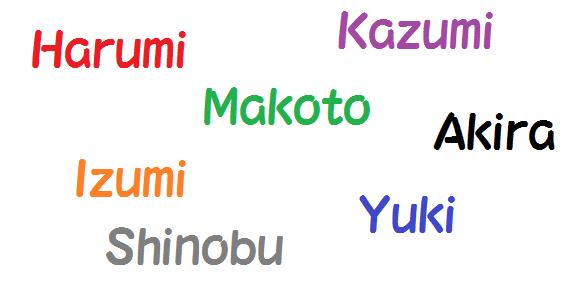
But –san is a catch-all that can be used for both sexes. It also works independently of whether the person is single or married, meaning –san saves you the risk of having to choose between Ms., Mrs., or Miss. This gender-neutral nature is especially handy in the era of social media, where many people have a network of friends and acquaintances of whose sex they’re unsure of and even unconcerned about.
Okay, so we’ve seen there are a couple of legitimate arguments to be made for using –san in English speech. But before you go tossing the word about, here are some counterpoints to consider.
First, although this sort of goes without saying, it’s important to bear in mind that –san is a uniquely Japanese speech pattern. Insisting on adding it to a Japanese person’s name when speaking English can give the impression that you’re trying to dumb down the language, based on the assumption that the person you’re speaking to is less than proficient in English. In the above birthday wish to “Murakami-san,” for example, the –san probably isn’t really necessary, seeing as how the famed author is also an experienced English-to-Japanese translator who’s produced Japanese versions of The Great Gatsby, Catcher in the Rye, and The Giving Tree.
There’s also the fact that while –san is a general-purpose “polite” suffix, there are times when the word would feel awkwardly out-of-place even when speaking Japanese. While some Japanese offices with a more relaxed atmosphere allow employees to call their corporate superiors by their last name plus –san, standard Japanese business etiquette, within a company, is to use the person’s last name followed by their title. So, for example, if you were talking to Taro Yamada, the section chief (bucho in Japanese), it’d be more appropriate to call him Yamada-bucho than Yamada-san.
On the other end of the spectrum, in certain social contexts –san can sound unnaturally stiff, especially among men who are friends and met outside the rigid social structure of work. I have a number of friends who I met at college in Tokyo, and among the ones I’m particularly close to it would be extremely awkward if we used any honorifics when talking with each other. I’d go so far as to say that if I were to suddenly stick –san at the end of their names they’d think I was about to tell them something incredibly solemn and important.
▼ I couldn’t really follow “Kota-san” with something as mundane as “We’re out of beer.”

Finally, there’s the tricky question of whether or not everyone in the English conversation warrants a –san. Because of the origin of the word, it’s common for those who use it in English to apply it only to the Japanese people in a conversation. After all, it really does feel awkward to say “I ate dinner with Julie-san and Anthony-san,” even if you’re talking to a native Japanese-speaker.
But on the other hand, dropping the –san only for non-Japanese people can leave the sentence feeling unbalanced and seemingly create a gap in the speaker’s expressed attitude towards the people mentioned. If I say “I ate dinner with Taro-san and Bob,” it sort of implies that there’s a fundamental difference in my relationship between the two, perhaps that I feel more respectful towards Taro or more friendly towards Bob.
So in the end, what’s the best way to handle the –san situation? Well, since language is about creating a meeting of the minds between the speaker and the listener, it’s probably best handled on a case-by-case basis. If nothing else, odds are anyone who’s so traditionally and adamantly Japanese in mindset as to insist on being addressed in English with –san, as opposed to Mr./Ms. and his or her last name, isn’t internationalized enough to carry on a conversation in English anyway, making it a moot point. And in general, Japanese people are happy to see those from other countries show an interest in their customs, so it’s unlikely a Japanese national is going to be offended from a single use of –san in English.
But should you introduce yourself with “Hello Kaori-san. My name is Angie,” and you get the response, “Oh, hi Angie!” then maybe it’d be best to drop the –san when speaking English together from then on.
Reference: Naver Matome
Images ©RocketNews24