
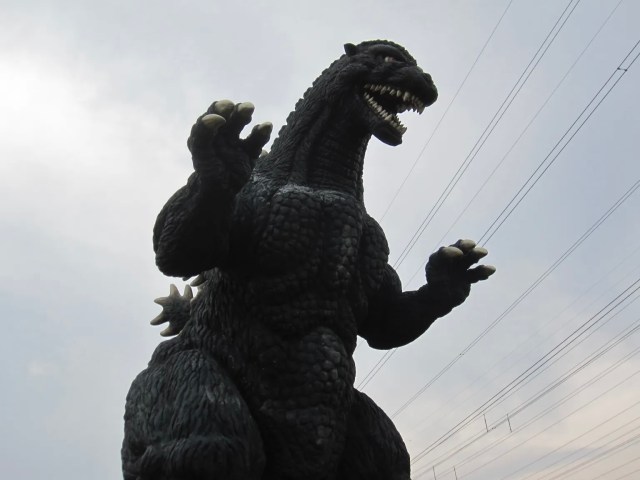
There are tricky legal hurdles when fighting kaiju.
Japan is going through a bit of uncharacteristic political turmoil recently. After the previous prime minister Fumio Kishida – affectionately known as “Tax-Hiking Glasses-Face” – stepped down, a lot of inner-party wheeling and dealing resulted in Shigeru Ishiba becoming PM on 1 October. However, after calling a snap election, Ishiba and his party got an electoral spanking and lost control of parliament, which is now negotiating to determine the next PM.
▼ And it seems to me you lived your life like a candle in the wind…
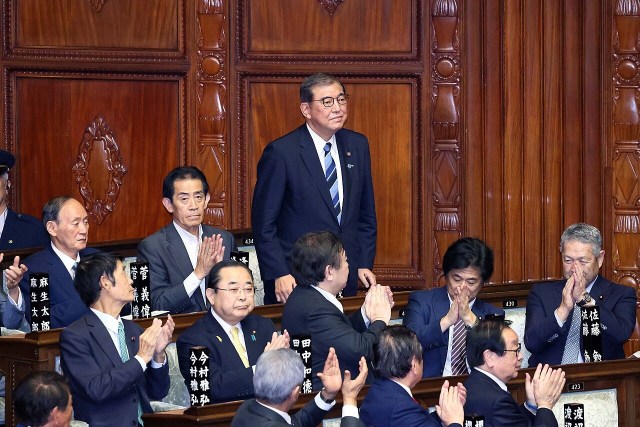 Image: Wikipedia/PMO
So, with Ishiba’s days numbered this might be a good time to look back on the time he questioned the Japanese government’s response to Godzilla in the 2016 film Shin Godzilla. In August 2016, Ishiba, who was then a member of parliament and frequent cabinet member, posted on his blog that he saw the film while on holiday and wrote: “I couldn’t understand why the Self-Defense Forces (SDF) were deployed to defend against Godzilla’s attack.” He adds that Godzilla is more akin to a natural disaster than an armed invasion by a foreign power, and thus the SDF could not be legally deployed in a combat capacity to deal with it.
At first, what Ishiba said might sound like the rambling of a lunatic because anyone’s gut instinct would tell them to send the big guns against a giant lizard, but he’s technically not wrong. He clarifies in a subsequent blog post that it’s a matter of being legally bound by constitutional law when having to deal with Godzilla.
To understand this we first need to understand the concept of buryoku koshi or “use of force” which is very similar to the English military concept of use of force, but in Japan relies on the strict fulfillment of all three conditions:
1) A military attack occurred on our country, or a foreign country with which we have a close relationship, that threatens the existence of our country and poses a clear danger to the lives, liberty, and right to pursue happiness of the citizens.
2) There are no other appropriate means to eliminate the threat, ensure the existence of our country, and protect the citizens.
3) Use of force shall be limited to the minimum necessary.
The key wording in this passage is “military attack” (buryoku kogeki), which would imply a planned, strategic use of weapons by a nation or nation-like organization. So, according to these conditions, the Japanese government is well within its rights to send in the SDF in cases where Planet X controls Godzilla, Rodan, and King Ghidorah with their magnetic waves, because that constitutes a clear military invasion with the monsters being used as weapons.
▼ One trick to knowing whether a military assault can be legally ordered is the presence of UFOs hovering nearby.
But when Godzilla acts on its own accord as the bad guy, the situation is murkier. It’s clearly not an army, which is why Ishiba made his initial comment, but I would argue Godzilla has all the characteristics of a military force. It clearly has the power of an entire military organization, and it operates like a military in that it’s largely focused on crippling infrastructure in a belligerent nature. This is the crucial difference between Godzilla and a natural disaster which has no implicit intent to destroy or between it and a wild animal which behaves on primal instincts and self-preservation, again with no implicit intent to destroy.
▼ Exhibit A: Godzilla striking an oil refinery and numerous electrical transmission lines, not to mention using Kyoto Tower for target practice with its atomic breath for seemingly no other reason than to terrorize and destabilize.
Regardless of the truth, most politicians would probably think along the lines of Ishiba and I would just waste valuable time showing them YouTube clips to convince them otherwise as Godzilla continues to cripple our supply chain.
Shin Godzilla accurately brings up this dilemma but in the film, the prime minister is pressured to act extrajudicially in ordering a military attack on Godzilla. In doing so he would have left himself vulnerable to legal repercussions had he and most of his cabinet not been sniped by Godzilla’s back lasers while it was razing Japan’s center of political and economic power: something that sounds totally like the actions of a wild animal and nothing at all like a military attack…
The more expedient and legal path that Ishiba suggests is authorizing a saigai haken or “disaster dispatch” which is what happens when the SDF is deployed to assist in disaster relief in times of typhoons, flooding, earthquakes, and so on. Since we all can agree a Godzilla attack is a disaster, that should have no problem getting approved.
However, the issue here is how they can fight Godzilla. Disaster dispatches generally don’t involve the use of missiles or tanks, but there is another legal concept known as buki no shiyo or “use of weapons.” These are the rules that the SDF can follow to use weapons in a non-combat situation such as guarding facilities or acting in a police-like capacity such as protecting human life from a violent attacker.
The rules on use of weapons are the same as the police must follow in that there must be an imminent and otherwise unavoidable threat and the level of force must be proportional to the threat. When the threat is Godzilla, that would seem to give the SDF and police the entire arsenal of Japan at their disposal.
▼ Exhibit B: Godzilla throws a bus right in the middle of the tracks in front of an oncoming train before severing a main transport artery of Tokyo. Your honor, these are not the actions of a wild animal.
Ishiba wonders about this too, however, because the use-of-weapons concept applies to using weapons against humans. He equated an encounter between the SDF and Godzilla to be more like a “pest control” operation in which the heavy artillery isn’t even being used as weapons but “tools” to deal with the problem. This would bring the issue into uncharted territory since there are no “use of tools” laws on the books.
▼ Exhibit C: Oh, well if it isn’t Godzilla, out denying its own sense of self-preservation by walking directly into enemy fire in order to disable a key communications tower in Sapporo. That kooky wild animal thinks it’s people.
Ishiba ended his musings on the topic there, but that was back in 2016. Perhaps the Japanese government has taken measures to prepare for such an unprecedented threat to the nation.
To find out, a blogger going by the name Suzuki filed for disclosure of documents regarding military preparedness for a Godzilla attack. The surprisingly accommodating clerk provided Suzuki with a genuine, official military legal officer’s report from 2016 titled “Legal Considerations for Dealing with Godzilla” with the subtitular questions of “Does it meet the requirements to issue an SDF mobilization order?” and “Is attacking Godzilla with weapons ‘use of force’ or ‘use of weapons?'”
The report came to the same conclusions I outlined above, that Godzilla is considered a wild animal unless unleashed on us by a hostile nation and the SDF would have to instead be sent out as a disaster dispatch with their arsenal instead considered “tools” for the purpose of disaster prevention. As a similar example legality-wise, the report cited an incident in which the SDF used weapons as “tools” to scuttle a tanker that was set adrift and posed a threat of collision to other ships or shoreline communities.
In conclusion, setting the SDF against Godzilla is legally problematic but possible through an indirect process. While I’ll die on the hill that a Godzilla attack is militaristic in nature and he does not act like a wild animal, unless you count that crappy 1992 version, it’s at least good to know that the government has considered how such a situation could play out. Although it might seem ridiculous, it is a good exercise to test the legal mechanisms in place and possibly spot issues that might affect more realistic scenarios in the future.
Source: Shigeru Ishiba Official Blog 1, 2, Hatena Blog / Suzuki Online, Cabinet Secretariat
Featured image: Photos © SoraNews24
● Want to hear about SoraNews24’s latest articles as soon as they’re published? Follow us on Facebook and Twitter!