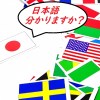
Recently, we talked about how Japanese, while a tough language to learn, isn’t quite as difficult as some horror stories make it out to be. Still, if English is your native language, certain Japanese grammar rules, like saying “wa” and “o” to mark the subject and object of your sentences, can seem like a major hassle.
With practice, though, these things start to become automatic. Even better, the Japanese language is filled with incredibly handy phrases that we’d love to import into English.
1. Doumo – Hello, thanks, and hello and thanks
The extremely convenient domo manages to do the job of both “hello” and “thank you,” as it’s the first component of both doumo konnichiwa (good afternoon) and domo arigato gozaimasu (thank you very much).
Aside from being shorter than the two phrases it can replace (which are both a bit of a mouthful even by Japanese standards), doumo can also be used to combine the two sentiments. Did someone invite you to their house? A warm “Domo!” with a smile as they open the front door works as both a friendly greeting and a heartfelt thanks for opening their home to you.
2. Ozappa – Working in broad strokes
Ozappa is often used to describe a type of personality, and while it directly translates to “rough” or “broad,” it doesn’t mean the person in question is abrasive, nor does it indicate someone who’s broad-minded in the sense of being open to new ideas. Rather, someone who’s ozappa doesn’t really sweat the details, whether for better or worse. Your friend who planned the barbeque, said he’d buy the beer and stick it in the cooler, but didn’t think to buy ice? He’s ozappa, but so is your other pal who doesn’t get worked up when you hand him a lukewarm brew.
3. Bimyou – Subtly…not right
Although it literally means “subtle,” bimyou usually implies that something is a little off, and that maybe it’d be better to just do without it altogether. The dash of red wine that pork cutlet sauce really doesn’t need, the clunky metaphors in the love letter your wrote to your junior high crush, and the tasteful nose piercing you picked out for your job interview could all be described as bimyou.
4. Irusu – The “the lights are on but nobody’s home” fake-out
This is one many foreign residents in Japan do without even realizing there’s a term for it. Imagine it’s a nice Sunday afternoon. You’re lounging at home, enjoying your day off and browsing the Internet, when all of a sudden, there’s a knock at the door. Staring out the peephole, you spot someone dressed in clothing that could only be described as “missionary casual.”
Since you’ve already discovered your own personal guiding light, you slink quietly back from the door, fooling the solicitor into thinking you’re out so that he goes and bothers your neighbors instead. Congratulations, you just pulled off a successful irusu (pretending to be out when someone comes by) operation.
5. Chu to hampa – Not quite one thing, but not quite the other, either
Say you’re waiting to meet up with your friend, and he calls to say he’ll be five minutes late. No big deal, right? You can hold out that long.
Likewise, if he’s going to be two hours late, this doesn’t put you in such a big bind, since you can go do something else while you’re waiting. You could get something to eat, do some shopping, or grab a couple cups of coffee (or glasses of bourbon, neat, if it’s late enough in the day and/or you’re an alcoholic).
But what if your friend is going to be 20 minutes late? Now that’s a pain, since it’s way too long to sit around twiddling your thumbs, but not enough time to actually do anything with.
This kind of situation is what the Japanese call chu to hampa, halfway and some fragments. It’s used whenever you’ve got something that would be fine if it was just a few steps in either direction on whichever scale you’re measuring it with, but like some Opposite Day-version of Goldilocks and the Three Bears, it’s just wrong. The car that’s too big and bulky to be fun to drive but also doesn’t have enough trunk space to be practical? The girl you have too much chemistry with to be “just friends,” but don’t get along with well enough to want to see more than once a month? Chu to hampa, chu to hampa.
6. Majime – Earnestness for the 21st Century
Majime is usually listed in textbooks as “serious,” and you could translate it that way. However, saying a person is majime doesn’t mean they’re somber, since even people with professional-caliber senses of humor can be majime.
Majime is actually a little closer to “earnest,” but it doesn’t have the same nuance of ineffectualness associated with “earnest efforts,” nor the Victorian ring of calling someone “an earnest young man.” Majime indicates the personality possessed by people who are reliable, responsible, and can simply get things done without causing drama or problems for others. Not surprisingly, this is seen as an extremely desirable mindset in industrious Japan, and calling someone majime neither labels them as uptight or old-fashioned, but rather respectable and admirable.
7. Otsukaresama desu – You’re probably tired, and I think that’s great
Coming from tsukareru (to be tired), otsukaresama desu is one of the most useful phrases in Japanese business. Although it literally means, “You’re tired,” it’s not used to point out someone’s lack of pep, but to thank them for exhausting their energies to do something you, or the team you’re part of, benefitted from.
While the meaning is akin to “I appreciate your hard work,” otsukaresama desu has a couple distinct advantages over its English equivalent. For starters, it doesn’t sound nearly as stiff and impersonal. It can also be used when speaking up or down the chain of command. Managers can say it to their subordinates, and you can even say the phrase to your boss if he’s heading out of the office before you.
Otsukaresama desu is even a common greeting is business correspondence, especially among employees of the same company. Even if you don’t work side-by-side with him, it’s polite to give Tanaka in accounting the benefit of the doubt and assume he’s been busting his butt at work just like you have. So when you call him up to ask for the quarterly revenue figures, it’s common courtesy to start off your request with otsukaresama desu.
8. Yoroshiku onegai shimasu – I hope things go well, even if I’m not exactly sure what those things are
Fittingly, we finish with a phrase that’s often used to express an abstract yet genuine hope for good things to come, yoroshiku onegai shimasu. While onegai shimasu is pretty much just a polite way of saying “please,” yoroshiku means “well” or “favorably,” so the whole thing together is essentially a way of making the request, “Favorably, please.”
“Umm…favorably what?” is the reaction most English speakers initially have to this. Sure, Japanese can be a vague language at times, but this is a little much, isn’t it? If someone just says to you, “Favorably please,” what exactly are you supposed to do?
And therein lies the beauty of yoroshiku onegai shimasu: The exact thing you do doesn’t matter. As a matter of fact, the person who says yoroshiku onegai shimasu likely doesn’t have any concrete idea either. All they know is that somehow the two of you are connected, whether socially or professionally, and they hope that the relationship will be a mutually happy one.
Did your boss just hand you an important project? He’ll probably give you a yoroshiku onegai shimasu, or at least its informal variant, yoroshiku, before you get started on it, since you may run into some problems that take extra time and effort to resolve. Hopping in a friend’s car for a trip to the beach? Give him a yoroshiku, since he’ll be driving safely, even if he’d rather be sitting in the back joking and fooling around with everyone else. Meeting your significant other’s parents for the first time? You’d better believe that’s a yoroshiku onegai shimasu, since if things progress to marriage and babies, you’ve just linked two families who are going to be connected for generations to come.
And of course, this phrase gets used all the time with businesses and organizations who hope their patrons keep coming back for years to come. So thanks for reading, and to all of you, yoroshiku onegai shimasu!