
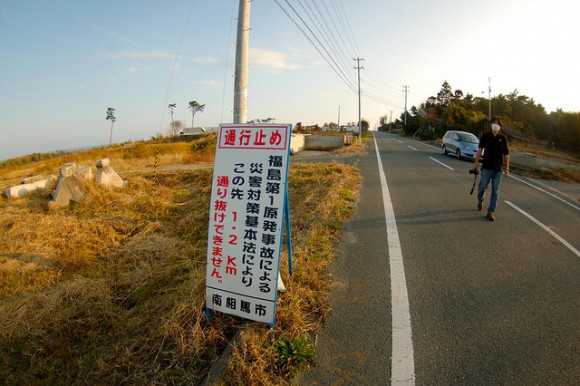
Following the events of the 2011 Tohoku earthquake and tsunami and the subsequent meltdowns at the Fukushima Daiichi Nuclear Power Plant complex, radiologists in Japan have been closely observing the area for potential changes. A new report by the National Institute of Radiological Sciences now suggests that the fir trees in Fukushima may be exhibiting strange growth patterns, with the radiation from the disaster being named as a possible factor.
The report, published on the organisation’s website on August 28, states that when comparing fir trees from within the affected zone to those from areas with lower radioactivity, the fir trees in the affected area were increasingly found to be stunted and exhibiting signs of morphological change, particularly bifurcation, the splitting of a body into two parts, i.e. ‘branching’.
Each year of a healthy fir tree’s growth sees it growing directly upward while also putting out two horizontal branches. Scientists have noted, however, that some of the trees in the affected areas are only branching off into two separate directions at the tip, and exhibiting lack of upward growth.
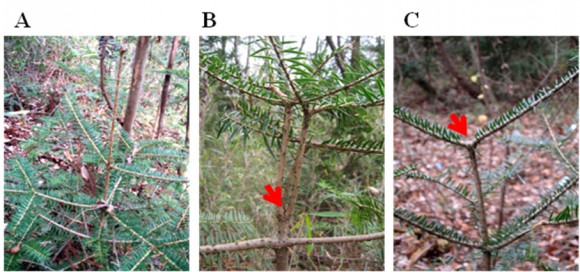
The changes can be identified in the below images, which were included with the report. Image A shows a normal example of growth. Note the vertical central branch. Photo B shows a trunk which has entirely split into two, and photo C shows horizontal growth only, with a distinct lack of vertical growth. The red arrows indicate where bifurcation has occurred. You can see in image C how the central, vertical branch of the tree which should be growing upward is missing entirely.
The investigation was conducted in January of this year, with trees examined in (S1) Okuma, Fukushima (3.5 kilometres from the nuclear plant), and two locations (S2, S3) in Namie, Fukushima (8.5 and 15 kilometres from the plant). Radiation levels in Okuma were recorded at 33.9 microsieverts, and in Namie, the levels were 19.6 and 6.85 microsieverts, respectively. These trees were compared against trees in the north of neighbouring Ibaraki Prefecture (S4) from an area with a microsievert reading of 0.13.
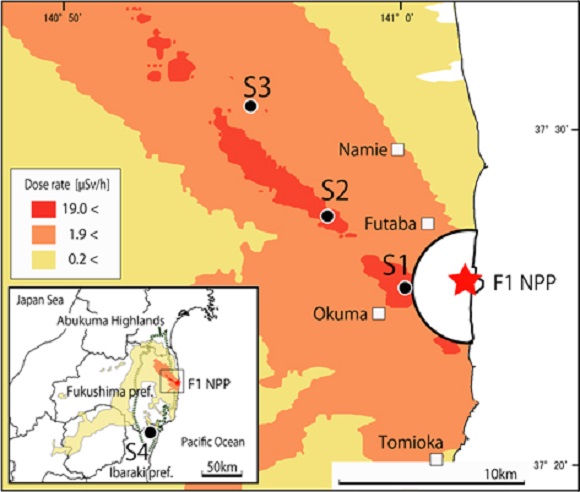
Between 100 and 200 trees in each location were examined for changes, with the effect seen more often in the areas with higher levels of radiation. 90% of the trees examined in Okuma exhibited some degree of morphological change, a number which fell to 40% and 30% in Namie, and to less than 10% in northern Ibaraki Prefecture.
The correlation between the frequency of the morphological change and the proximity to the Fukushima Daiichi site/level of radiation recorded suggests that it is likely—but as yet not confirmed—that the changes are connected to the increase in background radiation.
However, the report notes that this particular morphological change has been identified in other areas and can be attributed to a range of other factors including environmental changes and as a result of pest damage. The report states that rather than attributing this change directly to the nuclear disaster, researchers are instead presenting evidence that proves that this change is seen more often when radiation is a contributing factor.
Source: Report on Morphological Changes to Fir Trees in Areas with High Radiation, National Institute of Radiological Sciences via Asahi
Main Image: Flickr/raneko
Other Images: National Institute of Radiological Sciences