
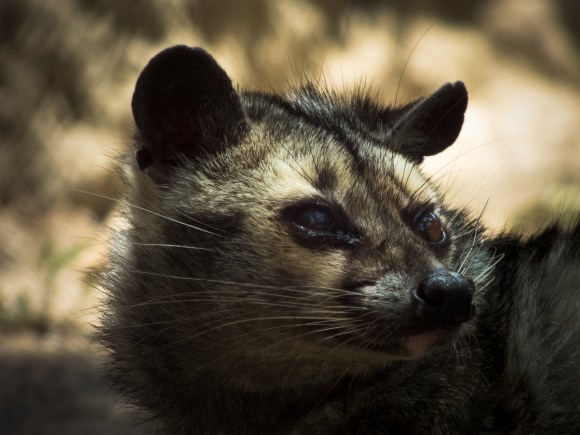
Human beings are endlessly inventive when it comes to food. From curried cicadas to snake soup to lemon and mint Pepsi, we never stop inventing new ways to follow the evolutionary imperative to stuff our faces with calories. And while I’m generally a cultural relativist when it comes to “weird” foods, sometimes there is a concept so out-there, you can’t help but say it’s bizarre.
Like kopi luwak, coffee made from beans that have been through the poop shoot of a tree cat. We’ve all heard of it, and it sounds revolting, but have any of us ever actually tried it? Why, yes, actually…
In truth, we’ve talked briefly about kopi luwak before. It’s gained global notoriety not just for the odd means of production, but also for the eye-popping prices; a steaming cup of kopi luwak can cost you upwards of US$100 at posh shops in Hong Kong and New York, earning it the descriptive nickname of “the world’s most expensive coffee.”
While visiting Indonesia recently, we were able to locate a cup at a much more reasonable 50,000 rupiah (about US$5) by going to the source: a coffee and tea plantation. At that price point, how could we not do a taste test for you, Rocketeers?
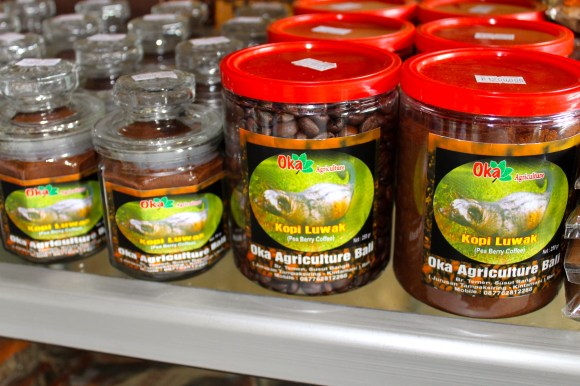
According to the staff at Oka Agriculture, civet coffee originated during the time of Dutch colonialism. Workers at the coffee plantations were forbidden from picking beans for themselves, so they would glean ones that had fallen to the ground for use at home, including the ones lodged in civet dung. They discovered that the poop coffee actually tasted different and, in their minds, better. Before long, the Dutch were drinking it as well.
▼Poop beans drying in the sun. Don’t worry, they wash them first.
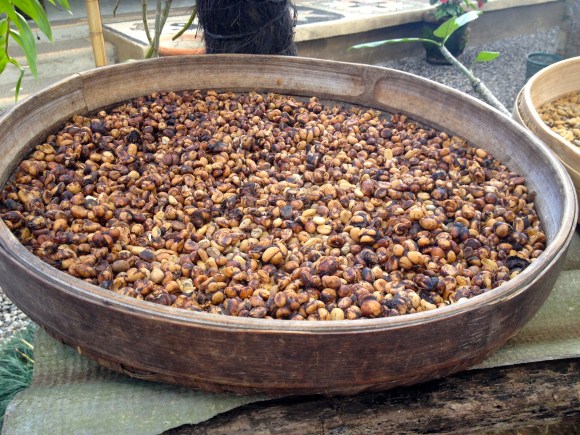
Other than the step where they hang out inside a civet for a while, the beans are roasted, ground and brewed just like regular coffee.
The flavor of kopi luwak is said to be milder and rounder than typical coffee, but with an increased complexity as well. Of course, that is usually said by sales staff and insufferable coffee snobs. However, there is some evidence that the chemical makeup of the coffee is altered by its journey through the palm civet’s acidic digestive tract.
Anyway, we’ll be the judge of that.
▼One cup of poop coffee coming right up!
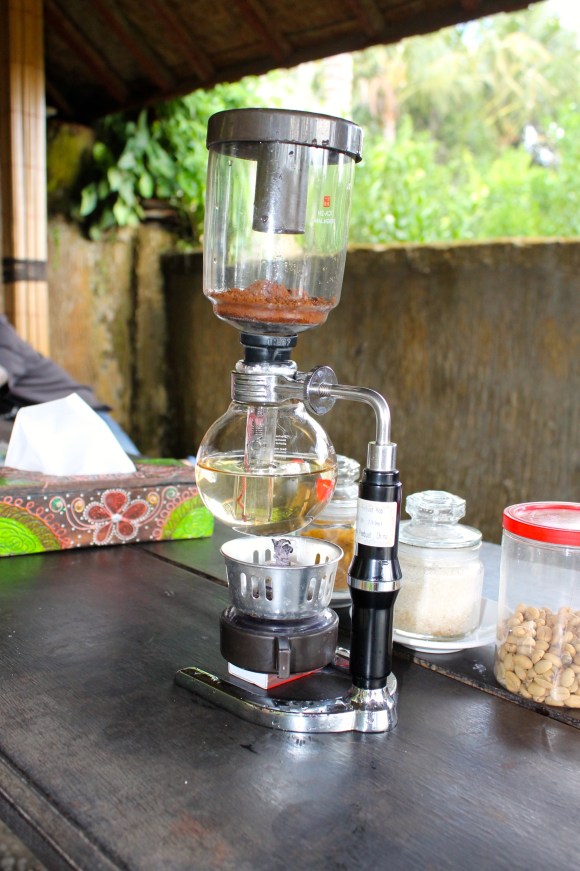
▼The prospect of caffeine was clearly making me too excited to hold the camera steady. 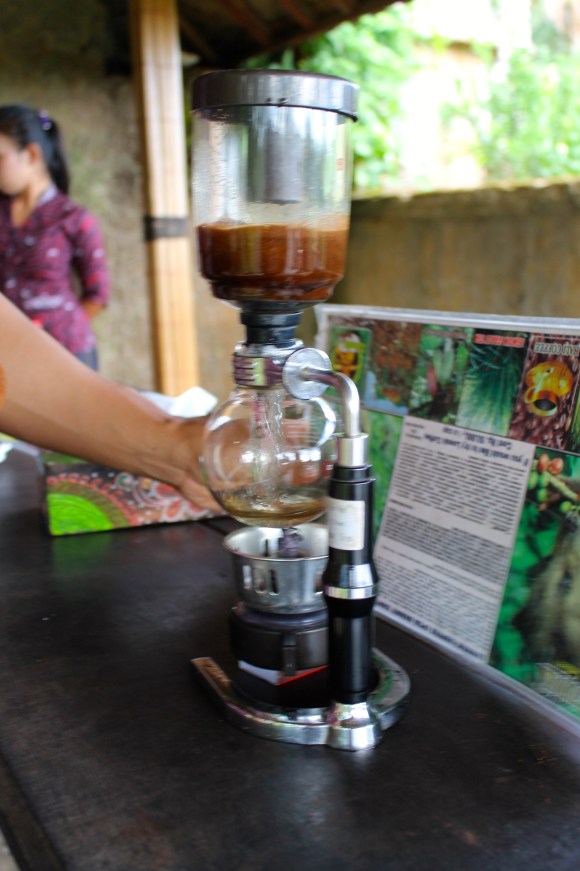
Normally, I take my coffee with cream and sugar, but in the interest of getting a clean taste test, I took this cup black.
▼Direct from the civet’s anus to your mouth! 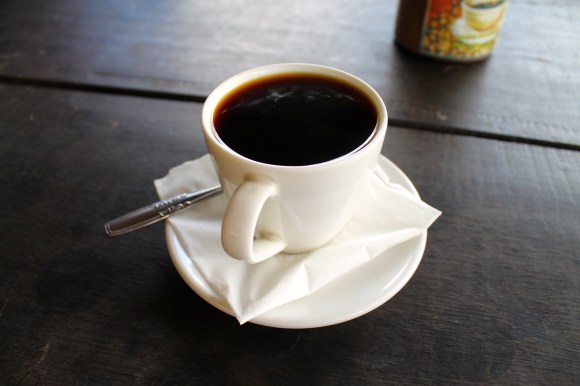
So, how does it taste? Well, mostly it tastes like coffee. But black coffee usually has an almost metallic bitterness to me. This one didn’t have that at all. It did have a nice depth, with a nutty finish that enjoyed, at least until I started thinking of it in terms of poop.
Overall, I’d say it was a very fine cup of coffee, though not one I would pay $100 for. Frankly, even $5 was stretching it. I was happy enough thinking of it as an experiential surcharge.
It’s also worth noting that the astronomical prices have led to some unscrupulous business practices. There is apparently a lot of fake kopi luwak out there, and the pressure to increase yield has many producers in Indonesia and abroad keeping civets in battery cages and feeding them unhealthy diets, instead of the traditional method of just letting wild civets do their thing. I unfortunately discovered this after trying the coffee, but if you would like to give it a shot, do your due diligence in sourcing the beans.
For my money, there is less hassle and more value (and sugar!) in a standard cup of coffee at one of the bazillion coffee shops you will come across in Indonesia. It’s home to coffee-producing powerhouses Java and Sumatra, after all. And if you want to try something a little different, ginger coffee is a tasty and commonly available option with no feces involved, or so they tell me.
Civet image: ßlåçk Pærl/Wikicommons
Content and other images © RocketNews24
 Win a large intestine scarf from one of Japan’s leading enema manufacturers
 Top Asian delicacies that many consider kind of gross
 We brave the should-be-abomination of raw egg and coffee, is it a taste sensation? 【Taste Test】
 Japan actually grows coffee, but how does it taste?【Taste test】
 The Osaka taste sensation that no one in Osaka has ever heard of: Coffee & Raw Egg 【Taste Test】
 Uniqlo announces new T-shirts for One Piece, Naruto and more for manga publisher’s 100th birthday
 Japan now has a special desk for people who work at home with a pet cat[Photos]
 Why is Yoshinoya called Yoshinoya?
 Picturesque Tokyo park plays host to millions of flowers and soap bubbles this spring
 This standing sushi bar inside a Tokyo train station blew us away with its speedy deliciousness
 50-year-old instant noodle recipe is back from the past in Japan for a limited time[Taste test]
 10 vegetarian foods you can order at almost any Japanese restaurant
 Famous Tokyo cherry blossom spot installs view-blocking screens to fight overcrowding[Video]
 Mr. Sato tried an unbranded lunchbox meal courtesy of Muji, found it to be just plain delicious
 Japan now sells…sake made with moth poop?!?
 Krispy Kreme releases Super Mario doughnuts in Japan for a limited time
 7-Eleven Japan releases a crazy new viral sandwich: Chocolate Sprinkles and Whipped Cream
 Japan now has a “for foreign tourists only” Mt. Fuji sightseeing train[Video]
 Totoro and Calcifer become little light-up lanterns for Ghibli-style excursions or at-home decor
 Studio Ghibli releases the My Neighbour Totoro tea caddy, with a magical self-closing lid
 Create a tiny Ghibli anime world on your bookshelf with new miniature papercraft art kits
 Starbucks Japan unveils new sakura cherry blossom collection for hanami season 2026
 Train station platform ramen store closes its doors on half a century of history in Tokyo
 Starbucks Japan releases new My Fruit³ Frappuccino at only 34 stores around the country
 Studio Ghibli releases Catbus pullback keychain that runs like the anime character
 Japanese onsen egg maker from 100-yen store Daiso needs to be on your shopping list
 Nine great places to see spring flowers in Japan, as chosen by travelers (with almost no sakura)
 Survey asks foreign tourists what bothered them in Japan, more than half gave same answer
 Japan’s human washing machines will go on sale to general public, demos to be held in Tokyo
 Starbucks Japan releases new drinkware and goods for Valentine’s Day
 We deeply regret going into this tunnel on our walk in the mountains of Japan
 Studio Ghibli releases Kodama forest spirits from Princess Mononoke to light up your home
 Starbucks Japan releases new sakura goods and drinkware for cherry blossom season 2026
 Japan’s newest Shinkansen has no seats…or passengers [Video]
 Major Japanese hotel chain says reservations via overseas booking sites may not be valid
 Put sesame oil in your coffee? Japanese maker says it’s the best way to start your day【Taste test】
 No more using real katana for tourism activities, Japan’s National Police Agency says
 We tried six Japanese burger chains’ coffee to test the state of fast food coffee in Japan[Taste test]
 Put sesame oil in your coffee? Japanese maker says it’s the best way to start your day【Taste test】
 Transparent coffee! We taste-test Asahi’s Clear Latte, marvel at Japanese drinks wizardry
 Coffee-infused rice for rice balls and curry? Taste-testing a recipe from Japan’s coffee experts
 How does 27-year-old coffee taste? We find out with another fearless taste test 【Video】
 Meg tries out Starbucks Japan’s newest treat: the White Brew Coffee and Macadamia Frappuccino
 Starbucks vs. Tully’s — Is there such a big difference between Japan’s coffee giants?【Taste test】
 In Japan, you can now get Coca-Cola pre-mixed with coffee【Taste test】
 Starbucks’ retro Japanese kissaten menu debuts deliciously mature coffee gelatin cake【Taste test】
 We tried Japan’s first nitro cold-brew coffee at the Starbucks in Tokyo’s new GINZA SIX
 We Try Beer Made with Coffee from an Elephant’s Butt!
 New coffee order: Freemason Coffee on sale in Japan in June
 We try ramen from a can on the backstreets of Tokyo【Taste Test】
 We tried out the new Starbucks Cold Brew “Lime” coffee and it tasted unexpectedly refreshing
 Who wins in a battle of McDonald’s and Komeda Coffee’s chicken tatsuta burgers?【Taste test】