
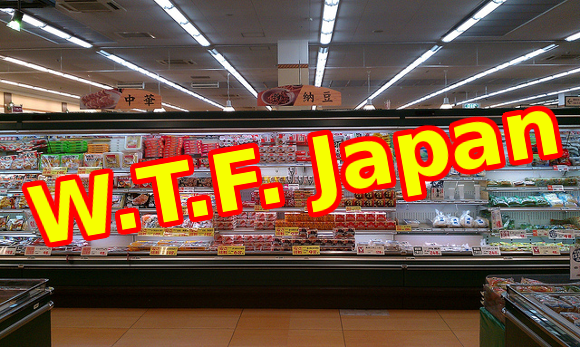
The most plentiful item at a Japanese grocery store: insanity.
Whenever I leave Japan and come back, one thing always manages to surprise me: supermarkets. It’s not so much the layout or the items for sale, but just some of the things we take for granted in grocery stores outside Japan that are completely different here – things you never realized existed until they were gone.
That’s why today we’re counting down the top 5 crazy things about Japanese supermarkets. These are the things that turn what you thought would be an average grocery store visit into jaw-dropping experience.
So let’s get to it! Starting off with…
Honorable Mention: Food, especially produce, is expensive!
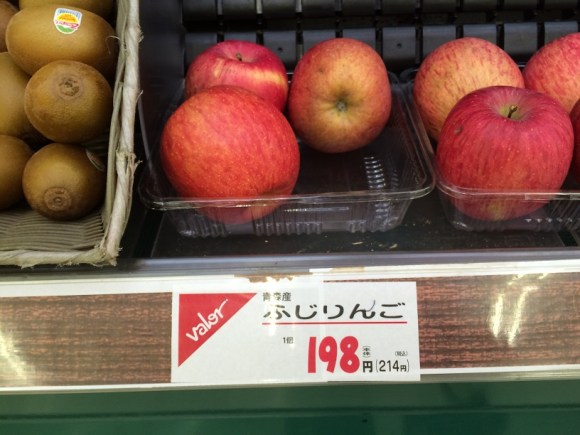
See that picture of apples? That’s not 198 yen (US$1.90) for a pack of three or four… that’s 198 yen for one apple.
And hey, that’s not even including tax, which brings it up to 214 yen ($2.06). I don’t know how much apples are in the rest of the world, but in the U.S. (or at least New England) I’m used to prices like this:
▼ Ah yes, much better. At this price, depending on size, you could buy somewhere around 10 to 50 apples for the same price as one in Japan.
Washington Red Delicious Apples are back for a great price! They're just .39¢ a pound now at FoodMaxx! pic.twitter.com/ZRC9JxvK8B
— FoodMaxx (@FoodMaxx) November 4, 2015
In Japan, fruits are considered more of a dessert/luxury than a snack or part of a meal like in the U.S., so most Japanese people don’t really care that they’re expensive. But if you’re like me and you’re used to chomping down on an apple a day, then be prepared to change your habits or spend most of your income on fruit.
The reason this is only an honorable mention is because pretty much everything is more expensive in Japan, and produce is just another part of that rising tide. There is one silver lining though: the fruit tastes really good. But keep in mind that you will pay for that extra deliciousness.
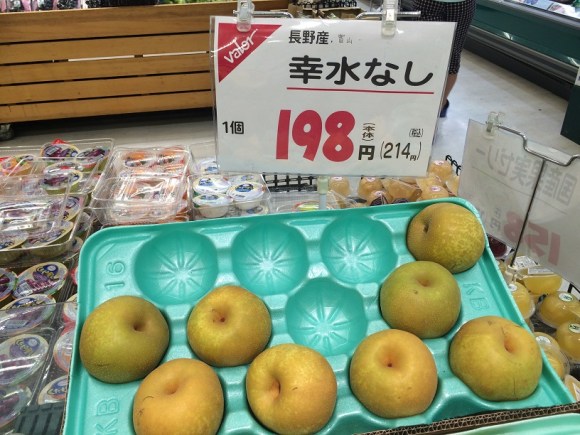
▼ Pears are just as guilty of being “high price fruit” as apples.
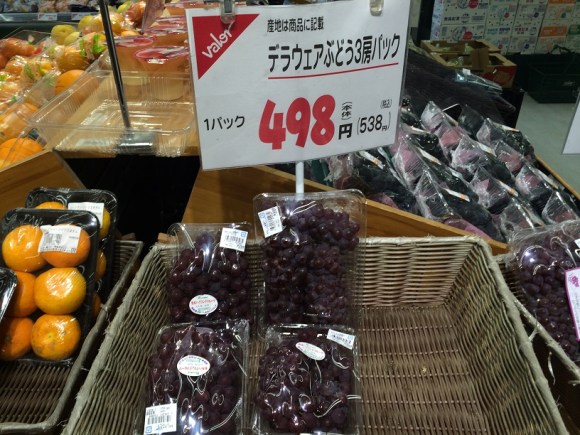
▼ And if you’re a fan of grapes, well, I have some bad news….
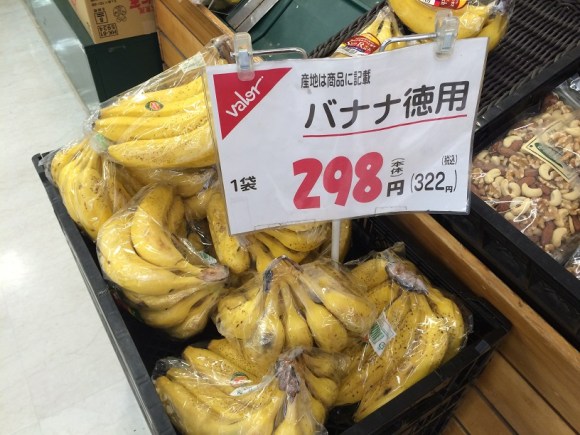
▼ Bananas are basically the cheapest fruit in Japan. I cried sucrose tears of joy
when I realized that price was for a whole bag and not just one banana.
#5. Late-night discounts
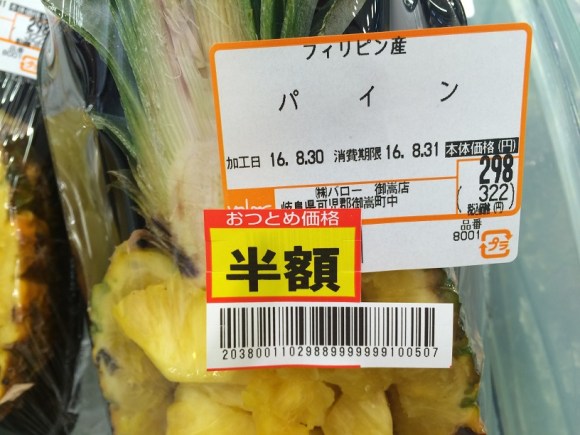
If the last item on the list got you depressed, fear not! There is a way around the high prices of Japanese food: late-night discounts.
Each store does it differently, but typically Japanese grocery stores will start putting discount labels like the one above on produce, meat, and other items a few hours before the store closes. Pineapple may not be too tempting at 322 yen ($3.11), but at half that price it’ll probably find its way into your basket.
Before I came to Japan, I’d never seen discount stickers like this before. Even stores that did have a “discount shelf” were usually busted canned goods or expired cat food, and there was never much at all. But in Japan, the discount stickers are everywhere, and the discounted items are usually just as good as the normally priced ones… so long as you’re planning on eating them pretty soon.
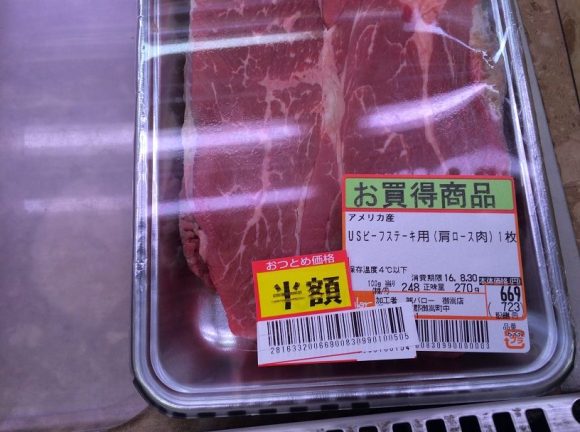
▼ When there’s a half price sticker on some delicious slabs of beef,
it suddenly becomes steak night.
#4. The cashier rattling off the price of everything in your basket

Again, I’m not sure what the typical customer/cashier relationship is like in other countries, but in the U.S. it’s pretty friendly. You ask each other how you’re doing, you lie and say you’re doing fine, the cashier lies about liking your shirt/purse/purchases, and everyone leaves with a smile on their face after having enjoyed a satisfying, if brief, lie-filled friendship.
But not in Japan.
In Japan, the second the cashier starts scanning your groceries it’s off to the number-rattling races. The price of every single item gets called out loud and clear as it’s scanned, acting like a numerical brick wall between you and the cashier ever having any sort of conversation.
For those who have never experienced it, watch this video below. It’s taken from the Japanese national cashier competition (because of course that’s a thing). Skip to 0:13 to see the number-shouting madness in action. It’s a little exaggerated here, but not by much, and what you see here is considered the “ideal.”
Also bear in mind that the usual number-shouting goes on for much longer, since most people buy more than five things. It’s a wonder the cashiers don’t collapse after counting a giant cart full of groceries. Although maybe that’s because in Japan it’s hard to buy a lot of things since…
#3. They use baskets as carts
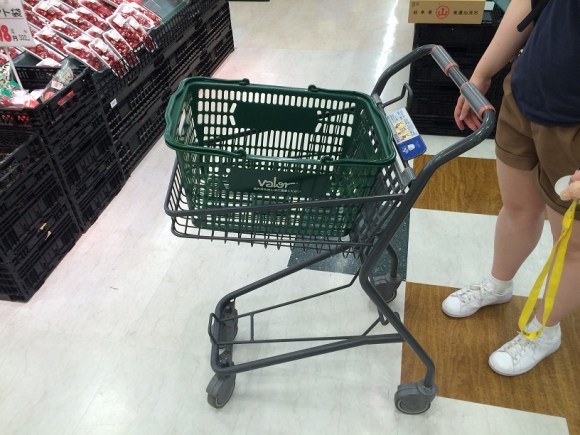
In Japan there’s no massive metal grocery carts with wheels that squeak and get stuck. In fact, there aren’t any big shopping carts at all. Instead they just have what I like to call “pushable basket accessories.”
Instead of loading your groceries into the gray plastic cart you see in the picture above, you’re supposed to get a basket, place it into the cart, and then just use it to ferry the basket around. I remember the first time I saw that, it blew my mind, and it still kind of does. I don’t really understand why they couldn’t just make the plastic rim on the cart a little higher, negating the need for the basket entirely.
Maybe it’s because Japanese people go food shopping more often, meaning they buy less at a time? Or maybe it’s because big carts would get stuck in the narrower Japanese aisles? Or maybe… it’s because they like having the feeling of assembling Voltron every time they go to the grocery store
▼ I think I can see the appeal now.
@SaintRPh @MoonbatCatnip Voltron Assemble!!!!! pic.twitter.com/ih7QjYIKG6
— ¡El SooperMexican! ن c137 🦬 (@SooperMexican) July 5, 2013
#2. No price per weight

In the U.S. pretty much every item available on the shelf has two prices: the cost of the item itself, and the price per weight/volume.
▼ I don’t know what “dry soda ginger” is,
but it’s 12.5 cents per ounce!
In Japan you also get two prices: the cost of the item… and the cost of the item after tax. There’s not usually the price per weight/volume anywhere to be seen. This isn’t a huge deal, but as someone who wants to stretch every yen/penny as far as it can go without having to do too much math, it’s asking a lot of my feeble brain.
▼ Let’s buy some cheese! Oh look, this six piece set of cheese
is 198 yen for 108 grams. This will be easy to compare!
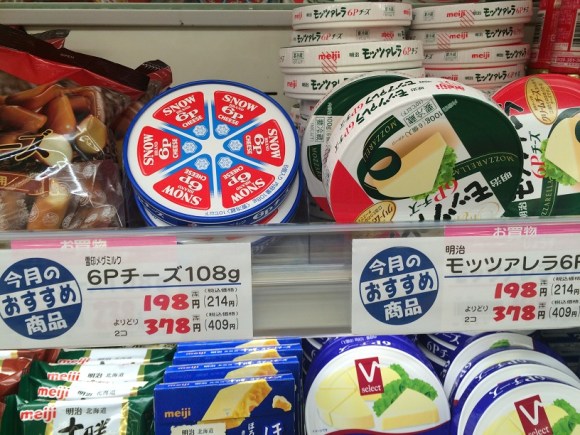
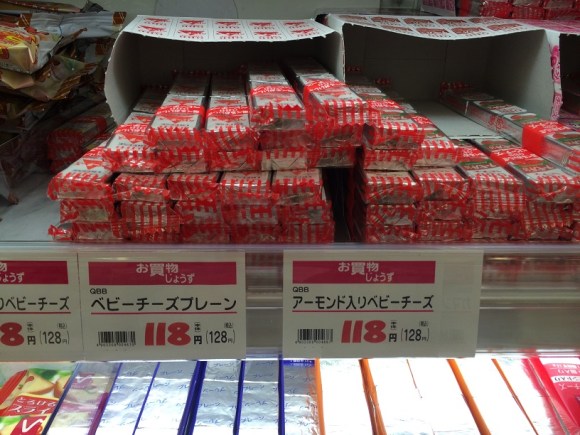
▼ Hmm, well these sets of four cheese are 118 yen, and on the back it says each
block is 15 grams, for a total of 60 grams, meaning it’s… wait… where was I?
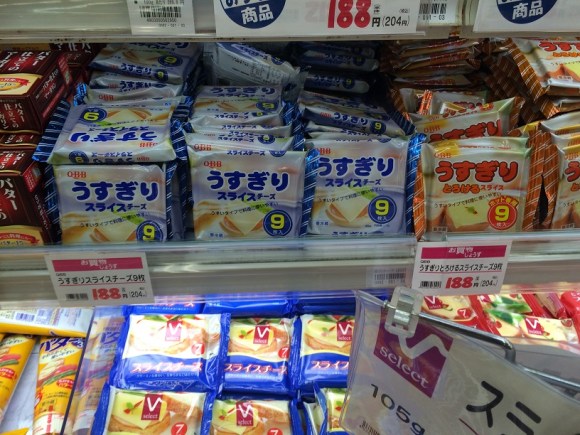
▼ Uh, 9 slices of cheese at 13 grams each for a total of 188 yen means… uh…
eh, screw it I’ll just wait until they get a half-price sticker slapped on.
And the #1 craziest thing about Japanese supermarkets is…
.
.
.
.
.
.
.
.
.
.
1. The self-bagging stations
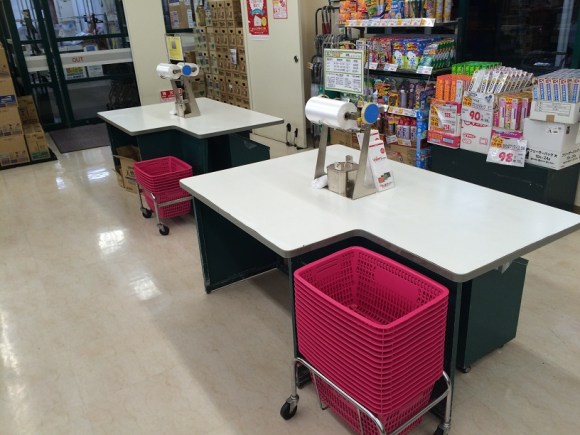
I’ll never forget the first time I went to a Japanese grocery store. I pushed my little cart-basket up to the register, the cashier read out the price of every super-expensive item as she scanned it and put it into another basket, I paid for it all, and then I reached for the bags that weren’t there.
I was at a loss. All I had was a new basket full of all the stuff I had just bought, no plastic or paper bags anywhere. I was flustered for a moment, wondering how I was going to carry everything home without stealing a basket, when the cashier awkwardly directed me to a series of tables past the registers: the self-bagging areas.
For those who have never experienced this, what you’re supposed to do is bring your basket of groceries over to a table like in the picture above, grab as many small plastic bags as you need, and then put those bags into bigger bags – either ones you brought yourself or purchased from the cashier. Plastic bags like you would normally get for free at the register in the U.S. cost around five yen each here.
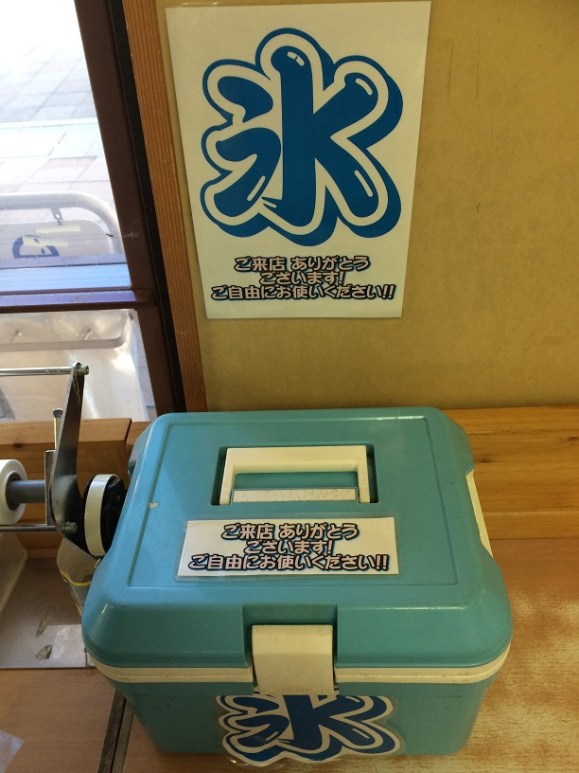
▼ And if you bought something cold, like meat, there are ice boxes at the bagging
stations where you can fill a bag of ice to put in with your groceries for free.
Personally I’ve always found it strange that in Japan, the land of going all out for the customer, supermarkets don’t bag your groceries for you. Maybe they used to do it in the past but changed? Maybe it’s just more efficient to process more customers this way? I’m not sure, but having my own groceries bagged for me is a luxury I took for granted when I lived in the U.S. and it’s something I enjoy probably far too much whenever I go back.
So there you have it, the top five crazy thing about Japanese supermarkets. Have you ever had a shocking surprise at a Japanese grocery store? Let us know in the comments, and be sure tell us if your store has any good discounts because we love a good bargain.
Featured/top image: Flickr/Yuya Tamai (Edited by RocketNews24)
Insert images: ©RocketNews24
In the meantime, give me a follow on Twitter and let me know if there’s any topics you’d like to see covered on W.T.F. Japan. See you next week!
 W.T.F. Japan: One year anniversary special! Top 5 W.T.F. Japan articles 【Weird Top Five】
 W.T.F. Japan: Top 5 nicest sounds in Japan【Weird Top Five】
 W.T.F. Japan: Top 5 best Tamagotchi releases 【Weird Top Five】
 W.T.F. Japan: Top 5 biggest Japanese food challenges【Weird Top Five】
 W.T.F. Japan: Top 5 “shikata ga nai” (“it can’t be helped”) situations in Japan【Weird Top Five】
 Japan reportedly adding Japanese language skill requirement to most common foreigner work visa
 Peanuts and Coke becomes a viral hit in Japan, but is it a trend worth joining?
 7-Eleven Japan’s new baked-in-store sweet treat is only available in three parts of the country
 Pokémon and Ikea Japan cross over into each other’s worlds with collaboration events
 Japan named most sleep-deprived country for fourth year in a row, according to survey
 Beautiful Ghibli earrings allow you to finally reunite two of the studio’s star-crossed lovers
 Starbucks Japan closing only Shinkansen platform branch for popularity-triggered renovations
 A diner’s guide to oden: Japan’s weird-looking, super-popular winter dish
 McDonald’s Japan adds new Hello Kitty and Pompompurin drinks to the menu for a limited time
 Train station platform ramen store closes its doors on half a century of history in Tokyo
 Pokémon lacquerware series expands for Year of the Horse with new handcrafted design[Video]
 Two food hacks take Japan’s convenience store fried chicken to amazing new sandwich heights
 Tokyo’s best museum for foreign travelers finally reopens after being closed for four years
 Totoro Fund line of beautiful artwork and apparel lets you help the real-world Totoro Forest
 Fading Tokyo – Searching for signs of the Showa era as local neighborhoods evolve[Photos]
 You can assemble a well-balanced team of Pokémon, them eat them, thanks to Japanese cake chain
 Tokyo turns its phone booths into free Wi-Fi hotspots, and here’s how to use them
 Japan now has a special desk for people who work at home with a pet cat[Photos]
 Famous Tokyo cherry blossom spot installs view-blocking screens to fight overcrowding[Video]
 Uniqlo announces new T-shirts for One Piece, Naruto and more for manga publisher’s 100th birthday
 Starbucks Japan releases new My Fruit³ Frappuccino at only 34 stores around the country
 Studio Ghibli releases Catbus pullback keychain that runs like the anime character
 Krispy Kreme releases Super Mario doughnuts in Japan for a limited time
 Japanese onsen egg maker from 100-yen store Daiso needs to be on your shopping list
 Nine great places to see spring flowers in Japan, as chosen by travelers (with almost no sakura)
 Survey asks foreign tourists what bothered them in Japan, more than half gave same answer
 Japan’s human washing machines will go on sale to general public, demos to be held in Tokyo
 Starbucks Japan releases new drinkware and goods for Valentine’s Day
 We deeply regret going into this tunnel on our walk in the mountains of Japan
 Studio Ghibli releases Kodama forest spirits from Princess Mononoke to light up your home
 Starbucks Japan releases new sakura goods and drinkware for cherry blossom season 2026
 Japan’s newest Shinkansen has no seats…or passengers [Video]
 Major Japanese hotel chain says reservations via overseas booking sites may not be valid
 Put sesame oil in your coffee? Japanese maker says it’s the best way to start your day【Taste test】
 No more using real katana for tourism activities, Japan’s National Police Agency says
 W.T.F. Japan: Top 5 Japanese words with cool ancient origin stories【Weird Top Five】
 W.T.F. Japan: Top 5 most confusing Japanese counter words【Weird Top Five】
 W.T.F. Japan: Top 5 craziest things about the Japanese medical system【Weird Top Five】
 W.T.F. Japan: Top 5 kanji with the longest readings 【Weird Top Five】
 W.T.F. Japan: Top 5 hardest Japanese habits to break 【Weird Top Five】
 W.T.F. Japan: Top 5 confusing Japanese hand gestures【Weird Top Five】
 W.T.F. Japan: Top 5 strangest Japanese home goods【Weird Top Five】
 W.T.F. Japan: Top 5 crazy awesome features of Japanese restaurants 【Weird Top Five】
 W.T.F. Japan: Top 5 most annoying sounds in Japan 【Weird Top Five】
 W.T.F. Japan: Top 5 strange things Japanese people do for Christmas【Weird Top Five】
 W.T.F. Japan: Top 5 myths about learning Japanese【Weird Top Five】
 W.T.F. Japan: The top five “sora” references of all time! 【Weird Top Five】
 W.T.F. Japan: Top 5 most confusing Japanese compound words【Weird Top Five】
 W.T.F. Japan: Top 5 craziest Japanese certification exams 【Weird Top Five】
 W.T.F. Japan: Top 5 Japanese foods for people who don’t like seafood 【Weird Top Five】
 W.T.F. Japan: Top 5 hand gestures that Japanese people don’t understand【Weird Top Five】
 W.T.F. Japan: Top 5 confusing Japanese Internet slang words 【Weird Top Five】