
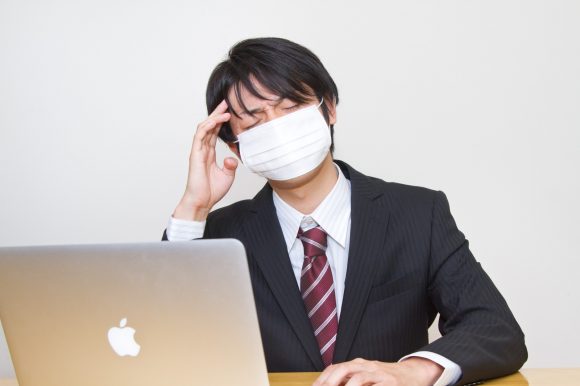
Should I stay or should I go? A Japanese employee shares some insight from his American boss about when to take time to recuperate.
It’s hard to tell exactly how much of a universal constant the phenomenon of “sick leave anxiety” is, but both in Japan and my native England I felt a dire and existential dread every time I had to pick up the phone to call in sick. Even if I was hallucinating, losing vision, bleeding from every orifice: “Listen, I can still work! Put me in the game, coach!”
While companies in both my home country and Japan are legally required to give lee-way when it comes to sick employees, actually taking that sick leave is another matter entirely. Even if your boss gives the go-ahead, there’s the knowledge that everyone else in your office will have to pick up your slack. There’s also the realization that if work is particularly tough that day, lack of morale might be blamed entirely on you. In a worst-case scenario, taking too much sick leave (even for a good reason) creates a fear that it might convince your superiors you’re not cut out to keep working there.
So the following story from Twitter user @mike_flaherty03 (yes, his account is named after the Spin City character) is particularly thought-provoking. “Mike”, as we’ll call him from here on out, works at a company with frequent international conferences conducted in English – and he’s candid about how he’s been diagnosed with bipolar disorder, making those tough calls even tougher and seemingly more frequent.
In this thread, he reminisced about his first time telling his American boss that he would occasionally need to opt out due to sickness.
https://twitter.com/mike_flaherty03/status/997397548439515137“When I first brought up the issue of my health with my American boss, I told him I might need to take days off from time to time to handle it. He immediately replied, “Oh, you can just work from home on those days.”
I protested, “But what about the others in the office? Won’t they think that’s unfair?”
My boss answered, “Why would they? I think it’s much more unfair that someone should struggle in an environment where they’re incapable of working at full capacity.”
It was as though the scales had dropped from my eyes, and I realized he was right.”
He clarified his statement in a follow-up tweet:
“Now, don’t get me wrong. The world of foreign-owned corporations is unforgivably cut-throat. Even if they make accommodations for you in your workplace, you must produce results – or else you wind up with a lower salary, and you can never rule out the possibility that you could be fired without warning. So please don’t presume those accommodations are a ‘soft option’ – I work every day with that stress hanging over me.”
One of the first replies to his comment, from Twitter user @fiore_eterno, brought up the story of an American acquaintance, who told them that “working healthily isn’t a privilege; it’s an obligation that workers owe it to themselves to respect” and therefore “it’s ethical to rest when sick”. Mike agreed, saying “it seems like a fundamental difference in how they think, compared to Japan.”
It’s no news that Japan has a critical overwork problem, with a 2016 survey citing overwork as a leading reason that 40 percent of Japanese people sleep six hours a night or less. While the government has attempted to curb the worst offenders with lights-out policies and even drones to monitor that employees will leave when expected, there is a definite cultural compulsion that drives the desire to stay back longer.
This is broadcasted loud and clear in @fiore_tereno’s second reply: “I think the root concept is different: In Japan, it’s more like ‘you owe it to your customers to be at peak performance’.”
Another comment highlighted it even more graphically:
さすが外国人の発想は違う!働き方に対しての考え方が違うねぇ。日本人はそういう時、「ズルい!」とか言う奴が居るので困る😰条件が違うのに、一緒にしろっつ~方が間違っとるわ!と思います。良かったですね☺️
— みぃRabbit (@Rabbit78273526) May 20, 2018
“Foreigners really do approach this issue differently! Our whole attitude towards working is different, too. If you were to propose that around a Japanese company, you’d always be worried that someone might say “ah, getting special treatment are we?” and so no one does it. I think it’s more of a problem to yell “let’s all pull our weight together!” when the working conditions are bad, so it’s nice to see this perspective.”
▼ It’s easy to say you’ll skip out on overtime, but the social pressure usually means the opposite

There were numerous other voices of assent throughout the thread, with many users saying “your boss is right, for sure” or “it’s a shame you would never hear this from a Japanese boss”. Envy was also very present: it’s no wonder Mike had to post his second comment, with so many users clamoring for his boss to hire them instead.
It’s important to note that while this concept has many supporters in the thread, the reality is that Japan still has much work to do. As recently as 2017 Prime Minister Shinzo Abe went on the record to state more aggressive work reforms to stop overtime (and presumably help workers use their sick leave responsibly), prompted by the karoshi death of journalist Miwa Sado. Only time will tell if this possible precedent set by foreign owned companies will take root. Until then, we’ll just have to wait and see what unorthodox methods Japanese bosses cook up to get their employees to stay home for a change.
Top image: Pakutaso
Insert image: Pakutaso
Source: Twitter/@mike_flaherty03 via Hachima Kikou, Reuters
 Japanese exchange student sparks culture debate on Twitter with comment about American clothing
 Japanese company tells worker he probably doesn’t have coronavirus, to come to work with a fever
 Japanese company trips – Workers “absolutely hate” them, so why do they still happen?
 What are the worst things about the first year working in a Japanese company? Survey investigates
 20 signs that a woman should think about quitting the Japanese company she works for
 Man bites woman at cherry blossom park in Japan, dies shortly after
 New Japanese KitKats come in sakura flavour, with poetic symbolism for success
 Japanese manhole lid raises eyebrows with fertility god symbol that looks like… well, you know
 Foreign man arrested for walking on Shinkansen tracks, claims he was on the run from yakuza
 Schoolkids learn life skills through shopping field trips at street markets in Kochi Prefecture
 Peanuts and Coke becomes a viral hit in Japan, but is it a trend worth joining?
 Japan reportedly adding Japanese language skill requirement to most common foreigner work visa
 How to take your home ramen to the next level by making your own chashu pork in a frying pan
 Häagen-Dazs releases new Green Tea sandwich in Japan for a limited time
 Huge life-size Eevee Eeveelution Pokémon plushies will steal hearts, conquer living rooms【Photos】
 Pokémon and Ikea Japan cross over into each other’s worlds with collaboration events
 Starbucks Japan closing only Shinkansen platform branch for popularity-triggered renovations
 Two food hacks take Japan’s convenience store fried chicken to amazing new sandwich heights
 You can assemble a well-balanced team of Pokémon, them eat them, thanks to Japanese cake chain
 Fading Tokyo – Searching for signs of the Showa era as local neighborhoods evolve[Photos]
 Pokémon lacquerware series expands for Year of the Horse with new handcrafted design[Video]
 Tokyo turns its phone booths into free Wi-Fi hotspots, and here’s how to use them
 Tokyo teahouse serves up a sakura matcha dessert you won’t find anywhere else
 Totoro Fund line of beautiful artwork and apparel lets you help the real-world Totoro Forest
 Japan now has a special desk for people who work at home with a pet cat[Photos]
 Famous Tokyo cherry blossom spot installs view-blocking screens to fight overcrowding[Video]
 Uniqlo announces new T-shirts for One Piece, Naruto and more for manga publisher’s 100th birthday
 Train station platform ramen store closes its doors on half a century of history in Tokyo
 Starbucks Japan releases new My Fruit³ Frappuccino at only 34 stores around the country
 Studio Ghibli releases Catbus pullback keychain that runs like the anime character
 Krispy Kreme releases Super Mario doughnuts in Japan for a limited time
 Japanese onsen egg maker from 100-yen store Daiso needs to be on your shopping list
 Survey asks foreign tourists what bothered them in Japan, more than half gave same answer
 Japan’s human washing machines will go on sale to general public, demos to be held in Tokyo
 Starbucks Japan releases new drinkware and goods for Valentine’s Day
 We deeply regret going into this tunnel on our walk in the mountains of Japan
 Studio Ghibli releases Kodama forest spirits from Princess Mononoke to light up your home
 Starbucks Japan releases new sakura goods and drinkware for cherry blossom season 2026
 Japan’s newest Shinkansen has no seats…or passengers [Video]
 Major Japanese hotel chain says reservations via overseas booking sites may not be valid
 Put sesame oil in your coffee? Japanese maker says it’s the best way to start your day【Taste test】
 No more using real katana for tourism activities, Japan’s National Police Agency says
 Japanese manners debate: Is it OK to tell your coworkers “I’ve found a new job?”
 American’s Japanese calligraphy gets called “cultural appropriation,” Japanese Twitter disagrees
 Valentino sparks outrage with insincere apology for disrespecting Japanese culture in photo shoot
 Japanese restaurant chain installs tip boxes in response to foreign tourists leaving tips, sparks debate
 Is this common Japanese phrase for “goodbye” the reason for Japan’s crazy overtime hours?
 What’s the point? Young Japanese professionals list five business manners they find unnecessary
 Five things that keep Japanese people chained to their jobs
 Eight Japanese words we’d love to import into English
 There’s no need to care about our staff, because they’re foreigners, says Japanese maid service