
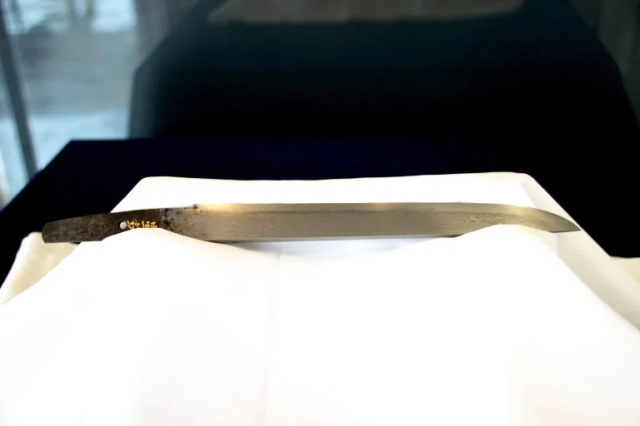
One of Japan’s most beautiful blades is now on display, and owes its existence to some dude who just wanted to eat some potatoes and pickles.
Roughly 130 years ago, a farmer in what’s now Japan’s Toyama Prefecture was digging for potatoes when he came across an unusual stone. Even appraisers from the Osaka mint couldn’t tell what it was, and it spent the next several years being used as a tsukemono ishi, basically a large stone placed on top of vegetables as part of the pickling process.
However, this mysterious mineral was destined for greater things. In 1895, geologists from the Ministry of Agriculture and Commerce determined that the stone was a meteorite, which they would dub the Shirahagi Meteorite (Birch Meteorite). It was purchased by Enomoto Takeaki, a samurai who would go on to play a key role in the creation of Japan’s first modern navy and also serve as Minister of Communications, Education, Foreign Affairs, as well as two separate terms as Minister of Agriculture and Commerce.
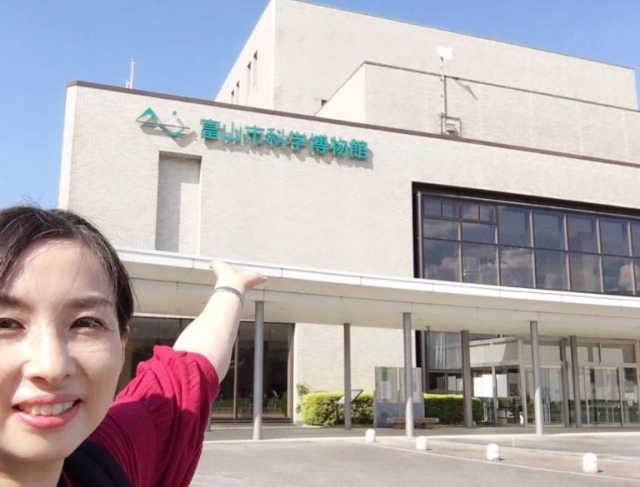
Instead of using the meteorite to make some pickles, Enomoto decided to use it to make some swords. Enlisting the services of swordsmith Okayoshi Kunimune, Enomoto commissioned five blades, two long swords and three tanto (literally “short swords,” but often closer in length to daggers) to be forged from the Shirahagi Meteorite. One of the tanto is housed at the Toyama Science Museum in Toyama City, and we took a trip to see its celestial craftsmanship for ourselves.
▼ Field reporter Meg arrives at the Toyama Science Museum
Of the five meteorite blades, collectively known as the Ryuseito (literally “comet swords”), the higher quality of the two katana was presented by Enomoto to the current crown prince of Japan, who would later become Emperor Taisho, who reigned from 1912 to 1926. The remaining four were handed down to Enomoto’s descendants. The second katana is now owned by Tokyo University of Agriculture (which grew out of an institution Enomoto founded). As for the three tanto, one is in the possession of Ryugu Shrine in Otaru, on the island of Hokkaido, one’s whereabouts are unknown, and one is the blade seen here, kept as part of the Toyama Science Museum’s collection.
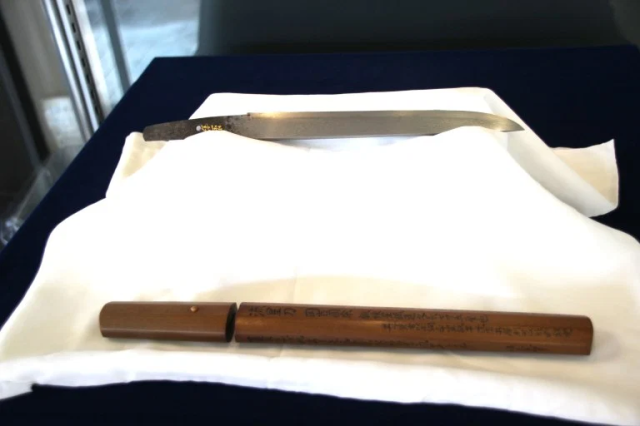
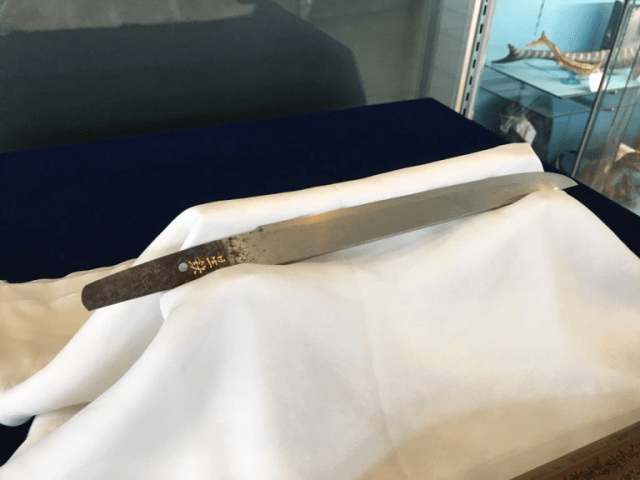
The tanto isn’t on permanent display, but visitors can feast their eyes on it between now and October 14. On our visit, we also had the chance to talk to Mr. Hayashi, the museum’s astronomy curator, who told us more about what makes the blade so special.
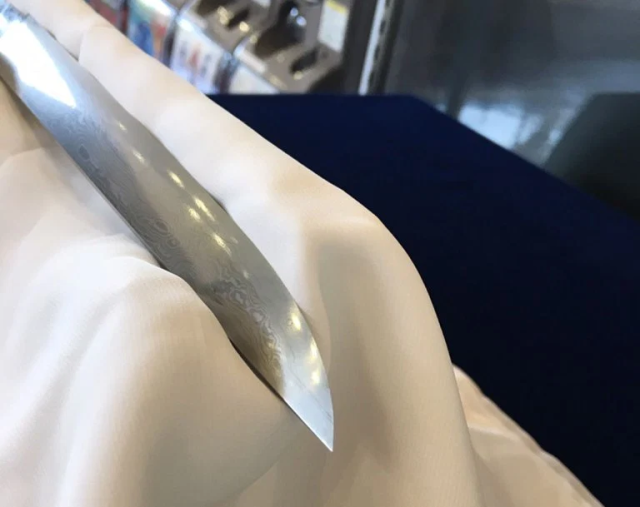
For starters, it’s not just the origin of the metal in the Ryuseito that makes it different. Meteoric iron has a nickel content of about 10 percent, which is higher than terrestrial iron, and also less carbon. That actually makes it somewhat difficult to work with, since a lower carbon content makes the metal comparatively resistant to hardening during quenching. Because of that, the ryuseito aren’t made from meteoric iron alone, but an alloy that’s 70 percent meteoric iron and 30 percent tamahagane, the iron sand-rich metal used for regular katana.
▼ The Ryuseito’s scabbard
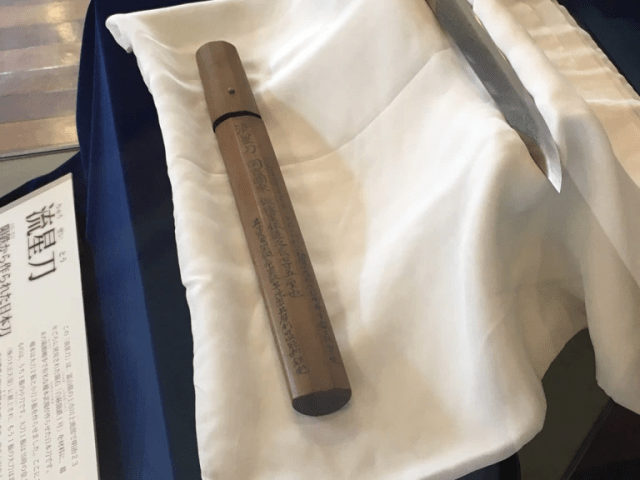
In his journals, Enomoto says that the Ryuseito “cut well,” but Hayashi is somewhat skeptical of the claim. Even with their tamahagane content, the Ryuseito have less carbon than similar swords forged from occurring-on-earth components, and so while “meteorite sword” sounds like the sort of thing that should let you slay dragons and cleave ogres, it might not actually be the most combat effective blade, not that Hayashi and his colleagues have actually tried cutting anything with the priceless historical artifact which it’s doubtful anyone could repair (it took Okayoshi three years to complete the five swords).
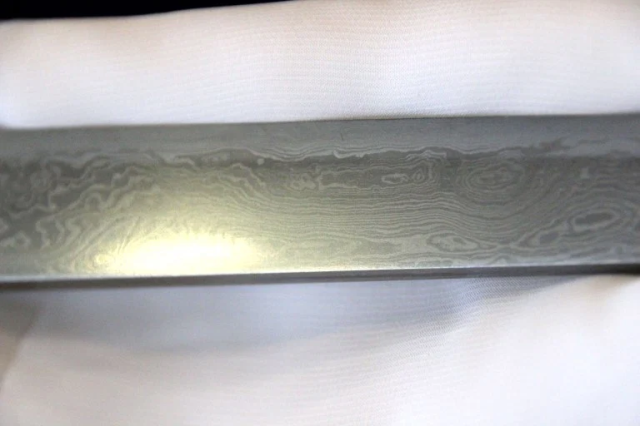
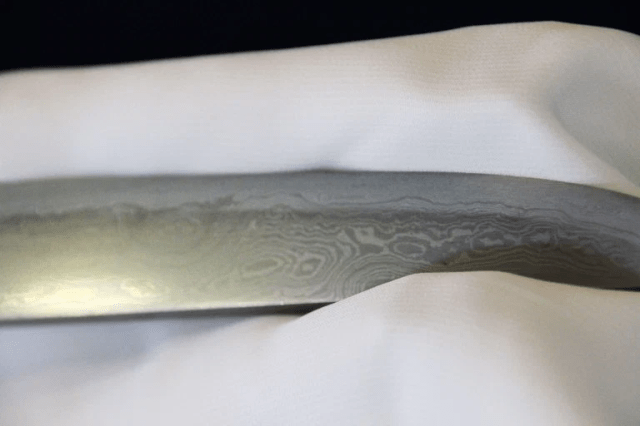
However, there is one advantage to the use of meteoric iron, which is that it produces uniquely beautiful hamon (tempering marks) along the blade’s surface. The Ryuseito had to be forged at higher-than-normal temperatures, and the final result is stark black waves that flow over the metal.
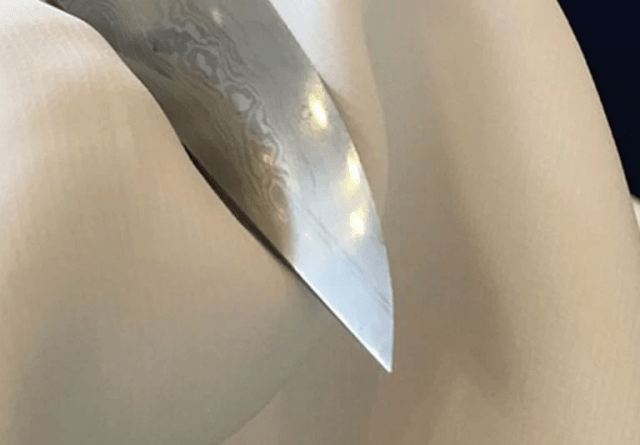
▼ Hamon totally unlike the ones we saw at the Evangelion and Katana exhibit in Tokyo
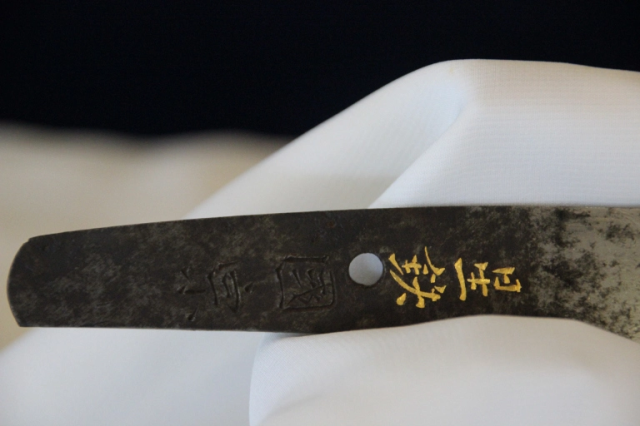
Hayashi was also able to dispel a rumor about the Ryuseito. Some people claim that unlike most notable Japanese swords, which bear the smith’s inscribed signature on their inner hilt, the Ryuseito are unmarked. That’s not the case, though, as we can clearly see the kanji for “Kunimune” engraved into the sword, as well as a solid-gold inlay reading seitetsu, or “star iron.”
So while the Ryuseito may or may not do you much good in a duel, it’s undeniably awesome to look at, and well worth stopping by the Toyama Science Museum to see if you happen to be in the area. As for the fifth Ryuseito, we’ll just have to keep our fingers crossed that it turns up, but if a farmer can find a meteorite while looking for potatoes, hopefully someday someone will find the long-lost fifth sibling sword too.
Museum information
Toyama Science Museum / 富山市科学博物館
Address: Toyama-ken, Toyama-shi, Nishinakanomachi 1-8-31
富山県富山市西中野町1丁目8-31
Open 9 a.m.-5 p.m.
Closed September 17-19
Admission 520 yen (US$4.80)
Website
Photos ©SoraNews24
● Want to hear about SoraNews24’s latest articles as soon as they’re published? Follow us on Facebook and Twitter!
[ Read in Japanese ]
Follow Casey on Twitter, where he wishes he could go back in time and tell his younger self ‘One day, you’ll write multiple professional articles about tamahagane.’”
[ Read in Japanese ]
 Final Fantasy artist Yoshitaka Amano anthropomorphizes katana made from a meteorite
 Legendary crescent moon katana, one of Japan’s Five Swords Under Heaven, now on display in Tokyo
 Amazing exhibition of Japan’s legendary “cursed katana” is going on right now【Photos】
 How did samurai swords and armor evolve over time?【Part 2】【Photos】
 Japan’s legendary Brother Katana might not be brothers after all? Investigating the mystery【Pics】
 Mt. Fuji decorated with a 500,000-flower pink carpet is Japan’s ultimate spring view
 30 Pikachus want to share a Tokyo hotel room with you that has separate Grass, Water, Fire spaces
 Does a long line mean a sweeter deal? We compare two sweets from a Hokkaido food fair【Taste test】
 Krispy Kreme Japan giving free donuts with morning drink purchases at all branches, maybe forever
 New Travelling Bento pouches turn your luggage into a Japanese lunch box
 7 great places to see Mt. Fuji from without having to climb it
 Japan’s Fake Black Stockings offer sheer looks and winter-cold protection
 Rage against the smoothie machine with this 7-Eleven drink hack【Taste test】
 Tokyo Station staff share their top 10 favorite ekiben
 Japanese politician arrested on charges of accepting bribes to reduce number of monkeys in park
 Japan reportedly adding Japanese language skill requirement to most common foreigner work visa
 Pokémon and Ikea Japan cross over into each other’s worlds with collaboration events
 Starbucks Japan closing only Shinkansen platform branch for popularity-triggered renovations
 You can assemble a well-balanced team of Pokémon, them eat them, thanks to Japanese cake chain
 Two food hacks take Japan’s convenience store fried chicken to amazing new sandwich heights
 7-Eleven Japan’s new baked-in-store sweet treat is only available in three parts of the country
 Man bites woman at cherry blossom park in Japan, dies shortly after
 Peanuts and Coke becomes a viral hit in Japan, but is it a trend worth joining?
 Can a downtown Tokyo super sento bathhouse beat a hotel for a one-night stay?
 New Japanese KitKats come in sakura flavour, with poetic symbolism for success
 Japan now has a special desk for people who work at home with a pet cat[Photos]
 Famous Tokyo cherry blossom spot installs view-blocking screens to fight overcrowding[Video]
 Uniqlo announces new T-shirts for One Piece, Naruto and more for manga publisher’s 100th birthday
 Train station platform ramen store closes its doors on half a century of history in Tokyo
 Starbucks Japan releases new My Fruit³ Frappuccino at only 34 stores around the country
 Krispy Kreme releases Super Mario doughnuts in Japan for a limited time
 Studio Ghibli releases Catbus pullback keychain that runs like the anime character
 Japanese onsen egg maker from 100-yen store Daiso needs to be on your shopping list
 Survey asks foreign tourists what bothered them in Japan, more than half gave same answer
 Japan’s human washing machines will go on sale to general public, demos to be held in Tokyo
 Starbucks Japan releases new drinkware and goods for Valentine’s Day
 We deeply regret going into this tunnel on our walk in the mountains of Japan
 Starbucks Japan releases new sakura goods and drinkware for cherry blossom season 2026
 Studio Ghibli releases Kodama forest spirits from Princess Mononoke to light up your home
 Japan’s newest Shinkansen has no seats…or passengers [Video]
 Major Japanese hotel chain says reservations via overseas booking sites may not be valid
 Put sesame oil in your coffee? Japanese maker says it’s the best way to start your day【Taste test】
 No more using real katana for tourism activities, Japan’s National Police Agency says
 Demon-slaying Dojigiri, one of Japan’s Five Swords Under Heaven, now on display at Kasuga Shrine
 Real-life Rurouni Kenshin katana forged based on sword of series’ most merciless villain【Photos】
 Historical katana dessert knives turn your sweet snacks into a delicious duel【Photos】
 This hotel has one of the coolest katana collections in Japan, and admission is totally free【Pics】
 Sword of one of Japan’s last samurai discovered in house in America
 Dojigiri, the millennium-old katana said to have slain a demon, is now on display in Tokyo【Pics】
 Swords of famous samurai reborn as beautiful kitchen knives from Japan’s number-one katana town
 Real-life Rurouni Kenshin reverse-blade katana, forged by master swordsmith, now on display【Pics】
 “2D vs. Katana” exhibition shows off recreations of swords from anime and video games in Osaka
 Cruel angels, beautiful blades: The amazing sword of the Evangelion and Katana exhibition【Photos】
 “Katana steel cookies” are the latest sweet treat from Japan’s samurai sword capital【Taste test】
 How did samurai swords and armor change over time?【Part 1】【Photos】
 Genuine Muramasa blade and Muromachi katana on display at Tokyo’s Touken Ranbu store【Photos】
 Stay at an old samurai residence in the heart of a “Little Kyoto” warrior town