Multi-country study has one element in every nation’s top five emoji, but not Japan’s.
In Japan, yearly observances such as Wagashi Day, Good Bath Day, and Boobs Day are always a source of fun for aficionados of their particular themes. However, Japan isn’t the only country with such quasi-holidays. In fact, some such celebrations are global affairs, such as World Emoji Day, which falls on July 17.
In observance of World Emoji Day, Baidu Japan, the Japanese division of Chinese tech firm Baidu, maker of the Simeji emoji keyboard app, conducted a tally of the most-used emoji among Simeji users across 16 different countries, Japan, the U.S., the U.K., France, Russia, Spain, Italy, Turkey, Argentina, Mexico, Iraq, Egypt, Vietnam, Indonesia, Thailand, and India, during the first half of 2025.
When everything was added up, the most-used emoji across that entire user base was…

…this specific crying face. Those twin tear cascades were the most commonly used emoji in 12 of the 16 countries, including Japan, the U.S., and the U.K. What’s more, out of the four remaining countries, three of them, France, Iraq, and Egypt, had different crying faces as their favorites, with Russia the only country with no tears in its number-one emoji.
▼ Top five emoji for Japan, U.S., U.K., and France (first row), Russia, Spain, Italy, and Turkey (second row), Argentina, Mexico, Iraq, and Egypt (third row), and Vietnam, Indonesia, Thailand, and India (fourth row)
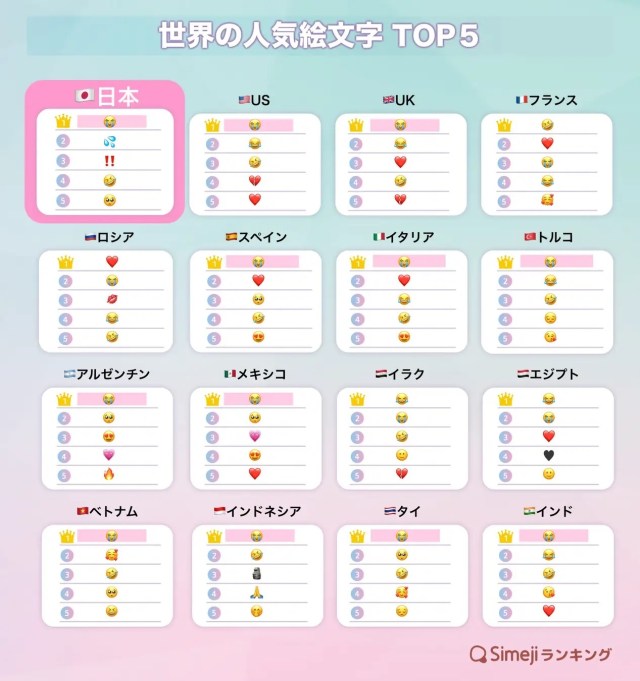
So why is the 😭 so widely used across different regions, languages, and communication cultures? Baidu Japan thinks it’s because of how versatile that exact emoji is. The free-flowing tears are a strong show of emotion, but the overall expression (the shape and position of the eyebrows, eyes, and mouth) and pretty noncommittal. Those could be tears of joy, laughter, gratitude, empathy, or sadness, depending on the context, or even some mix of those that’s hard to convey in words, making an emoji an especially effective and appealing way to send those sentiments to somebody on the other end of a text chat. Some of that also applies to the crying faces that were the top picks for France, Iraq, and Egypt, but the expressions on their number-one emoji seem to be either smiling or wincing, which sort of limits how useful they are for expressing more tender or sympathetic feelings.
As further proof of how versatile crying emoji are, aside from Argentina and Mexico every country had at least two in their top five, and some had three. But while crying faces showed up across the board, Japan’s top five results were unique in the three different ways.
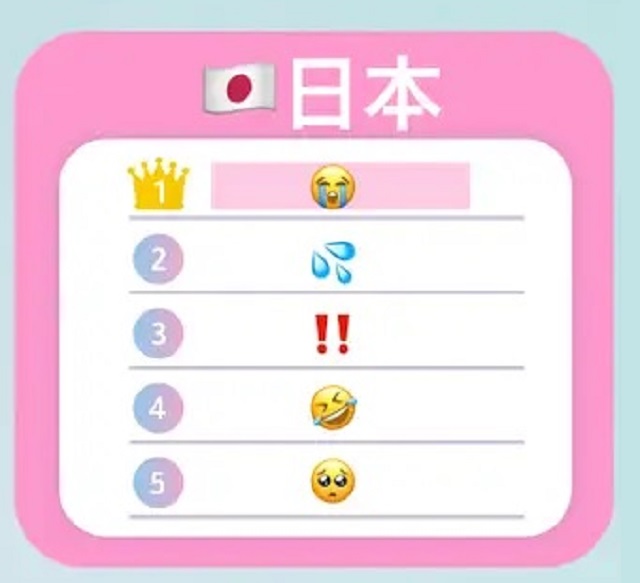
Japan’s number two and three emoji didn’t show up in any other country’s top five. It’s not hard to imagine the reason for the disparity with 💦. In Japan, stylized sweat drops have been used as a symbol for hurried, panicked, or emphatic action in manga/anime and graphic art for several decades, but it’s not uncommon for the emoji to be used/seen as a symbol of a different sort of bodily fluid among online communities in other countries, one with much narrower situational applicability. As for the double exclamation points, they don’t have any unique significance in Japan, but their popularity could be related to how one of the most common ways to show surprise in Japanese is to let out an elongated “E—-eeeee,” with a rising intonation. However, that same sound, but with a dropping intonation, instead indicates disapproval or doubt that what the other person said is true, and since intonation isn’t something that can be conveyed in Japanese writing, using an emoji to show that you’re surprised is sometimes a safer choice.
And the third way Japan’s results are unique? It’s the only country with no hearts, either as stand-alone emoji or as elements (such as a face with hearts for eyes) in its top five.
The easy explanation here is that Japanese people are less likely to directly say “I love you” than people in many other cultures, but there’s a little more to it than that. While people in some countries may use heart emoji to express familial love, in Japan they’re almost exclusively used to express romantic love. A Japanese grandma, for example, isn’t likely to send her out-of-prefecture grandchild a text that says “Happy birthday, sweetie! Grandma misses you ❤,” nor would said grandkid respond with, “Thanks, Grandma! I miss you too ❤.” With a narrower range of usable situations, it’s not surprising that Japan uses fewer heart emoji, but it doesn’t necessarily mean that Japanese people don’t care about love (after all, they’ve got multiple words for it).
Source: PR Times
Top image: Pakutaso
Insert images: PR Times
● Want to hear about SoraNews24’s latest articles as soon as they’re published? Follow us on Facebook and Twitter!