

Researchers are far from jaded about this jade.
It’s sometimes surprising what we humans don’t know. Take rocks for example. Animals and plants are always moving around and evolving in a state of flux, so it’s not surprising to find new ones here and there, but I would have sworn we’d have had all the rocks bagged and tagged by now.
And yet a research team composed of academics, corporate scientists, and even amateur mineral researchers has managed to come across an entirely new mineral. It’s a variation of jade, or more specifically, the jadeite form of what we call jade, but this rock has a composition unique enough to classify it as a mineral all its own.
Only a very tiny amount of it was discovered in a sample of regular jade from Okayama Prefecture. Pure Jadeite has a chemical composition of NaAlSi2O6, but this new mineral is made up of Sr4Ti6Si4O23(OH)Cl, which includes significant amounts of strontium and titanium.
▼ This photo shows a section of jade (the white part) only two millimeters wide. Only the very small green parts are the newly discovered mineral.
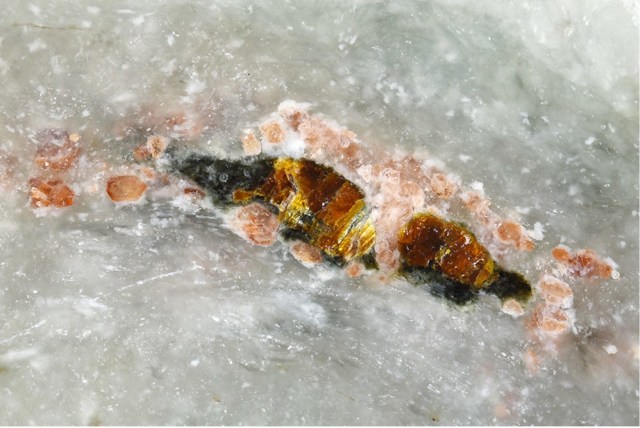
It was named Amaterasuite (“ah-mah-terra-soo-ite”) after the Japanese creation goddess Amaterasu. Part of the reason for the naming is that jade has long been an important mineral in Japan throughout history, and was even declared the National Stone by the Japan Association of Mineralogical Sciences in 2016. It only seems fitting to name a version of jade after the main goddess of the Shinto religion in that way.
But there’s actually another, more important reason for the name. Many gods in Shinto are said to exist in a duality called aratama and nigitama, where the former is the raging form of the god and the latter is the peaceful form. The aratama and nigitama are one and the same god, but are never seen in the same place at the same time, kind of like two heads of the same coin.
Meanwhile, minerals always have a uniform crystalline chemical arrangement, much in the way that diamond and graphite are both just carbon but differ in the way the atoms are uniformly arranged throughout. Amaterasuite, however, has two atomic arrangements existing in the same mineral but never in the same place at the same time.
▼ Diagram showing the dual structure (Type A and Type B) of Amaterasuite
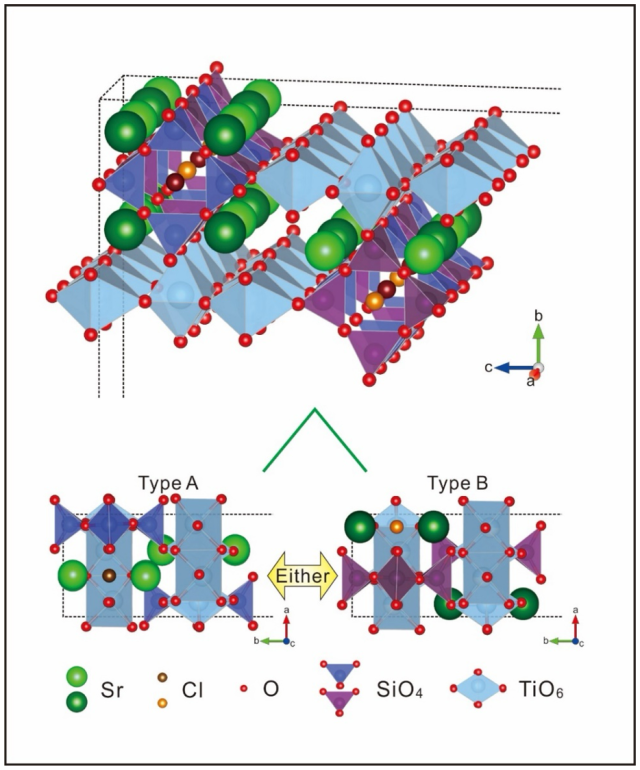
This type of crystalline structure has been theorized before, but Amaterasuite is the first time such a structure has ever been found in nature. This not only bridges the gap between theoretical and observed mineralogy, but it provides some more insight into the conditions that cause jade to form.
Speaking of which, jade is created when the same subduction of tectonic plates that causes so many earthquakes in Japan makes small cracks in the Earth’s crust. Chemicals from that part of the ocean seep into the cracks and, with the unique combination of low temperatures and high pressures, form into jade. The unique composition of Amaterasuite suggests that more complex reactions might be occurring in this process than previously thought.
This also marks the second recent scientific discovery to be named after Amaterasu. We can assume zoologists in Japan are chomping at the bit to find a new species of wolf they can name after her too.
Source: The Institute for Solid State Physics, The University of Tokyo, Yomiuri Shimbun Online, My Game News Flash
Featured image: Wikipedia/Utagawa Kunisada
Insert images: The Institute for Solid State Physics, The University of Tokyo
● Want to hear about SoraNews24’s latest articles as soon as they’re published? Follow us on Facebook and Twitter!
 Krispy Kreme releases Super Mario doughnuts in Japan for a limited time
 Ghibli Museum building becomes a cuddly cushion
 7-Eleven Japan releases a crazy new viral sandwich: Chocolate Sprinkles and Whipped Cream
 Ramen restaurant in top Tokyo tourist neighborhood skips price gouging, but how does it taste?
 How many doughnuts can you pack in a Mister Donut all-you-can-pack deal?
 Krispy Kreme releases Super Mario doughnuts in Japan for a limited time
 Ghibli Museum building becomes a cuddly cushion
 7-Eleven Japan releases a crazy new viral sandwich: Chocolate Sprinkles and Whipped Cream
 Ramen restaurant in top Tokyo tourist neighborhood skips price gouging, but how does it taste?
 How many doughnuts can you pack in a Mister Donut all-you-can-pack deal?
 “Online streamer” tops dream job poll for young Japanese kids, older kids not so interested
 Japan now has a “for foreign tourists only” Mt. Fuji sightseeing train[Video]
 Starbucks Japan offers special sakura picnics at Reserve Roastery Tokyo beside Meguro River
 Japanese idol creates kawaii Gunpla, the world’s cutest Gundam models【Photos】
 Anime-style isekai story is actually an English-learning textbook from Japan’s public broadcaster
 Japanese onsen egg maker from 100-yen store Daiso needs to be on your shopping list
 Starbucks Japan releases new My Fruit³ Frappuccino at only 34 stores around the country
 Tokyo government organizes food truck event to clear out delinquent/homeless teen gathering area
 Cherry blossoms begin blooming in Japan with record-early starts for sakura season
 Nine amazing off-the-beaten-path cherry blossom spots in Japan for yaezakura and shidarezakura
 Stunning central Japan wisteria festival is like a purple fantasy straight out of a Ghibli movie
 Create a tiny Ghibli anime world on your bookshelf with new miniature papercraft art kits
 Studio Ghibli releases the My Neighbour Totoro tea caddy, with a magical self-closing lid
 When will the cherry blossoms reach full bloom in Japan this year?[Forecast]
 Starbucks Japan unveils new sakura cherry blossom collection for hanami season 2026
 Train station platform ramen store closes its doors on half a century of history in Tokyo
 Studio Ghibli releases Catbus pullback keychain that runs like the anime character
 Nine great places to see spring flowers in Japan, as chosen by travelers (with almost no sakura)
 Starbucks Japan releases first-ever Hinamatsuri Girls’ Day Frappuccino
 Studio Ghibli adds new Mother’s Day gift sets to its anime collection in Japan
 Virtual idol Hatsune Miku redesigned with look that adds new elements and brings back old ones
 Survey asks foreign tourists what bothered them in Japan, more than half gave same answer
 Japan’s human washing machines will go on sale to general public, demos to be held in Tokyo
 Starbucks Japan releases new drinkware and goods for Valentine’s Day
 We deeply regret going into this tunnel on our walk in the mountains of Japan
 Studio Ghibli releases Kodama forest spirits from Princess Mononoke to light up your home
 Starbucks Japan releases new sakura goods and drinkware for cherry blossom season 2026
 Japan’s newest Shinkansen has no seats…or passengers [Video]
 Major Japanese hotel chain says reservations via overseas booking sites may not be valid
 Put sesame oil in your coffee? Japanese maker says it’s the best way to start your day【Taste test】
 No more using real katana for tourism activities, Japan’s National Police Agency says
 “Online streamer” tops dream job poll for young Japanese kids, older kids not so interested
 Japan now has a “for foreign tourists only” Mt. Fuji sightseeing train[Video]
 Starbucks Japan offers special sakura picnics at Reserve Roastery Tokyo beside Meguro River
 Japanese idol creates kawaii Gunpla, the world’s cutest Gundam models【Photos】
 Anime-style isekai story is actually an English-learning textbook from Japan’s public broadcaster
 Tokyo government organizes food truck event to clear out delinquent/homeless teen gathering area
 Senkoji: The Japanese temple that’s more like a theme park to heaven and hell
 Can rhythm games make you a pro drummer? Japanese DrumMania fans investigate【Video】
 We visit Japanese fast food chain Dom Dom’s upscale branch for a taste of luxury
 Japan’s chubby musical cat toys are a ridiculously cute piano substitute 【Video】
 Top Japanese cosplayer Enako reveals jaw-dropping annual income
 Deer are appearing in Osaka City, may have wandered there from Nara[Video]
 Japanese elementary school “randoseru” bag brand creates Showa-inspired line for adults
 A secluded British mansion in Chiba is a hidden holy land for afternoon tea lovers
