

It really is all in the wrists.
In music, there is the concept of timbre, which is the quality that makes notes have a different “tone color” or emotion to them, even if sung or played in the exact same way. It’s that essence you can hear when instruments of very different quality are handled by the same player or when a song can seem to take on a completely different feeling even with no changes were made to the volume, speed, or key.
▼ A quick example of changing timbre
Manipulating timbre requires very delicate alterations in how a sound is produced. You could argue that singers tend to have the best control over timbre through various manipulations of their own bodies in combination with their natural raw voices. String instruments like violins can also demonstrate a great range in timbre in skilled hands due to their sensitivity.
In other words, the more “in touch” we are with the sound production of the instrument, the more control we can have over timbre. So, where does that leave pianos?
With a piano, we essentially press a key and then the mechanisms inside the instrument do the rest of the work. Of course, you can press the key harder to make it louder and so on, but those techniques alter the sound in ways that are considered separate from pure timbre.
Despite this, for decades, music fans have sworn that pianists have the ability to manipulate a piano’s timbre simply in the way they interact with the keys, while others argue it’s only an auditory illusion, a misunderstanding of what “tone” is, or influenced by other external factors like acoustics or incidental sounds, and thus technically impossible. Here’s a few comments I picked up online regarding the debate.
“Hammers can vibrate as they fly. That might affect the sound, but they vibrate fast enough (25Hz) that it would be implausible to be able to control the effect, especially on different pianos.”
“You cannot with keys alone. There is only one variable which dictates the sound emitted from the strings: velocity of the hammer. A technician can modify the hammers to change the timbre.”
“Played classically for 12 years. As far as I can tell ‘tone’ is really a combination of dynamics, phrasing, articulation, and pedaling. This seems all the more clear considering how the action works – the hammer is literally disconnected from the key when it hits the string. “
“On piano, the only thing that matters is how fast you press the key. That is the only thing that will change how THAT key will sound.”
“Most pianists’ impression of tone is a two-factor relationship of volume × time and how it works within a phrase of notes. The reason why it gets interpreted as tone is because that is easier to describe and quantify for a lot of musicians.”
Now, though, a team of researchers with NeuroPiano and Sony Computer Science Laboratories has determined that a skilled pianist can make a song sound different while playing the same music on the same piano with no alterations except for how they manipulate the keys.
First, they asked 20 internationally renowned pianists to perform a piece of music in a variety of timbres, such as “light and heavy” or “bright and dark.” Although a subsequent survey of 40 musicians and non-musicians revealed it was possible for everyone to detect the tone of these pieces accurately, the techniques to do so were so subtle that it was impossible to quantify exactly how it was done until now.
As the top pianists played, the state-of-the-art, non-contact Hackkey system monitored the movements of all 88 keys at a rate of 1,000 frames per second, mapping the keys to 0.01 millimeter and one millisecond accuracy.
They found that the changes in perceived timbre were linked to three specific changes in the movement of the keys. The first one is a little tricky to visualize, but first, we need to understand “escapement,” which is the point when the hammer corresponding to a pressed key is sent flying upward into the string to produce a sound.
▼ This diagram shows the mechanics of a piano key and the placement of the Hackkey sensor (in green).

The researchers found that the acceleration of the key press up until escapement occurs dictated the tonal quality of the sound. Remember this is neither related to speed or power alone, as those will affect other aspects of the sound.
You might compare it to swinging a bat versus a whip. You can conceivably hit the target in the same amount of time and with the same amount of force, but the way each weapon accelerates as it approaches the target will be very different. This is true with a piano key as well, in that by hitting it with a steady, uniform pace like a baseball bat or gradually building up speed like a whip will produce a note at the same volume but have a different timbre.
Another factor controlling timber is much simpler in theory but extremely difficult in execution. Very minute asynchronicities between fingers and hands can also affect the tone color of the note. Since everyone probably has innate asynchronicities on that level to some degree, it could help explain how different players can have different timbres from each other in general, but to be able to control this phenomenon at will would take an incredibly skilled set of hands.
The third factor is simply the initial speed at which the key moves. Combining all three, the team were able to map out exactly how different tones can be created on a piano.
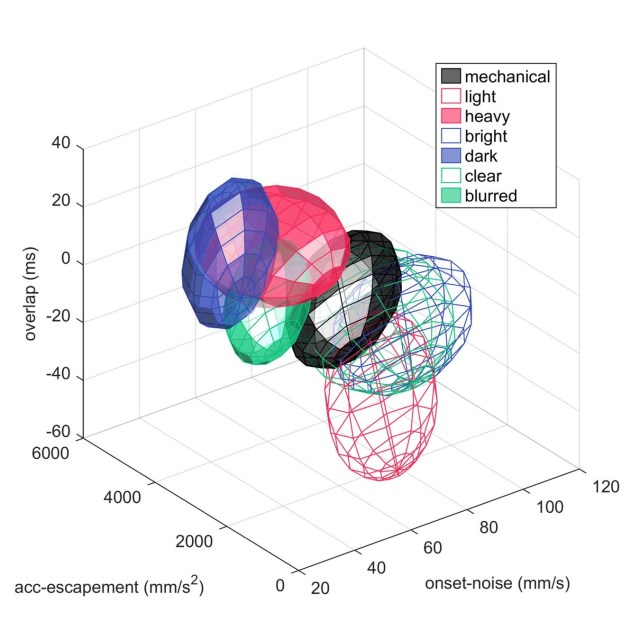
In this graph, the “overlap” axis shows how far different notes played by different fingers or hands either overlap, with a positive value in milliseconds, or are separated, with a negative value in milliseconds. The acc-escapement is the acceleration the key is undergoing at the moment the hammer is released, and the onset-noise is the initial speed of the key. The combination of these three values will make the hammer escape in a very slightly different way and create a sound in the corresponding timbre zone.
Not only does this mean that the age-old debate over whether timbre can be created on a piano through its keys has been solved, but we now know exactly how it’s done. This means it can even be potentially developed and taught to others, though my teacher, Mrs. Makino up the street, might have her work cut out for her.
By the way, this research was carried out as a part of the Japanese government’s Moonshot Research and Development Program, which aims to free humanity from physical, mental, temporal, and spatial restraints by 2050. I’m not exactly sure how this fits into all that, but it’s pretty neat and good to see the work is being done on it.
Source: PR Times, Reddit 1, 2, 3
Top image: Pakutaso
Insert images: PR Times
● Want to hear about SoraNews24’s latest articles as soon as they’re published? Follow us on Facebook and Twitter!
 Mt. Fuji decorated with a 500,000-flower pink carpet is Japan’s ultimate spring view
 30 Pikachus want to share a Tokyo hotel room with you that has separate Grass, Water, Fire spaces
 Pringles Chocolate, but with a Japanese twist, is the snack hack you should be trying right now
 Howl’s Moving Castle’s scene-stealing dog is here to clean your home as a plushie mop
 Does a long line mean a sweeter deal? We compare two sweets from a Hokkaido food fair【Taste test】
 Mt. Fuji decorated with a 500,000-flower pink carpet is Japan’s ultimate spring view
 30 Pikachus want to share a Tokyo hotel room with you that has separate Grass, Water, Fire spaces
 Pringles Chocolate, but with a Japanese twist, is the snack hack you should be trying right now
 Howl’s Moving Castle’s scene-stealing dog is here to clean your home as a plushie mop
 Does a long line mean a sweeter deal? We compare two sweets from a Hokkaido food fair【Taste test】
 What does a kanji with 12 “kuchi” radicals mean? A look at weird, forgotten Japanese characters
 Japanese fashion company’s modernized haori half coats will keep you warm and samurai chic
 New Travelling Bento pouches turn your luggage into a Japanese lunch box
 Drink vending machines disappearing in Japan as number drops to lowest in 30 years
 Hey, 2020s kids! The ’90s have a sticker picture message waiting for you in Tokyo
 Japan reportedly adding Japanese language skill requirement to most common foreigner work visa
 Pokémon and Ikea Japan cross over into each other’s worlds with collaboration events
 Starbucks Japan closing only Shinkansen platform branch for popularity-triggered renovations
 You can assemble a well-balanced team of Pokémon, them eat them, thanks to Japanese cake chain
 Two food hacks take Japan’s convenience store fried chicken to amazing new sandwich heights
 7-Eleven Japan’s new baked-in-store sweet treat is only available in three parts of the country
 Man bites woman at cherry blossom park in Japan, dies shortly after
 Peanuts and Coke becomes a viral hit in Japan, but is it a trend worth joining?
 Japan now has a special desk for people who work at home with a pet cat[Photos]
 Famous Tokyo cherry blossom spot installs view-blocking screens to fight overcrowding[Video]
 Uniqlo announces new T-shirts for One Piece, Naruto and more for manga publisher’s 100th birthday
 Train station platform ramen store closes its doors on half a century of history in Tokyo
 Starbucks Japan releases new My Fruit³ Frappuccino at only 34 stores around the country
 Krispy Kreme releases Super Mario doughnuts in Japan for a limited time
 Japanese onsen egg maker from 100-yen store Daiso needs to be on your shopping list
 Studio Ghibli releases Catbus pullback keychain that runs like the anime character
 Survey asks foreign tourists what bothered them in Japan, more than half gave same answer
 Japan’s human washing machines will go on sale to general public, demos to be held in Tokyo
 Starbucks Japan releases new drinkware and goods for Valentine’s Day
 We deeply regret going into this tunnel on our walk in the mountains of Japan
 Starbucks Japan releases new sakura goods and drinkware for cherry blossom season 2026
 Studio Ghibli releases Kodama forest spirits from Princess Mononoke to light up your home
 Japan’s newest Shinkansen has no seats…or passengers [Video]
 Major Japanese hotel chain says reservations via overseas booking sites may not be valid
 Put sesame oil in your coffee? Japanese maker says it’s the best way to start your day【Taste test】
 No more using real katana for tourism activities, Japan’s National Police Agency says
 What does a kanji with 12 “kuchi” radicals mean? A look at weird, forgotten Japanese characters
 Japanese fashion company’s modernized haori half coats will keep you warm and samurai chic
 New Travelling Bento pouches turn your luggage into a Japanese lunch box
 Drink vending machines disappearing in Japan as number drops to lowest in 30 years
 Hey, 2020s kids! The ’90s have a sticker picture message waiting for you in Tokyo
 Is the all-you-can-eat KFC buffet in Tokyo really as good as they say it is?
 Criminals of Japan’s Edo Period Were Often Punished by Getting Face Tattoos
 Famous koi ponds overwhelmed with tourists throwing thousands of coins in them
 The breathtaking beauty and bathing luxury of Oita’s Gettouan【Photos】
 Undead train station in Yokohama is beautifully nostalgic, poignantly desolate
 Final Fantasy invites you to adventure in Fukushima with Fukushima Fantasy Chocobo fun[Video]
 Monjayaki, the popular Tokyo dish you’ve probably never heard of 【RocketKitchen】
 Japan reportedly adding Japanese language skill requirement to most common foreigner work visa