
Ask someone to describe the Japanese people in ten words or fewer and more often than not ‘polite’ or ‘reserved’ will appear somewhere in the mix. Japan is known the world over as a safe, pleasant place to live where people are on the whole helpful and courteous; few people visit Japan and return home with tales of rude airport staff or inattentive waitresses.
When I first came to Japan, I had the pleasure of living for five years in a pretty little town in Fukushima Prefecture, surrounded by rice fields, rivers and some of the deepest greens I have ever seen. Of course, I experienced the warmth of locals’ hospitality and kindness first-hand, but it was only in when I moved south to Tokyo in 2011 that I came to understand the real meaning of the word manā (‘manner’), and began to appreciate how much more important it is in urban living.
An English word adopted into the Japanese lexicon, manā is used to describe everything from not sticking your chopsticks upright in a bowl of rice to putting your mobile phone in discreet mode during a meeting. During my time in Fukushima, I had become accustomed to Japanese customs and rules of social etiquette — saying ‘itadakimasu’ and ‘gochisousama deshita’ before and after a meal, respectively; reversing into a parking space so as not to make others wait while I reversed out later; saying ‘ojama shimasu’ when entering someone’s home or office — but city ‘manner’, I soon came to realise, is an entirely different beast.
With its population of more than 12 million, to say that Tokyo is crowded would be putting it mildly. Add an extra 3 million to that figure to include those commuting into the city from outside areas each day to arrive at a staggering 15 million. With so many people squeezed into such a small space, it’s little wonder that manners are such an important a part of daily life.
Every year, numerous surveys are carried out both by independent groups of statisticians and the three big rail companies–JR (Japan Rail), Keio, and Odakyu. Their goal: finding out what really gets on commuters’ nerves.
When it comes to interaction with other people and a lack of personal space, nothing can trump the rush-hour trains in Tokyo, so it’s only natural that, crammed into these steel tubes twice a day, five days a week, little annoyances are eventually going to take their toll on commuters. With this in mind, transport companies endeavour to keep abreast of the things that irk their customers, and hopefully take steps to dissuade such activities.
So what really ticks Tokyo’s commuters off? Of all the surveys and tables of data published in the last few years, the most common annoyances reported include:
1. People eating and drinking on the train
2. Not waiting for others to alight before boarding
3. Not removing backpacks when it’s crowded
and my own personal pet hate
4. Listening to music too loudly through headphones.
On those busy trains, there’s plenty to get on your nerves before long, it would seem.
But these are all merely insignificant niggles when compared to the two top-ranking offenders, which have remained unchanged for years: ‘using mobile phones,’ and ‘sitting inconsiderately and taking up seats.’
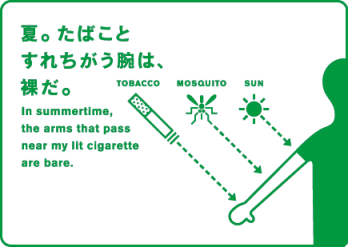
▼ Japan Tobacco’s posters usually focus on issues of safety and etiquette
Mobile phones are nothing new, but since the birth of the smartphone, allowing us to browse the internet, check our Facebook account or tweet about the annoying guy beside us who keeps peering at our screen, just about everyone has a mobile in their hand during their commute. While operating a mobile phone inside a train is not in itself considered rude, talking on the phone, or allowing it to ring, beep, or — as once happened to me and caused me a great deal of embarrassment — accidentally play an obnoxiously loud YouTube video, is a definite no-no.
Perhaps the reason Japanese people have such a reputation for impeccable politeness and consideration is due to the very architecture and shape of their society. In city areas, where land is sold at a premium and buildings are designed with ever-ingenious space-saving features, people often live in extremely close proximity to others. Thinking about others and how one’s own actions may affect, or bother, those around us, is more of a necessity here than it is in many developed countries. So when people violate these codes of conduct it stands out.
A friend of mine once told me of an incident he’d witnessed on his way to work that at once surprised him and made his day. On a crowded Shinjuku Station platform early one weekday morning, a pair of young foreigners were waiting for a train, both looking a little dishevelled as though they were making their way home after a night on the town. The taller of the two lit a cigarette and started smoking, seemingly oblivious to the glares he was receiving from those around him. Mere seconds later their train pulled into the station, so, with no time to finish his cigarette, the young man threw it on the ground, gave it a half-hearted stamp and moved to board the train.
To their right, a young Japanese couple looked on, their expressions a mixture of anger and frustration. The smoker suddenly noticed the couple looking between him and his discarded cigarette, but merely affected an apologetic smile while putting his hands together and making a small, sarcastic bow. Chuckling, he and his friend jumped on the train.
My friend was about to lose his temper, and felt that, as a foreigner himself, he ought to say something. But before he could even open his mouth, the young Japanese woman had already walked over to the discarded cigarette and picked it up. She hopped on the train after the pair, approached the smoker and calmly popped the cigarette into his breast pocket, before turning on her heel and stepping off the train. The doors closed and the train swept the young men, literally open mouthed, out of the station. The young woman, meanwhile, rejoined her partner wearing a huge grin and exchanged a cheesy high-five.
It’s still rare to see people take a stand like this, especially since incidents of gyaku-gire (where the offender turns angry after being reproached) are being reported more and more in the news, and it is simply not in most Japanese people’s nature to cause a scene in public, but there is a definite feeling of transition in the air in Tokyo when it comes to upholding rules with regard to appropriate manner. Of course, it would be wrong to suggest that all Japanese are champions of courtesy and politeness (nor do I share my friend’s story to suggest that non-Japanese are the villains here), and there are plenty of people who will happily ignore the rules, but these occasional outbursts seldom go unnoticed. In a city where people spend the vast majority of their time either in shared spaces while at work or commuting, or in close proximity to others while living in apartment-stlye housing, it’s difficult to imagine Tokyo functioning any other way.
▼Tokyo Metro’s famous ‘Do it at Home’ poster campaign
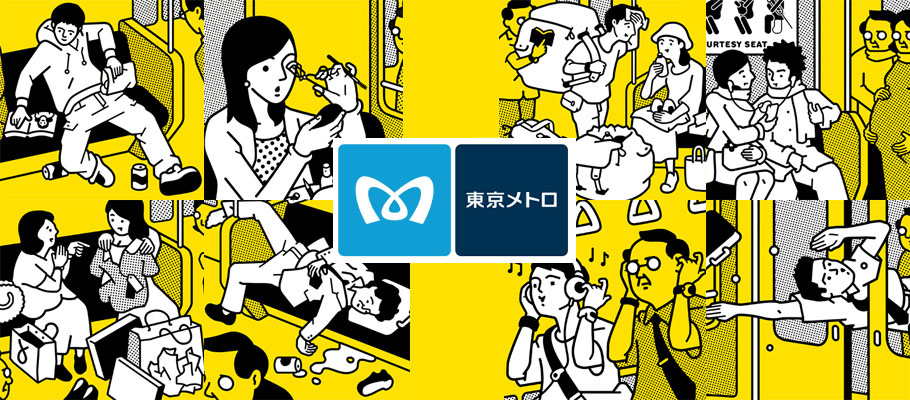
Smoking has been prohibited in Tokyo’s stations since 2009 after many complained of passive smoke while waiting for their trains. And while it’s still legal to smoke in many publics places like restaurants and izakayas, attitudes are slowly changing. A number of cities within the Tokyo area, for instance, now have no smoking emblems emblazoned on many roadways and pavements, and people are asked to smoke only in designated smoking areas. Anti-smoking poster campaigns, which are almost always based on manners and public perceptions of smokers rather than health risks, are a regular sight around stations, especially Japan Tobacco’s now famous ‘green men’ posters, that warn smokers about everything from breaking a child’s heart by putting out a cigarette in the snowman they built, to looking un-cool by tossing a butt on the ground like the hero in an antiquated cowboy film. Similarly, Tokyo Metro’s Ie de Yarou poster campaign goes some way towards showing how important ‘manner’ is in Japanese commuting life by depicting various anti-social acts such as falling asleep drunk, taking seats meant for disabled or elderly passengers, or applying make-up on the train (although personally I don’t have an issue with someone wanting to add a little mascara while commuting…), and politely asks ‘Please do it at home.’ It’s clear that, in the land where trains run on time and people bow while talking on the phone, Japan’s society also relies heavily on co-operation and the consideration of others.
So remember, kids: remove your backpack when it’s crowded, switch your phone to manner mode and get ready to give up your seat to an old lady. Chances are if you don’t, someone nearby might be working up the courage to tell you to.
Insert images InventorSpot, Kanpai
 Young People Speak Out: Recent Survey Suggests That Japan’s Older Generation’s Manners Stink
 Online backlash suggests smokers are becoming less tolerated in Japan
 Social experiment in India reveals smokers’ true feelings about their lethal habit
 Train etiquette poster features legendary Japanese folklore hero in an unusual plot twist
 Japan’s best conveyor belt sushi restaurant of seven years ago has now, finally, come to Tokyo
 Wisteria season starts early with blooming of Japan’s Great Wisteria in its beautiful garden
 Starbucks Japan releases FIVE new Frappuccinos in a day, and we try them all in 90 minutes
 Japanese trains in Sapporo might be better than those in Tokyo, thanks to one special feature
 Fading Tokyo – Horikiri Station, the Arakawa River, and Kinpachi-sensei[Walking course]
 Lawson convenience store at popular tourist site is one of the most unusual in Japan
 Mr. Sato discovers his inner beaver with a 16-inch chocolate “twig” at Tokyo Station
 7 great places to see Mt. Fuji from without having to climb it
 Foreign tourists in Japan will get free Shinkansen tickets to promote regional tourism
 One Piece devil fruit ice cream coming back to Baskin-Robbins Japan
 Japan reportedly adding Japanese language skill requirement to most common foreigner work visa
 Mt. Fuji decorated with a 500,000-flower pink carpet is Japan’s ultimate spring view
 30 Pikachus want to share a Tokyo hotel room with you that has separate Grass, Water, Fire spaces
 You can assemble a well-balanced team of Pokémon, them eat them, thanks to Japanese cake chain
 Man bites woman at cherry blossom park in Japan, dies shortly after
 7-Eleven Japan’s new baked-in-store sweet treat is only available in three parts of the country
 Starbucks Japan closing only Shinkansen platform branch for popularity-triggered renovations
 Pokémon and Ikea Japan cross over into each other’s worlds with collaboration events
 Japan now has a special desk for people who work at home with a pet cat[Photos]
 Famous Tokyo cherry blossom spot installs view-blocking screens to fight overcrowding[Video]
 Uniqlo announces new T-shirts for One Piece, Naruto and more for manga publisher’s 100th birthday
 Train station platform ramen store closes its doors on half a century of history in Tokyo
 Starbucks Japan releases new My Fruit³ Frappuccino at only 34 stores around the country
 Krispy Kreme releases Super Mario doughnuts in Japan for a limited time
 Japanese onsen egg maker from 100-yen store Daiso needs to be on your shopping list
 Survey asks foreign tourists what bothered them in Japan, more than half gave same answer
 Japan’s human washing machines will go on sale to general public, demos to be held in Tokyo
 Starbucks Japan releases new drinkware and goods for Valentine’s Day
 We deeply regret going into this tunnel on our walk in the mountains of Japan
 Starbucks Japan releases new sakura goods and drinkware for cherry blossom season 2026
 Studio Ghibli releases Kodama forest spirits from Princess Mononoke to light up your home
 Japan’s newest Shinkansen has no seats…or passengers [Video]
 Major Japanese hotel chain says reservations via overseas booking sites may not be valid
 Put sesame oil in your coffee? Japanese maker says it’s the best way to start your day【Taste test】
 No more using real katana for tourism activities, Japan’s National Police Agency says
 Japan’s cigarette culture: elderly ramen customer’s gesture of courtesy goes up in smoke
 Tokaido Shinkansen removing smoking rooms, going entirely smoke-free
 Japanese manners videos show how to be a “really cool” traveller in Japan 【Videos】
 Company’s smoking regulations cover all bases with math, technology, psychology, and courtesy
 An often-forgotten part of Japanese train etiquette that we should all keep in mind
 Japan’s Ikoma City prohibits using its elevators for 45 minutes after smoking
 Smokers Find New Haven in Japan, But for a Price
 Japanese convenience stores starting new anti-smoking measures in preparation for 2020 Olympics
 The 8 most annoying things people do on Japanese trains, according to local commuters
 What are you supposed to do with your backpack on a crowded train in Japan?
 Man pushed onto tracks at train station in Japan after listening to loud music on headphones
 Foreign tourists on Shinkansen bullet train break suitcase etiquette, angering local passengers
 Tokyo curry restaurant refuses to serve any customer with a strong odor
 15 rude things not to do on trains in Japan【Survey】
 Japanese company prohibits employees from smoking on their commute to the office