As public perception of smoking becomes increasingly negative, and with the number of smoking areas in restaurants and cafes in Japan becoming fewer and fewer each year, it’s fair to say that those little white sticks that once brought so much pleasure to so many are perhaps on their way out.
As people find themselves becoming more and more irritated by cigarette smoke as they walk though crowded streets, and residents grow sick of sweeping up discarded cigarette butts in their neighbourhoods, smoking anywhere outside of specially designated kitsuen (smoking) zones has become a punishable offence in many urban areas of Japan.
The times, they are a-changing.
But even with so many turning their backs of tobacco and labelling it as un-cool, few could have predicted that a company as large as Hoshino Resorts would actively advertise the fact that they no longer accept job applications from smokers.
With its emphasis on “rediscovering the beauty of Japan,” it perhaps stands to reason that the resort operator might want to pursue a cleaner, more environmentally friendly image.
But is this the right way to go about it?
Entering the company’s recruitment page, the soothing background music that plays in every other area of the site suddenly cuts out, and a screen featuring a lush forest background asks applicants a simple question:
▼”Before applying to our company, one question: Do you smoke?”
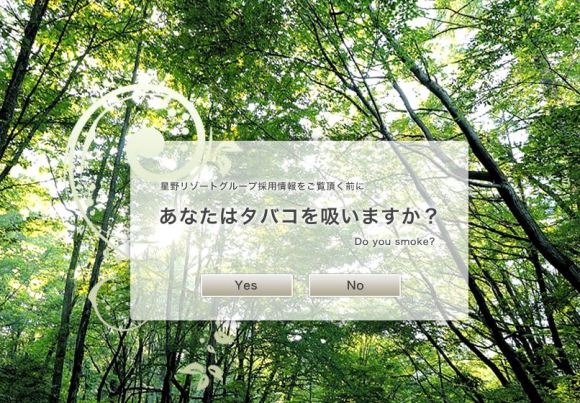
From there, users are asked to choose “Yes” or “No”. There’s no “sometimes” or “well, if I’ve had a few drinks and a friend offers me one…”.
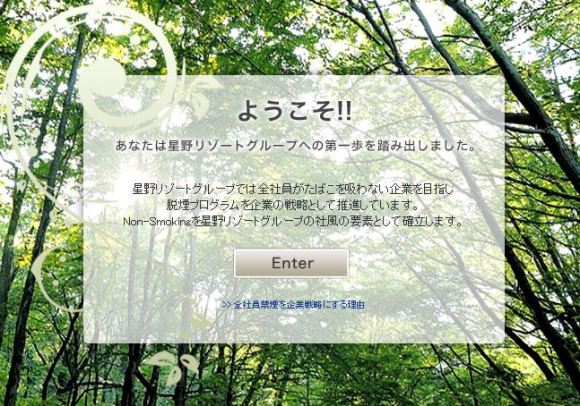
Clicking the “No” button takes users to the next screen where they are given a cheery greeting:
▼”Welcome! You’ve just taken your first step towards working with us!”
But by clicking the “Yes” button to signify that they smoke, users are taken to an altogether different place. A land of sobriety and dark backgrounds with lots of small text apologising, but making it quite clear, that smokers’ applications are not welcome at the group.
▼”We’re sorry, but the Hoshino Resort Group does not employ smokers.”
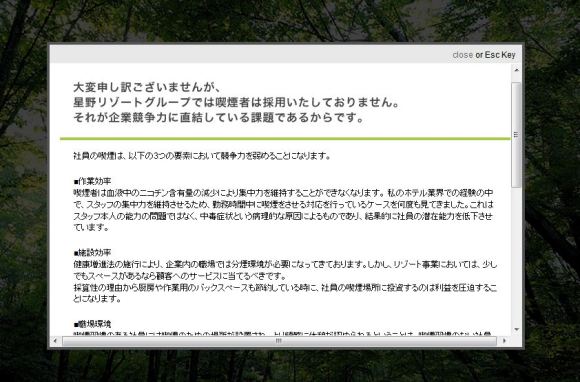
The long, detailed blocks of text go on to explain that the company refuses applications from smokers for reasons including cigarettes’ negative effect on “workers’ efficiency,” “the efficiency of facility itself” and “the overall working environment.”
This may seem a little harsh at first, but the company goes on to fully explain its decisions, outlining how, for example, those with a nicotine dependence often suffer from a lack of ability to concentrate when the time comes for their next cig. As well as this, smokers often feel the need to take breaks simply to smoke, which, in turn, requires the company to provide areas for them to do so without disturbing others. Hoshino Resorts argues that such practice, not to mention the segregation of staff and the need to invest capital in building a smoking area, has a negative effect on business, and one that they wish to avoid entirely by not employing smokers.
It’s not listed on Hoshino Resorts’ website, but this writer at least can’t help but feel that workers simply not wanting to sit next to a smoker after they return from a cigarette break might also be a legitimate reason for the move. That certainly made my working life quite unpleasant for several years in a previous job, anyway…
But how did Japan’s internet masses respond to the news that there are companies out there who actively shun smokers and deny them employment?
Overall, pretty positively:
– “One can only hope that this way of thinking spreads to other companies…”
– “So long as people obey the rules and only smoke where they’re permitted, I don’t have a problem with smoking. But when people pop off for a cigarette break during work and don’t come back for 10 minutes it kind of pisses me off.”
– “I’d love this to become the norm. I know that the tax levied on cigarettes goes back into the community, but after money is spent on healthcare and helping those with smoking-related diseases and illnesses, we’re still losing money.”
– “Makes good sense to me. People in this industry have to work closely with customers. If they stink it hardly makes a good impression…”
– “We can talk about ‘freedom of choice’ until we’re blue in the face, but at the end of the day, it’s non smokers who have to put up with smokers’ stink. I’m all for this new movement.”
Boom! The (non-smoking) people have spoken!
Hoshino Resorts stresses that smokers are, in fact, welcome to apply for positions at the company, but that- should they be successful in their application- they must sign a written pledge to kick the habit from then on. Perhaps someone ought to tell Hoshino Resorts that a smoker looking forward to their next cigarette is probably a lot more productive than one who’s attempting to go cold-turkey…
Of course, one or two internet users suggest that Hoshino Resorts’ anti-smoking system might be a little discriminatory, but, as many commenters state, “if they want the job badly enough they’ll quit. If not, there are plenty of other positions out there…”
What do you think of this radical new policy? Would you like to see similar measures taken in your workplace or is this a step too far? Let us know in the comments section below!
Source: Yahoo! Japan News Title image Inset images: 星野リゾート