
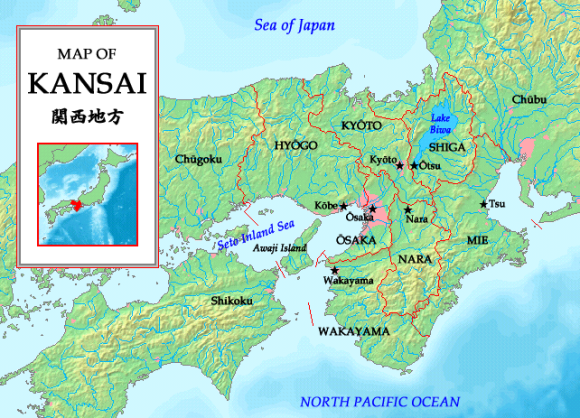
After last month’s false alarm of a large earthquake over our mobile phones, Nara and surrounding area residents’ blood pressures are finally getting back to normal. Well, don’t put away those paper bags yet. Now there’s another reason to worry. Research out of Yatsugadake Nanroku Observatory is suggests that we can expect a major earthquake of at least magnitude 7 to hit somewhere in the Kansai area from next week.
Earthquake-prone Japan is no stranger to proclamations of doom so it’s hard to get too worked up. However, the head of the observatory, Yoshio Kushida has made this prediction with a truly unique method that if correct could revolutionize earthquake prediction. Rather than looking down at the ground, Kushida suspects we can detect earthquakes better by watching the skies.
 Kushida was actually an astronomer by trade having discovered 56 asteroids and a couple of comets, both named after him. It was only by pure chance that his attention turned to earthquakes.
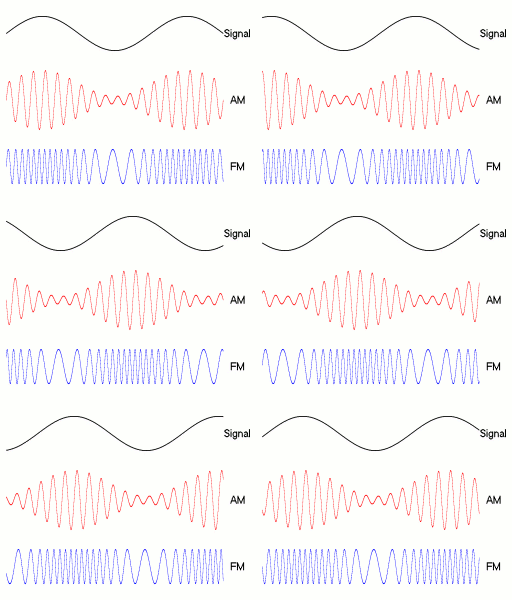
In searching for asteroids, he would use FM radio waves to scan the skies. If he picks up a disturbance in the signal then he may find a new heavenly body. Of course, in measuring these waves there’s bound to be a lot of interference which he has to overlook such as the Earth’s electrically charged ionosphere. So he calibrates a baseline to filter out the noise.
However, at certain times Kushida would notice the entire baseline get disturbed to the point it became jagged lines. One such time happened on 6 August, 1993. Two days later, a 6.5 magnitude quake hit the Okushiri Coast in Hokkaido. This was an aftershock of the Hokkaido Earthquake which claimed the lives of 202 people.
It was then that Kushida suspected there might be a correlation between earthquakes and FM radio waves. His theory goes that when a fault is formed it causes a fluctuation in the electric charge of the earth’s crust. If the fluctuation is large enough then it might trigger a change in the electron density of the ionosphere.
Therefore, when Kushida passes his FM waves through the ionosphere they experience either a stronger or weaker resistance. Throughout his experimentation he has discovered these changes prior to the 1995 Great Hanshin Earthquake, 2008 Iwate Miyagi Nairiku Earthquake, and several aftershocks following the Great Tohoku Earthquake of 2011.
 Now it appears data Kushida has collected from various locations in Japan has led him to believe the next epicenter will be located somewhere in the Kansai region of Japan but may spread out further to prefectures such as Aichi. The data also suggests that it could be the biggest one since the study began. Kushida explains his prediction as follows.
“Actually, we began formally observing the precursory phenomena in the beginning of July, 2008. Until now, this is the highest fluctuation we have seen following the pattern typical of a single earthquake. However, this could also be several fluctuations converging together to make one massive effect. Nevertheless, this level is unprecedented in the five years we’ve been doing this.”
This theory is still in its infancy and there’s no guarantee that any major earthquake will hit the area for quite some time. On the other hand, as I sit in Osaka I’m thinking it couldn’t hurt to grab some bottles of water and flashlights on the way home.
For those concerned about the possibility of an earthquake in Kansai, Kushida and the PHP Institute are making their day-to-day data available on a website (Japanese only).
Source: Zakzak (Japanese)
Top Image: Wikipedia – Zakuragi
Inset Images: Wikipedia – Kim Rötzel, Berserkerus