
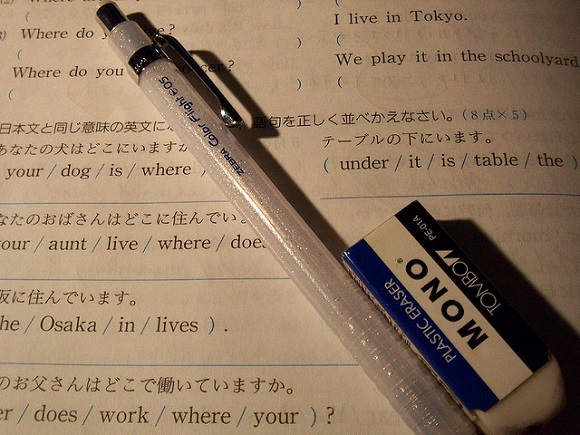
When you speak to foreign English educators in Japan, one thing becomes crystal clear: English education in Japan isn’t working. It’s just awful. While English classes are mandatory in Japanese schools, the percentage of students who emerge with actual English abilities are surprisingly low. Students in China, Korea and Japan are in an arms race to see who can produce students with the best English, and Japan seems to be trailing far behind in third place.
With the Olympic Games coming up in 2020, the Japanese government has proposed changes to increase the level of English ability in their students. Changes like starting introductory English classes in 3rd grade elementary school and making the subject compulsory from the 5th grade. Are these changes really going to help? We’ve gathered opinions from both foreign teachers and Japanese citizens about issues with the system and what might improve it.
Every foreigner who spends any amount of time in Japan will understand the fundamental need to change the way students study English. But a recent thread on the Japan subreddit, which seems to have been started by an English educator, tried to assemble as many opinions as possible about the matter in one place. Many of the complaints fell into three main categories:
1. Teaching to the tests
For those unfamiliar with the Japanese school system, most high schools and universities have a test that prospective students must take and pass. Especially in the case of high schools, there is a mandated set of content that appears. And so, Japanese Teachers of English (JTEs) focus on the grammar and vocabulary that will be on the test. A broader understanding and the practical uses of English are largely ignored because they have to cover the specific material and don’t have time for anything else.
So, if Japanese students have to learn specific material for the tests, why should they learn anything else? There is no point in actually learning the language if all that is required is being able to pick the correct answer on a multiple choice test. Many Japanese netizens agree, “Why change anything unless the style of testing is changed?”
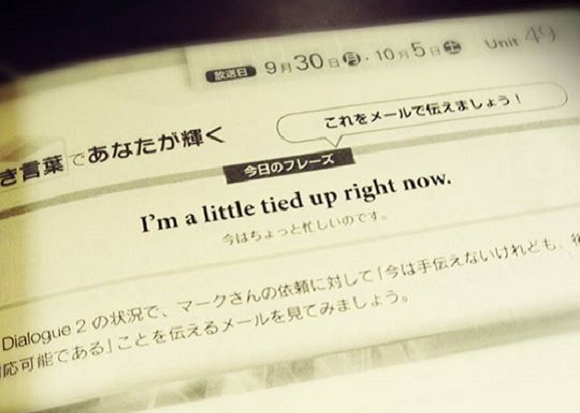 Image: Flickr (JaggyBoss)
2. The quality of the textbooks are quite low
Many foreign language teachers criticized the textbooks used in the classrooms, complaining about all manner of things including content and grammatical errors. Even more specifically, many people found the choice of grammar included to be suspect, saying it wasn’t grammar used very often in native English. The JTEs have to teach these archaic forms through topics such as recycling plastic, people and animals dying in WWII and boring Japanese history, causing students to be apathetic. (Topics like these are required in government approved textbooks.)
▼Ding dong, ding dong! Do you know why the school chime sounds like this?
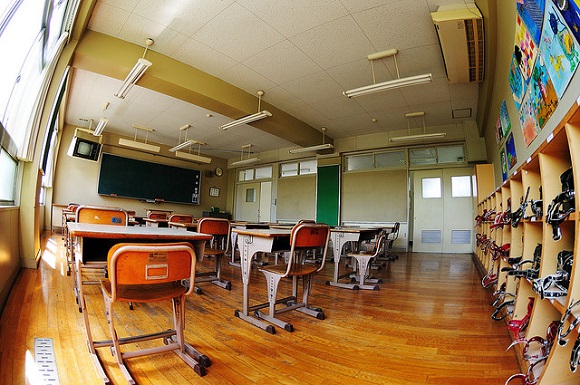 Image: Flickr (ajari)
3. A focus on translating into Japanese and JTEs speaking in only Japanese. Where is the English?
Perhaps one of the biggest complaints was the amount, or lack of English used in the classrooms. The JTEs often teach all the grammar in Japanese, and check that the students can follow the textbook by translating the English into Japanese. Assistant Language Teachers (ALTs) are relegated to human tape recorders, and then set free to roam the class and “help” the students. Of all the hours of English education, how many of those hours were spent actually listening to and speaking English? (Repeating English is not the same as speaking it.)
▼Teacher: “Repeat after me.” Students: “…Repeat after me.”
 Image: Flickr (Asako)
Japanese people agree that the current teaching style often limits students to what little English they hear from the teachers and what words are put in front of them. Successful teaching should include as many senses as possible to surround students in English. One Japanese netizen suggests that TV dramas should be utilized to hear real English, while seeing the facial expressions and mouth movements all together in one package. How can a student not be excited to learn phrases like “OK, I’m on my way”, “What’s the problem?” or “Freeze! You’re under arrest!”
▼24 was one of the TV shows suggested to interest students in English, Japan loves Jack Bauer
 Image: Amazon JP
Which brings us to the main problem with the current system: Japanese students don’t understand the benefits of learning English. This is certainly not limited to Japanese learners, but how many time do you hear a student say, “I’m Japanese, so I will never use English in the future.” Studying English as a language is one of the least interesting things about it. But, what about all the different things that you can experience when you understand English? TV shows, movies, books, games, and it’s not even limited to entertainment, scientific journals, international business and the majority of the Internet is conducted in English.
When the exposure of English is limited to the classroom and the unfortunate textbooks, a majority of the students will disengage from it and end up not learning anything. When students are forced to study and learn about certain grammar points and vocabulary, with no knowledge about how you can apply it to all the amazing things in English, of course, the students are going to do poorly. Expose them to the idea that, yes, this is a subject you have to study, but look at what you can do with it outside the classroom. You can excite students with that and promote self-study, which is a much better approach than learning “This is a pen” for the sake of a test.
As always, your opinions are welcome in the comments section.
Source: Vipper na Ore, subreddit
Top Image: Flickr (takako tominaga),
 English language education in Japan: Are native speakers essential?
 Japanese university English teacher fights student misbehaviour with eccentric new rulebook
 Japan reaches its lowest-ever ranking on Education First’s 2024 English Proficiency Index
 Learn English with Assassination Classroom
 English teachers in Japan apologize for having low-proficiency kids say “poison” in assigned video
 Japan reportedly adding Japanese language skill requirement to most common foreigner work visa
 Starbucks Japan closing only Shinkansen platform branch for popularity-triggered renovations
 You can assemble a well-balanced team of Pokémon, them eat them, thanks to Japanese cake chain
 7-Eleven Japan’s new baked-in-store sweet treat is only available in three parts of the country
 Sailor Moon’s Artemis is part of the Artemis II NASA mission control team[Video]
 Fading Tokyo – Searching for signs of the Showa era as local neighborhoods evolve[Photos]
 Japan’s full-facemask Ninja Parka still lets you eat ice cream[Photos]
 Pokémon Centers across Japan cancel April events after stabbing in Tokyo
 We eat 13 of the most highly recommended sushi items at Sushiro and pick the best of the best
 Such recognition! Official doge meme dog manhole cover installed in Japan【Photos】
 Pokémon and Ikea Japan cross over into each other’s worlds with collaboration events
 Tokyo’s best museum for foreign travelers finally reopens after being closed for four years
 Pokémon lacquerware series expands for Year of the Horse with new handcrafted design[Video]
 Two food hacks take Japan’s convenience store fried chicken to amazing new sandwich heights
 Tokyo subway and almost all Tokyo train lines now accepting credit card tap payments
 Totoro Fund line of beautiful artwork and apparel lets you help the real-world Totoro Forest
 Famous Tokyo cherry blossom spot installs view-blocking screens to fight overcrowding[Video]
 Tokyo turns its phone booths into free Wi-Fi hotspots, and here’s how to use them
 Studio Ghibli adds new My Neighbour Totoro 2026 Corn Gift to its anime store for Mother’s Day
 Japan now has a special desk for people who work at home with a pet cat[Photos]
 Uniqlo announces new T-shirts for One Piece, Naruto and more for manga publisher’s 100th birthday
 Train station platform ramen store closes its doors on half a century of history in Tokyo
 Starbucks Japan releases new My Fruit³ Frappuccino at only 34 stores around the country
 Studio Ghibli releases Catbus pullback keychain that runs like the anime character
 Krispy Kreme releases Super Mario doughnuts in Japan for a limited time
 Japanese onsen egg maker from 100-yen store Daiso needs to be on your shopping list
 Nine great places to see spring flowers in Japan, as chosen by travelers (with almost no sakura)
 Survey asks foreign tourists what bothered them in Japan, more than half gave same answer
 Japan’s human washing machines will go on sale to general public, demos to be held in Tokyo
 Starbucks Japan releases new drinkware and goods for Valentine’s Day
 We deeply regret going into this tunnel on our walk in the mountains of Japan
 Studio Ghibli releases Kodama forest spirits from Princess Mononoke to light up your home
 Starbucks Japan releases new sakura goods and drinkware for cherry blossom season 2026
 Japan’s newest Shinkansen has no seats…or passengers [Video]
 Major Japanese hotel chain says reservations via overseas booking sites may not be valid
 Put sesame oil in your coffee? Japanese maker says it’s the best way to start your day【Taste test】
 No more using real katana for tourism activities, Japan’s National Police Agency says
 The anime girl English teacher textbook character that stole Japan’s heart has gotten a promotion
 Kyoto Board of Education administers English test for teachers with disheartening results
 English for otaku – New book provides fans with skills to internationalize their oshikatsu
 Japanese students learn English with help from a dating sim artist
 Anime girl English teacher Ellen-sensei to star in written-in-Japanese light novel series
 Under 35 percent of middle school English teachers in Japan meet government proficiency benchmark
 Japanese student’s English homework captures futility of life
 Japanese student’s “drug dealer” English gaffe confuses foreign ALT
 Japanese teacher wakes up sleepy students by whipping out realistic model pistol in classroom
 Foreign English teacher in Japan calls student’s ability garbage, says it was an “American joke”
 Anime girl English teacher Ellen-sensei becomes VTuber/VVTUber and NFT
 “5 + 9” is okay but “9 + 5” is wrong? Is this being logical or overly picky?
 Is Japan overworking its teachers? One exhausted educator says, “YES!”
 Teaching English in Japan? New book helps students talk about the Illuminati, alien abductions
 The reason why Japanese students don’t pronounce English properly
 Can you write the alphabet properly? According to Japanese teachers, probably not