
Japan must be one of the cleanest countries in the world. What’s behind it all? Find out what makes Japan so pika-pika!
While Japan has some environmental problems it has yet to thoroughly understand and tackle, such as garbage in the Seto Inland Sea, overall, it’s a pretty clean country. The cities in particular are extremely well looked after. Grafitti is rare, people seldom throw trash on the ground and there are no signs warning of a hefty fine if you do. While not all Japanese people are as persnickety about leading clean and uncluttered lives like their well-known compatriot Marie Kondo, when it comes to public cleanliness, Japanese cities habitually shine.
In Japan there is definitely a prevailing idea that clean is good. From children having to clean their own schools to ritualized shinkansen cleaning, it doesn’t take long for a tourist to suspect there is something behind all these sweeping, wiping, sanitizing busy bodies who don’t lick stamps and who take shoes off before entering a building.
Here are a few insights into the culture of cleanliness.
1. No public trash cans? No problem!
▼ Two men wait in line with their garbage to get on the ferry after a barbecue party on the beach on Shiraishi Island.

One of the first things you may notice when the set foot in the country is that there are few public garbage bins once you leave the train station. In my country, I’m pretty sure the reason we have so many public trash cans is to discourage people from just throwing stuff on the ground. But generally Japanese people don’t expect others to take care of their waste They’ve been taught that you should always take responsibility of your own mess and take any garbage you create home with you to dispose of.
2. Tidy garbage
▼ An individual trash bag is provided for every seat in long-distance buses.
One reason you receive a bag at a convenience store even when you order just one or two items is that the bag helps you keep everything in one place, even after the contents of the bag become garbage. Who wants to put an empty drink can or dirty yogurt cup in their purse or backpack until they can find a trash can? No one, which is why having that plastic convenience store bag encourages people to pitch their refuse properly. In long distance buses, an individual trash bag is provided at every seat with the express purpose of encouraging people to use it for their trash (and probably to take it home) rather than just tossing it on the floor or leaving it behind on their seat.
While it does seem like a waste of plastic, it helps remind people to mind their manners. And if you’re concerned about the environment, you’ll use your own bag for your garbage and leave that plastic one for someone who might truly need it.
3. Private homes and businesses are expected to keep their areas clean
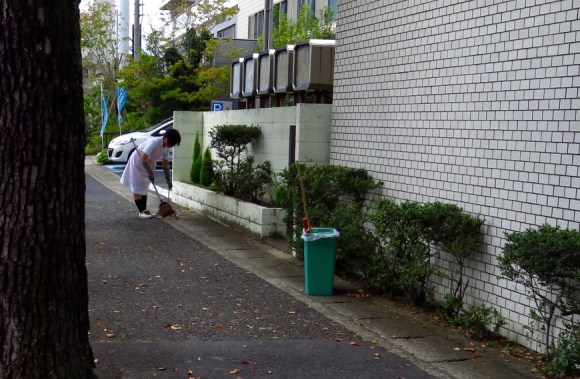
▼ A nurse sweeps up fallen leaves outside a medical clinic.
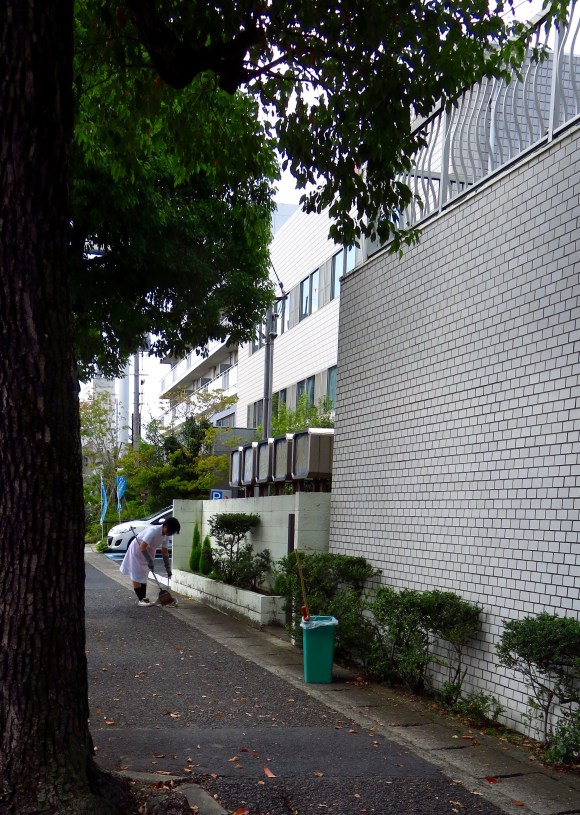
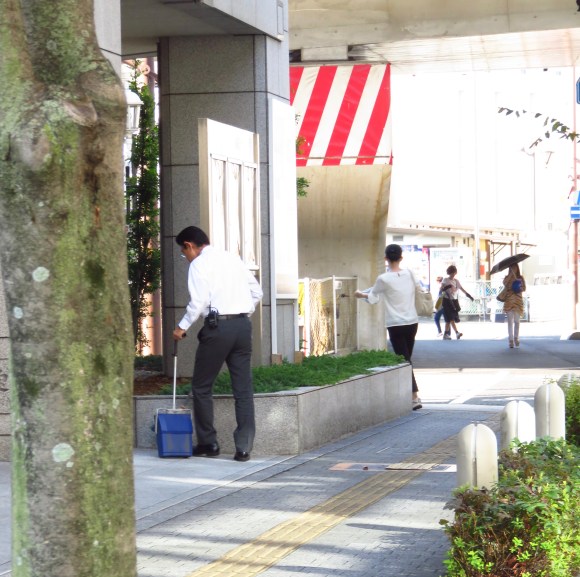
Why would you need street cleaners when you have a potentially endless source of inhabitants to pool from in the buildings along the sidewalk? Every morning you’ll find various people in Japan sweeping up around their house or place of employment. These are not building maintenance workers, but shop keepers, office men, nurses, etc.
▼ An office employee sweeps up outside his building at lunch time.
4. There is an art to tossing things asunder
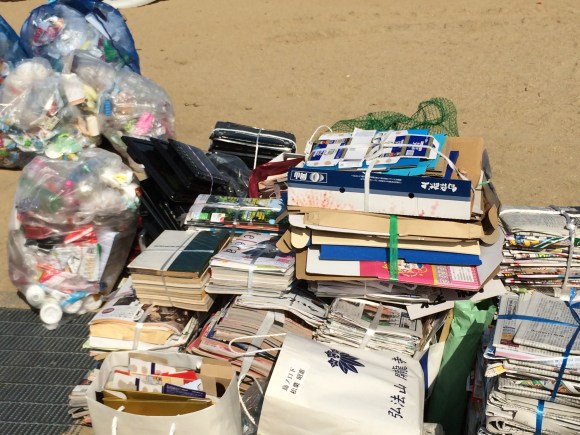
When it comes to household waste, you schlep your bags to the neighborhood’s designated curb yourself. On recyclable garbage days you’ll be expected to separate your garbage mindfully. And just to make sure you do, neighbors take turns overlooking the whole process (called gomi toban). Didn’t separate your newspapers from your magazines before stacking them on the pile? Didn’t rinse that soy sauce jar before tossing it in the recyclables bin? Tsk, tsk. You’ll have to take it back.
5. Volunteer litter cleaning organizations help keep awareness
▼ Volunteers from Greenbird Okayama, a non-profit organization, pose after a morning clean-up in the city (note their uniforms and gloves — always gloves!)
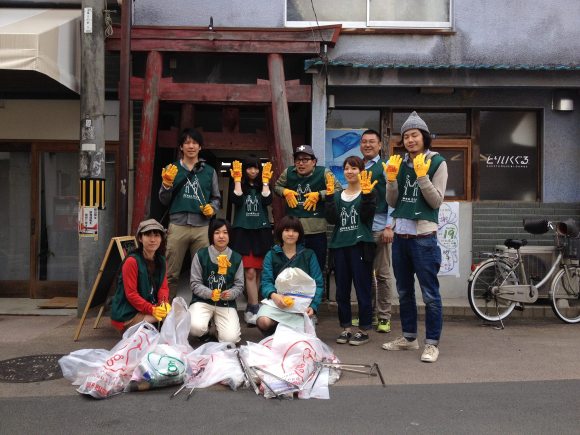
These NPOs take the pursuit of litter to an unprecedented level. Greenbird, an organization that can be found in many prefectures throughout Japan, invites citizens to regularly clean high traffic areas of the city such as near the train station. I joined this group once and was shocked. I thought we’d be picking up empty beer and soda cans, fast food wrappers etc. But no, we lifted tiny little pieces of paper off the dirt with tongs and collected cigarette butts that were hiding behind shrubs. Most of it was detritus that you could hardly even see. But that’s the idea–clean it up before it becomes noticeable. And people are less likely to leave a mess in orderly places than they are messy ones.
There’s a Greenbird branch in Singapore (no surprises there) and the Japanese organization has even taken their skills to Paris!
6. Immaculate Public Transportation is the norm
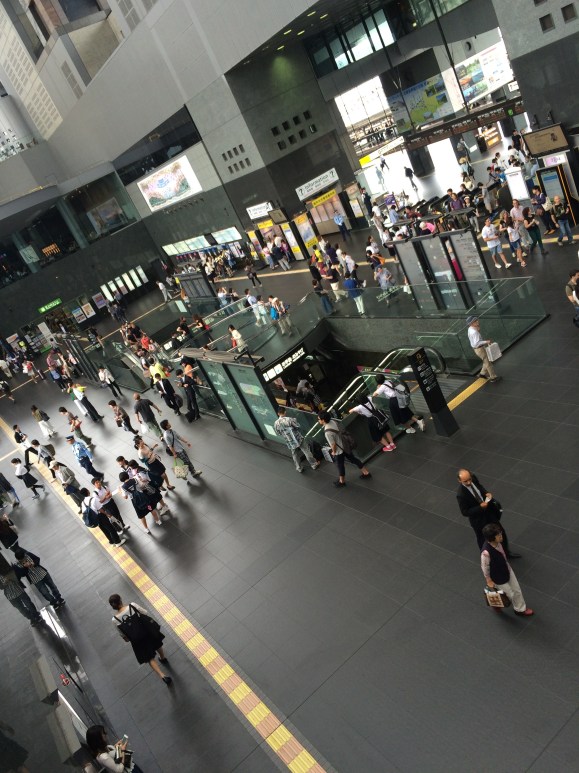
▼ A typical sparkling day at Kyoto’s train station
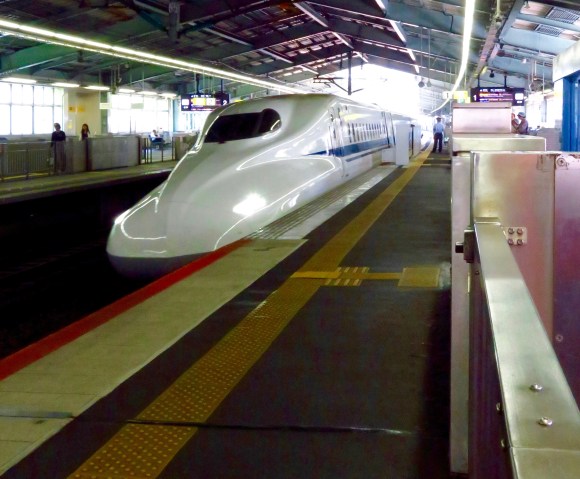
▼ The always gleaming shinkansen train
▼ Station cleaners even scrape up gum off the floor.
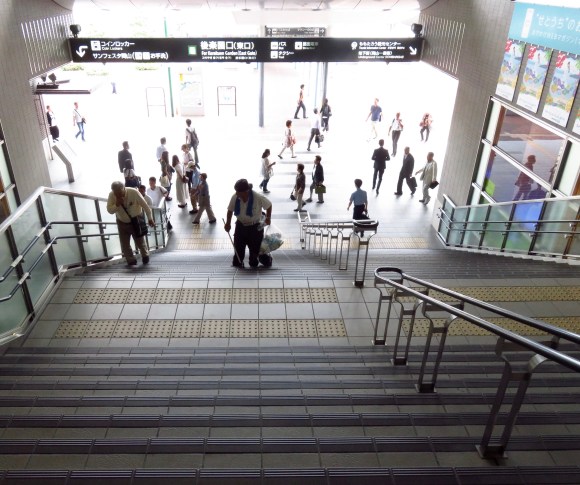
‘Nuff said!
7. Cleanliness–even on the road
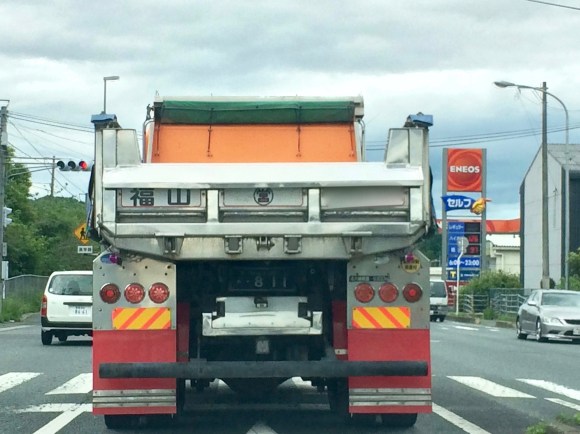
One of the things that surprised me when I first came to Japan was that even commercial trucks, such as those used in construction, cement-making and dirt hauling, are kept meticulously clean. Every night after their shift, truck drivers are careful to wash down their vehicles. Those semis on the highways are spotless, the chrome polished, because their drivers take pride in having beautiful sparkly vehicles.
And let’s not forget the white-gloved taxi drivers, polishing their chariots as they wait for the next passenger.
8. Neighborhood clean-ups

If you live in Japan, you’re bound to be asked to join regularly scheduled (and semi-obligatory) community clean-ups in your neighborhood. At these preset times, sometimes as early as 7 a.m. so people can participate before they have to go to work, neighbors don gloves, carry shovels, scythes, rakes and clippers and collectively clear the street drains, cut back the trees, weeds and grass and generally tidy up the surrounding area, including small parks and public toilets. A little bit of help goes a long way and residents can take pride in their neighborhood. It’s just part of the clean and tidy culture and also helps neighbors bond together as a community.
There are many more reasons why Japan is so clean, but these are just a few we wanted to share with you. And more over, they seem to work!
Let us know what you’ve noticed about cleanliness in Japan in the comments section.
All images ©Amy Chavez/RocketNews24 unless otherwise noted
 You party, we tidy — Volunteers, kids hit Shibuya streets to clean up after Halloween hijinks
 Highway rest stop’s new high-tech trash cans are another reason Japan’s parking areas rule
 Shibuya Halloween cosplay cleanup crew wants your help this year!
 No Time for Cleaning? Japan’s “Hot Cleaning Guys” Will Take Care of it For You!
 The morning after: Volunteers clean up the litter from Tokyo’s Halloween street party
 Studio Ghibli releases the My Neighbour Totoro tea caddy, with a magical self-closing lid
 Japan now has a “for foreign tourists only” Mt. Fuji sightseeing train[Video]
 7-Eleven Japan releases a crazy new viral sandwich: Chocolate Sprinkles and Whipped Cream
 Can you make butter by running with a pouch filled with cream? Let’s find out[Taste test]
 Drinkable pixels: 7-Eleven Japan creates new convenience store juice with “pixels” inside
 Ramen restaurant in top Tokyo tourist neighborhood skips price gouging, but how does it taste?
 When is the right time for a love confession in Japan?
 Public restrooms in Osaka to get in-stall video screens with ads
 Ghibli Museum building becomes a cuddly cushion
 Kamishibai — the precursor to manga and anime?
 Starbucks Japan releases new My Fruit³ Frappuccino at only 34 stores around the country
 Japanese onsen egg maker from 100-yen store Daiso needs to be on your shopping list
 Cherry blossoms begin blooming in Japan with record-early starts for sakura season
 Tokyo government organizes food truck event to clear out delinquent/homeless teen gathering area
 Nine amazing off-the-beaten-path cherry blossom spots in Japan for yaezakura and shidarezakura
 Stunning central Japan wisteria festival is like a purple fantasy straight out of a Ghibli movie
 When will the cherry blossoms reach full bloom in Japan this year?[Forecast]
 Studio Ghibli unveils new Rollbahn notebook in honour of Howl’s Moving Castle
 Studio Ghibli adds new anime tumblers to its cool streetwear brand in Japan
 Universal Studios’ Sailor Moon theme park attraction is finally coming to America
 Starbucks Japan unveils new sakura cherry blossom collection for hanami season 2026
 Train station platform ramen store closes its doors on half a century of history in Tokyo
 Studio Ghibli releases Catbus pullback keychain that runs like the anime character
 Nine great places to see spring flowers in Japan, as chosen by travelers (with almost no sakura)
 Starbucks Japan releases first-ever Hinamatsuri Girls’ Day Frappuccino
 Studio Ghibli adds new Mother’s Day gift sets to its anime collection in Japan
 Virtual idol Hatsune Miku redesigned with look that adds new elements and brings back old ones
 Survey asks foreign tourists what bothered them in Japan, more than half gave same answer
 Japan’s human washing machines will go on sale to general public, demos to be held in Tokyo
 Starbucks Japan releases new drinkware and goods for Valentine’s Day
 We deeply regret going into this tunnel on our walk in the mountains of Japan
 Studio Ghibli releases Kodama forest spirits from Princess Mononoke to light up your home
 Starbucks Japan releases new sakura goods and drinkware for cherry blossom season 2026
 Japan’s newest Shinkansen has no seats…or passengers [Video]
 Major Japanese hotel chain says reservations via overseas booking sites may not be valid
 Put sesame oil in your coffee? Japanese maker says it’s the best way to start your day【Taste test】
 No more using real katana for tourism activities, Japan’s National Police Agency says
 This Chinese university student’s room is so messy, it made news headlines【Video】
 Race against the clock: Shinkansen staff have just 7 minutes to get bullet train ready to ride
 American comedian Jimy Kimmel was blown away by Japan’s bathrooms【Video】
 Japanese city changes “burnable trash” bags to “the only option is to burn this trash” bags
 “Recycling in Japan” or “Reasons to get it right and avoid eternal shame”
 Garbage-collecting samurai keep Japanese streets clean, but what’s their real story?
 Japan’s secret garbage problem–and what you can do to help
 “Death room” cleanup employee makes “beautiful” replicas of terrifying rooms people died alone in
 Japan’s top sakura cherry blossom viewing spots littered with trash after hanami picnics
 Short video looks at why Japanese students serve their own school lunches, clean their classrooms
 Sumida River Fireworks Festival aftermath: Not everyone in Japan has perfect manners after all
 Kyoto merchants want city to install more trash cans to fight litter in historic neighborhood
 Seiji wants to invite his new girlfriend back to his place, but there’s just one problem…
 Confessions of a gaijin: 12 things we do that we’d never admit to Japanese people
 Divine prevention – Japan using Shinto symbols to combat litter and public peeing