Forget putting the fear of God into someone; this graveside sign calls on spirits to ensure people mind their manners.
When you visit Japan, one thing you notice is how clean the country is. Storefronts often look cleanly swept, and residential areas are so well-maintained you’d think a professional team was in charge of keeping the area clean.
Still, it’s actually the residents themselves who are responsible for the constant upkeep, with daily cleaning chores extending out of the house and on to the street, where flowerbeds are weeded, pavements washed with water, and litter collected and taken away.
To help maintain this sense of cleanliness, you’ll often find signs on the streets asking people not to litter in the area. For some residents, though, when ordinary street signs just aren’t doing enough to get the message across, it’s time to take matters into your own hands, and that’s exactly what our Japanese-language reporter found when he visited an area in Okinawa recently.
Here, on a street next to a small collection of gravestones in the capital city Naha, is a sign designed to strike fear into anyone who might be thinking of littering.
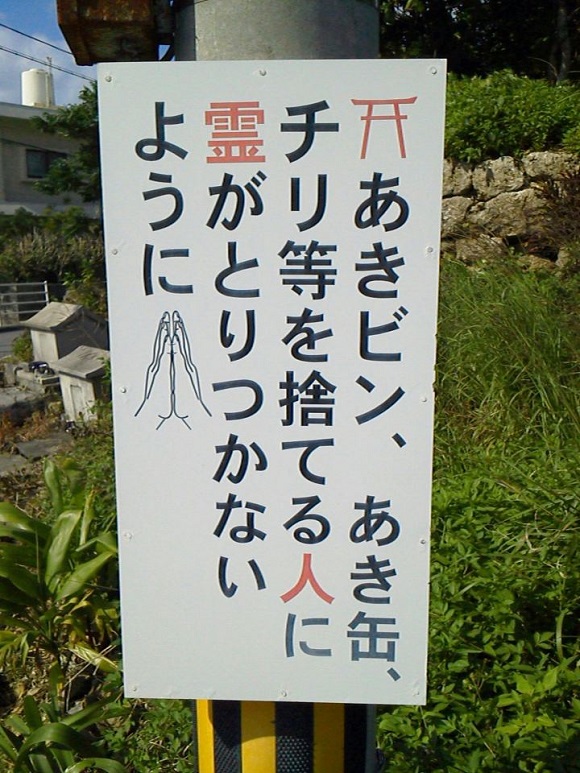
The literal translation of the sign reads:
“We hope spirits don’t posses people who litter with things like empty bottles, cans and trash.“
While the message itself might not sound overly ominous in English, in a country like Japan, where many people follow the Shinto religion, gods and spirits are ever-present in everyday surroundings. Even in Okinawa, where the indigenous Ryukyuan religion is prominent, the gods and spirits of the natural world are not to be messed with, so this mention of spirits would have people anxiously looking over their shoulders and holding on tight to their trash.
To add to the ominous nature of the message, the kanji for “person” and “spirit” appear in bright red to really make the message stand out, while a red torii Shinto gate can be seen in the top right-hand corner to remind people of the Shinto religion.
The clasped hands at the end of the message work to reinforce the sense of hope for the trash-throwers, as the words “ように” (you ni) are often used when making a request in prayer.
Given all the additional symbolism and nuance contained within the sign, for a Japanese passer-by this message reads more like:
“Beware the spirits that threaten to posses those who litter here.“
Our Japanese-language reporter who stumbled upon the sign had chills as soon as he saw it, and after stopping for a moment to snap the above photo, he immediately wondered who had erected the sign. Given that he could see a collection of graves to the left of it, he headed to the nearby cemetery office and asked them if they had put up the sign on the street.
According to the staff at the office, they weren’t responsible for the sign and had just assumed it was a local individual who had placed it there. While they hadn’t put it up themselves, they said it had been an effective deterrent as levels of trash in the surrounding area had noticeably decreased.
After speaking to the staff, our reporter went on his way, intrigued by the local initiative and impressed by the effective result. But as he walked along the trash-free street, he couldn’t help but wonder whether it was an individual or a spirit that should really be thanked for conjuring up the sign and ensuring the cleanliness of the town.
Photos © SoraNews24
[ Read in Japanese ]