
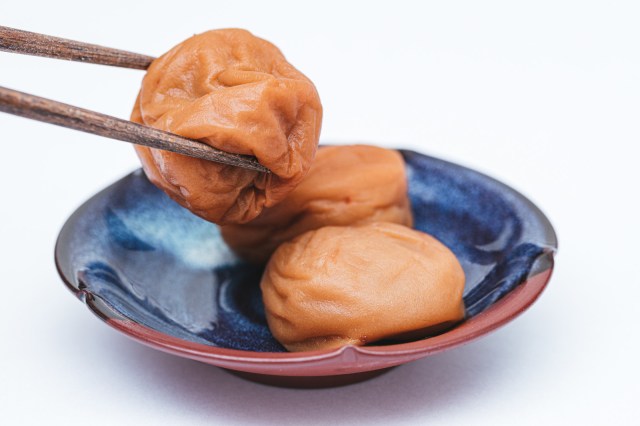
A traditional food is taking a hit among the younger generations in Japan.
Umeboshi (梅干し) is often translated as “pickled plum” in English but it more accurately describes the pickled version of a type of fruit called ume which is similar to an apricot. It’s often eaten on top of a bowl of rice or tucked away inside of an onigiri rice ball in Japan. With its high concentration of citric acid comes many health benefits, but also an extremely sour taste.
▼ Pucker up! A sample breakfast spread with two umeboshi waiting to be eaten
https://twitter.com/XcQpo/status/877631329822621697According to Sankei News, a daily Japanese newspaper largely focused on economic issues, the typical household expenditure for umeboshi among younger Japanese has decreased by roughly half since 1999. In general, a household budget survey by the Ministry of Internal Affairs and Communications indicated that yearly umeboshi expenditure per household (defined as two or more people) averaged 879 yen (US$8.11) in 1985, peaked at 1,897 yen in 1999, and while it rallied a bit in the last few years, has overall continued to decrease and dropped again to 1,474 yen last year.
When viewed in terms of different age brackets, last year those families with heads of household 70 years old and above spent over five times as much on umeboshi as those families with heads of household 29 years and below–2,012 yen versus 369 yen–resulting in the largest discrepancy in the past two decades. Furthermore, in 2000 the average umeboshi expenditure of families with heads of households 29 years and below was 694 yen versus the current 369 yen, indicating an almost 50 percent reduction.
Even Wakayama Prefecture, Japan’s top producer of ume which provides 65 percent of the nation’s crop, hasn’t escaped the declining trend. Last year’s household umeboshi expenditure in Wakayama averaged 3,168 yen–still overwhelmingly the highest expenditure in all of Japan, but nevertheless down from 2007 and 2009 when it exceeded 5,000 yen. From 2016 through last year the average expenditure has hovered around 3,000 yen.
▼ A typical reaction by younger Japanese and those unaccustomed to the sourness of umeboshi

So what accounts for the decrease in umeboshi consumption among younger Japanese? Dislike of its sour taste is generally attributed as being the main culprit. Sankei reporters interviewed some people outside of JR Wakayama Station in early March to hear their preferences for the pickled food. While the majority of younger voices expressed some form of distaste for the sourness, there were a few particularly strong reactions, including the following from a woman in her late 20s: “I hate it. I don’t like the texture, and it’s too sour. I ate it when I was little but I haven’t since then. My family likes it but I don’t.” Meanwhile, a 45-year-old man with a daughter in the second year of high school responded, “I like umeboshi and eat it every morning with breakfast. I feel something’s lacking if I don’t. However, my daughter doesn’t really eat it.”
Net voices also chimed in with their reactions to the data:
“I bought umeboshi yesterday. Ah, I guess I really can’t be called a ‘youth’ anymore.”
“But even just one umeboshi makes an excellent side dish at breakfast…”
“I see that today’s youth are closely monitoring their salt intake.”
“Even if you normally hate it you’ll want to eat it when you have morning sickness–trust me.”
“There are some sweeter varieties out there. Keep looking, young people!”
Bridging off that last comment, it seems that one possible strategy for cultivating an interest in umeboshi among the younger generations again is to increase production of sweeter varieties that are preserved with honey or brown sugar. Only time will tell if the household umeboshi expenditures rise again.
Source: Sankei News via Otakomu
Featured image: Pakutaso
Insert image: Pakutaso
● Want to hear about SoraNews24’s latest articles as soon as they’re published? Follow us on Facebook and Twitter!
 Japanese salted plum industry in dire straits, according to umeboshi company’s tweet
 Top five Japanese prefectures for childhood education expenditure would make any wallet shudder
 Japan’s best conveyor belt sushi restaurant of seven years ago has now, finally, come to Tokyo
 Wisteria season starts early with blooming of Japan’s Great Wisteria in its beautiful garden
 Starbucks Japan releases FIVE new Frappuccinos in a day, and we try them all in 90 minutes
 Japanese trains in Sapporo might be better than those in Tokyo, thanks to one special feature
 Downtown Tokyo’s meaty monster Kaibutsu ramen will challenge your stomach, thrill your taste buds
 Lawson convenience store at popular tourist site is one of the most unusual in Japan
 Mr. Sato discovers his inner beaver with a 16-inch chocolate “twig” at Tokyo Station
 Pringles Chocolate, but with a Japanese twist, is the snack hack you should be trying right now
 New Travelling Bento pouches turn your luggage into a Japanese lunch box
 Manga artist Kenya Suzuki convicted of child pornography charges, given suspended prison sentence
 Japan reportedly adding Japanese language skill requirement to most common foreigner work visa
 Mt. Fuji decorated with a 500,000-flower pink carpet is Japan’s ultimate spring view
 30 Pikachus want to share a Tokyo hotel room with you that has separate Grass, Water, Fire spaces
 You can assemble a well-balanced team of Pokémon, them eat them, thanks to Japanese cake chain
 Man bites woman at cherry blossom park in Japan, dies shortly after
 7-Eleven Japan’s new baked-in-store sweet treat is only available in three parts of the country
 Starbucks Japan closing only Shinkansen platform branch for popularity-triggered renovations
 Pokémon and Ikea Japan cross over into each other’s worlds with collaboration events
 Japan now has a special desk for people who work at home with a pet cat[Photos]
 Famous Tokyo cherry blossom spot installs view-blocking screens to fight overcrowding[Video]
 Uniqlo announces new T-shirts for One Piece, Naruto and more for manga publisher’s 100th birthday
 Train station platform ramen store closes its doors on half a century of history in Tokyo
 Starbucks Japan releases new My Fruit³ Frappuccino at only 34 stores around the country
 Krispy Kreme releases Super Mario doughnuts in Japan for a limited time
 Japanese onsen egg maker from 100-yen store Daiso needs to be on your shopping list
 Survey asks foreign tourists what bothered them in Japan, more than half gave same answer
 Japan’s human washing machines will go on sale to general public, demos to be held in Tokyo
 Starbucks Japan releases new drinkware and goods for Valentine’s Day
 We deeply regret going into this tunnel on our walk in the mountains of Japan
 Starbucks Japan releases new sakura goods and drinkware for cherry blossom season 2026
 Studio Ghibli releases Kodama forest spirits from Princess Mononoke to light up your home
 Japan’s newest Shinkansen has no seats…or passengers [Video]
 Major Japanese hotel chain says reservations via overseas booking sites may not be valid
 Put sesame oil in your coffee? Japanese maker says it’s the best way to start your day【Taste test】
 No more using real katana for tourism activities, Japan’s National Police Agency says