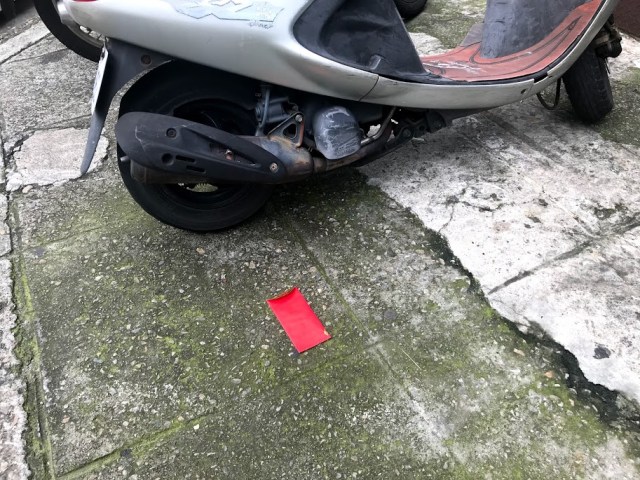
Especially for men, snatching an unassuming red envelope from the ground can lead to a shocking proposition.
Red envelopes in Chinese culture are considered a lucky item. Traditionally stashed with cash and given to children during the Lunar New Year, the red color of the envelope signals good fortune for future generations.
However, despite the positive associations of red envelopes and money-giving, Japanese Twitter users have been abuzz about the implications of a red envelope left on the ground.
Starting from a post by @oogoda1, who is a Mandarin teacher based in Taiwan, the user stressed a warning to their fellow Japanese netizens thinking about taking a jaunt through the tropical island country.
https://twitter.com/oogoda1/status/1270655232104468481“Warning about Red Envelopes in Taiwan.
Yesterday, I saw a red envelope on the ground. However, be careful about thinking it’s free money and celebrating too early! It’s most likely a ghost marriage proposal. Ghost marriage is tradition where a family tries to find their deceased daughter a groom, and they do so by placing her photo as well as a lock of her hair in a red envelope. If a man picks it up, the family will believe he is the fated groom of their deceased daughter, and force him to marry her. This is the third time I’ve seen this.”
While it’s common sense not to randomly grab things from the ground that don’t belong to you, it’s understandable why @oogoda1 posted a warning about this phenomenon: though red envelopes aren’t used in Japanese culture, they are often commonly associated with prosperity and cash, so anyone with this tidbit of cultural knowledge may feel tempted.
Japanese netizens, expats living in Taiwan, and even Taiwanese people pitched their voices into the discussion:
“If this is really true, please be careful folks.”
“Scary! This is even more terrifying than a ghost story.”
“I’ve been to Taiwan multiple times, and quite frankly I’ve never seen anything like this before.”
“I was born in Taiwan, but I’ve never seen this before. While it’s quite common to think that Taiwan is relatively modernized, in reality the superstitions of temples and even churches play an important role within many communities.”
“I’m Taiwanese, and when I was a kid, I remembered seeing these envelopes on the road side quite often since I lived near crematoriums and funeral parlors.”
“If a lot of Taiwanese people know about this, and don’t pick up the envelope, does this mean it’ll lead only to international marriages?”
▼ One Japanese Twitter user claimed that a ghost marriage proposal wouldn’t count if you’re a woman, as well as how to negate an accidental pick-up.
女性が拾った場合はノーカウントで、男性が手に取ったら物陰に隠れて見ていた家族がお近づきになり、式についてのお話しを始める…と聞いたけれど、お金を入れて「良い方と巡りあい下さい」と声に出すとノーカウントだそう。清王朝もあったよね。今も残ってる所は結構ある。 https://t.co/uERsM7ed30
— はるか (@usN9dQ0M3dz65DJ) June 10, 2020
“If a girl picks up the red envelope, it doesn’t count. If a guy picks it up, then a family member nearby watching the act will come out of hiding and confront the guy is what I heard. However, if you put some money in the envelope, and say ‘I hope you find a good match,’ then it won’t count anymore. I believe this tradition has been ongoing since the Qing Dynasty, and there’s a good amount of places that still practice it.”
▼ A Taiwanese Twitter user went the distance to explain another cultural tradition in Taiwan where a red envelope on the floor is involved.
可能不是冥婚的!應該神壇騙術“花錢消災術”、裡面放至少一百元起的現金、頭髮及指甲、丟在路邊讓人去撿、誰撿拾到就會等同拿錢幫他消災!其實這根本不可能、撿到的人別怕、什麼事都沒有、拿著裡面的錢去買彩券、買任何東西、其餘的拿去廟的金爐燒掉。冥婚的紅包外面會裹著東西、不會一眼就看到。
— 江 少 (@v_hawk2000) June 10, 2020
“If you see a red envelope on the ground, it might not be related to ghost marriage! In Taiwanese culture, we have a traditional practice called hua qian xiao zai shu [lit. Spend Money, Avoid Calamity Method].
Basically, if you experience a small misfortune, you spend money to lower the chance of a larger misfortune by putting in some cash and a piece of yourself (hair or nail acceptable) in a red envelope.
You then wrap it up in something [e.g. a piece of clothing, in another envelope] and leave it on the ground. If a stranger grabs it, they’re actually doing a favor by taking away the misfortune — the cash inside the envelope can be used however they like, but the hair/nail inside should be burned at a local temple!”
Regardless of the interpretations one may have about a red envelope on the floor, one important question to ask is: why is ghost marriage practiced, and what does it actually entail?
Traditionally in Chinese culture, families have altars dedicated to their deceased ancestors, usually taking time to pray and offer tributes in the form of favorite food items as well as incense. Women, however, are added to the ancestral altar of their husband’s family. If a woman doesn’t marry, she will not have a spot in an ancestral altar, and there is a risk that once she passes away, she will become a “hungry ghost,” assumed to wander starving and alone, eventually spiting humans out of vehemence.
▼ Feed your local ghosts, lest they show up through town in a spooky posse.

Through ghost marriage, the unmarried, deceased party is granted a place to rest and will be remembered onto posterity. Depending on the family, the living groom may be expected to commit through all rituals and practices of a traditional Taiwanese marriage. The living spouse will still be able to take on another spouse in the mortal world, so the arrangement isn’t necessarily going to restrict or hamper your dating chances if for some reason you become the spouse of a ghost.
It should be noted that the aforementioned practices differ between families, and sometimes ghost marriages are done between a deceased party and their still-living significant other. Not to mention ghost marriage isn’t just a purely Chinese tradition — it has been practiced in multiple parts of the world, from South Korea to France, and even in Japan. Japan’s ghost marriage traditions are primarily regulated to Okinawa and mountain villages in Yamagata. Historically, Okinawan ghost marriages were similar to Chinese ancestor worship customs — unsurprising considering the influence of Chinese culture on the former Ryukyu kingdom.
However, in Yamagata, the tradition of ghost marriage is related to a practice called mukasari ema, mukasari a derivation of the term mukaerare which means to welcome a marriage, whereas ema an is a votive tablet commonly purchased at a Shinto shrine.
▼ With the typical ema, the buyer can write, or even draw, their wishes on it for an extra divine boost.
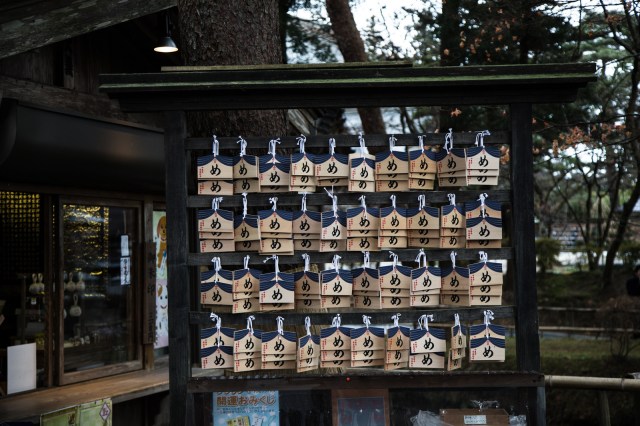
Mukasari ema is essentially a framed drawing of the unmarried deceased in a wedding ceremony, paired with a fictional spouse. When the deceased child is of age, their family commissions a local temple for this type of ema for two main reasons: to grant their offspring the rite of marriage, and to ensure they are happy even in the afterlife.
Even if you don’t believe in the afterlife or subscribe to superstition, the focus on securing a child’s overall well-being is universal no matter the country or customs. At the end of the day, parents simply want their children to be happy. They try their best in the cultural contexts available to them — for the sake of stability, longevity, and posterity — with traditional practices no doubt being one of the most common avenues today.
Source: Twitter/@oogoda1 via Jin
Top image: Twitter/@oogoda1
Insert images: Pakutaso (1, 2)
Related: Goda’s blog, Taitai Lesson
● Want to hear about SoraNews24’s latest articles as soon as they’re published? Follow us on Facebook and Twitter!
 Japan reportedly adding Japanese language skill requirement to most common foreigner work visa
 Peanuts and Coke becomes a viral hit in Japan, but is it a trend worth joining?
 You can assemble a well-balanced team of Pokémon, them eat them, thanks to Japanese cake chain
 Uniqlo reveals first-ever T-shirt collaboration with Your Name anime director Makoto Shinkai
 Pokémon and Ikea Japan cross over into each other’s worlds with collaboration events
 Japan reportedly adding Japanese language skill requirement to most common foreigner work visa
 Peanuts and Coke becomes a viral hit in Japan, but is it a trend worth joining?
 You can assemble a well-balanced team of Pokémon, them eat them, thanks to Japanese cake chain
 Uniqlo reveals first-ever T-shirt collaboration with Your Name anime director Makoto Shinkai
 Pokémon and Ikea Japan cross over into each other’s worlds with collaboration events
 7-Eleven Japan’s new baked-in-store sweet treat is only available in three parts of the country
 What exactly is the treat known as a “kougnané” that’s sold outside Tokyo’s Yurakucho Station?
 New unstaffed gyoza store in Tokyo sells pot stickers 24 hours a day
 Contest underway for Pikachu Tokyo Banana 4-piece cushion set
 Poop is in full bloom at the Unko Museums for cherry blossom season
 Pokémon lacquerware series expands for Year of the Horse with new handcrafted design[Video]
 Starbucks Japan closing only Shinkansen platform branch for popularity-triggered renovations
 Two food hacks take Japan’s convenience store fried chicken to amazing new sandwich heights
 Tokyo’s best museum for foreign travelers finally reopens after being closed for four years
 Totoro Fund line of beautiful artwork and apparel lets you help the real-world Totoro Forest
 Fading Tokyo – Searching for signs of the Showa era as local neighborhoods evolve[Photos]
 Tokyo turns its phone booths into free Wi-Fi hotspots, and here’s how to use them
 Japan now has a special desk for people who work at home with a pet cat[Photos]
 Famous Tokyo cherry blossom spot installs view-blocking screens to fight overcrowding[Video]
 Uniqlo announces new T-shirts for One Piece, Naruto and more for manga publisher’s 100th birthday
 Train station platform ramen store closes its doors on half a century of history in Tokyo
 Starbucks Japan releases new My Fruit³ Frappuccino at only 34 stores around the country
 Studio Ghibli releases Catbus pullback keychain that runs like the anime character
 Krispy Kreme releases Super Mario doughnuts in Japan for a limited time
 Japanese onsen egg maker from 100-yen store Daiso needs to be on your shopping list
 Nine great places to see spring flowers in Japan, as chosen by travelers (with almost no sakura)
 Survey asks foreign tourists what bothered them in Japan, more than half gave same answer
 Japan’s human washing machines will go on sale to general public, demos to be held in Tokyo
 Starbucks Japan releases new drinkware and goods for Valentine’s Day
 We deeply regret going into this tunnel on our walk in the mountains of Japan
 Studio Ghibli releases Kodama forest spirits from Princess Mononoke to light up your home
 Starbucks Japan releases new sakura goods and drinkware for cherry blossom season 2026
 Japan’s newest Shinkansen has no seats…or passengers [Video]
 Major Japanese hotel chain says reservations via overseas booking sites may not be valid
 Put sesame oil in your coffee? Japanese maker says it’s the best way to start your day【Taste test】
 No more using real katana for tourism activities, Japan’s National Police Agency says
 7-Eleven Japan’s new baked-in-store sweet treat is only available in three parts of the country
 What exactly is the treat known as a “kougnané” that’s sold outside Tokyo’s Yurakucho Station?
 New unstaffed gyoza store in Tokyo sells pot stickers 24 hours a day
 Contest underway for Pikachu Tokyo Banana 4-piece cushion set
 Poop is in full bloom at the Unko Museums for cherry blossom season
 The best independent fan cosplayers of summer Comiket【Photos】
 Fading Tokyo – Searching for signs of the Showa era as local neighborhoods evolve[Photos]
 The Almost All Lettuce Burger from Dom Dom Burger really lives up to its name
 Hershey’s Kisses teams up with Hello Kitty and Cinnamoroll for a cute chocolate collaboration
 Fatal stabbing at Pokémon Center in Tokyo reignites concern over rising stalking cases in Japan
 Famous koi ponds overwhelmed with tourists throwing thousands of coins in them
 Fake police phone scam also highlights dumb stereotype about how foreigners speak Japanese[Video]