One dish created in the video has some people angry that it was included when it’s not Chinese food.
These days you can find just about anything on YouTube. From parody music videos to crimes caught on film to food ASMR…if there’s something you want to watch, you can probably find it, barring pornographic or otherwise offensive material, of course.
But even though we have plenty of loud, funny, and flashy things to entertain us these days, with all the chaos going on in the world and the bustle of our daily lives, it’s nice to tune into something quiet, something that brings us down to earth, and something that soothes the very soul, and for that, many people turn to Chinese YouTuber Liziqi.
With 14.1 million subscribers, Liziqi’s channel might arguably be one of the most successful non-celebrity channels on YouTube, and it’s easy to see why. She has more than 100 videos documenting her life in rural China, where she farms, cooks, and uses the natural world around her to create.
▼ Her first video, shared in 2017, shows her method of making a dress and dying it with grape skins.
In her videos, Liziqi never directly addresses the camera; instead, her videos are filled with the sounds of nature and of her cooking and farming, supplemented with soothing, soft music, often piano music. Her videos are a breath of fresh air for many of us, but also an educational look at rural Chinese life and food culture.
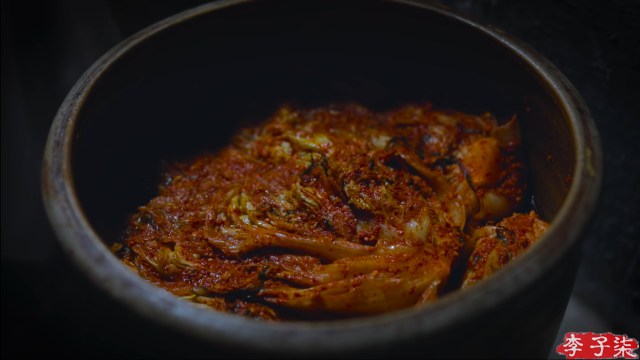
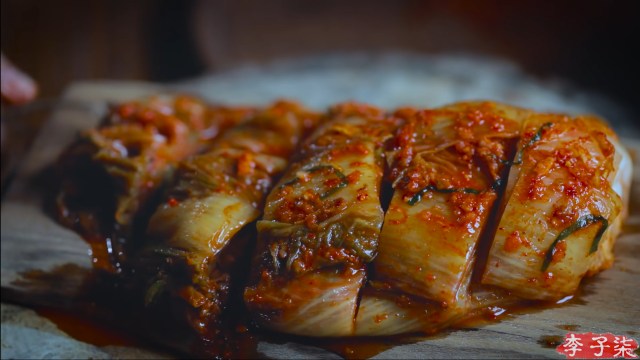
Her latest video, however, proved to be less than soothing for some viewers. Titled “The last episode of the “Life Series”: The life of white radish!”, the clip outraged Korean viewers because Liziqi made pickled boy choy using a process that appeared to mimic the traditional Korean method of making kimchi, known as gimjang.
▼ The process of making the pickled bok choy begins at the 7:24 mark.
Generally, commenters claimed that kimchi is not Chinese food and belongs to Korean heritage instead. Comments called her out for including this style of food preparation in her video about Chinese cooking, saying it implied that her method of making kimchi-like pickled bok choy was Chinese.
It is worth noting that nowhere in the video nor in the video’s description or title did Liziqi mention that the dish was Chinese, nor did she specifically say it was kimchi. In fact, the food is just one of several featured in the video, with the others including various pickled and preserved vegetables made into many different dishes and served together as a meal, so it doesn’t even have a prominent role in the story told by the video.
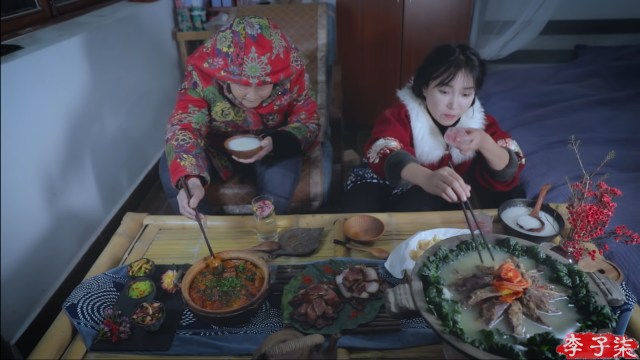
Instead, it seems that the complaints mainly stem from the fact that in the video description, the YouTuber included the hashtags “chineseucisine” and “chinesefood”, without any mention of whether the method she used to make the kimchi-like pickles comes from traditional Korean culture. One commenter wrote the following in English, as if to clarify the reason for the outrage:
“Liziqi you can make kimchi as you want. We’re even welcome. Just clearly indicate “Kimchi” and “Kimchi-jjigae” in the title and delete the hashtag “Chinese food” or change it to Korean food. This is all Koreans want.”
Of course, these comments sparked a digital war of words in the comments section of Liziqi’s video, which quickly became buried with arguments and criticisms from both sides. However, the animosity may not have started with Liziqi’s video; rather it was probably another outlet for an ongoing dispute over the origins of kimchi between China and South Korea.
According to a South Korean academic, China has been ramping up efforts to claim kimchi as its own product. “Chinese online influencers, state-controlled news media, government officials and even its ambassador to the UN are going all-out in their efforts to commandeer kimchi as something Chinese”, said Sungshin University’s Seo Kyoung-duk.
Furthermore, after China’s Sichuan province received recognition for its own pickled vegetable dish, known as pao cai–which is different in flavor and preparation from kimchi–a state-sponsored news source called the achievement the making of “an international standard for the kimchi industry led by China”.
▼ Tweets like this from the Chinese Ambassor to the UN certainly don’t help to douse the fire.
Winter life can also be colorful and enjoyable. One option is to try some homemade kimchi by yourself. Not too difficult. My colleagues said it's super tasty. pic.twitter.com/I7suR4jClt
— Zhang Jun (@ChinaAmbUN) January 3, 2021
Another YouTuber, Hamzy, also became collateral in the war over kimchi. The Korean vlogger earned the ire of China when she liked a comment on one of her videos that included, “It pisses me off that China claims to be the origin of kimchi and sam” (“sam” is a pork and vegetable wrap). Chinese followers who noticed were quick to criticize her, and she soon became another subject of controversy.
That one like, and a subsequent video where she said, “I don’t understand where I was wrong in saying that kimchi and sam are Korean foods”, resulted in her losing sponsorships in China because “her actions were offensive to her Chinese followers”. Her videos were also removed from Chinese platforms, losing her millions of followers.
Ad from NYT today. Is this Korea’s response to all the recent kimchi-is-Chinese noise? pic.twitter.com/Mpwtj1UOrQ
— Matthew A. Shapiro (@shapiromatty) January 18, 2021
The feud over kimchi still continues, as Seo Kyoung-duk recently ran an ad in the New York Times expressly stating that “Kimchi is Korean, but it belongs to everyone.” With a picture of a dish of kimchi front and center, the text on the ad reads:
“The Kimchi making & sharing culture was listed as a UNESCO Intangible Cultural Heritage in 2013. Historically, this iconic food of Korea and its culture date back thousands of years. Now it is a fermented food beloved by people all over the world. Kimchi is Korean, but it belongs to everyone.”
Of course, this is just one of many cultural battles between China and Korea, and it probably won’t be the last. But at least we can all (mostly) agree that kimchi is delicious, and we should all just be happy that we can eat it.
Source: Hachima Kiko, Chosun Online via Hachima Kiko, Chuo Nippo via Hachima Kiko, This Week in Asia, YouTube/李子柒 Liziqi
Images: YouTube/李子柒 Liziqi
● Want to hear about SoraNews24’s latest articles as soon as they’re published? Follow us on Facebook and Twitter!