

Dr. Timothy Mousseau, professor of Biological Sciences at the University of South Carolina and researcher for the Chernobyl and Fukushima Research Initiative, presented new findings to the International Ornithological Congress in Tokyo last week that suggest radiation contamination around Fukushima Daiichi, even at low levels, is negatively impacting biodiversity and wildlife populations.
Mousseau and his collaborators have been monitoring radiation levels at 1,500 sites and bird populations at 400 points across Fukushima over the last 3 years. The lay of the land and dispersal patterns of radioactive matter have created a very heterogenous situation in the Fukushima exclusion zone, meaning areas of high radiation lie right alongside areas of low radiation. By controlling for other environmental factors, the scientists can apply a rigorous statistical analysis to predict what the population in a particular area should be.
Using this method, Mousseau et al have found both the number of birds and the variety of species drop off as radiation levels rise, and more importantly, that there is no threshold under which the effect isn’t seen.
This is counter to what both the Japanese government and the United Nations Scientific Committee on the Effects of Atomic Radiation have said regarding low-level radiation. In a report on the situation in Fukushima released in April, UNSCEAR said, “Exposures of both marine and terrestrial non-human biota following the accident were, in general, too low for acute effects to be observed,” although the report goes on to hedge that “changes in biomarkers cannot be ruled out.” Indeed, Mousseau and the Wild Bird Society of Japan report seeing partial albinism in Fukushima birds, a condition rarely seen outside of Chernobyl (see photo above).
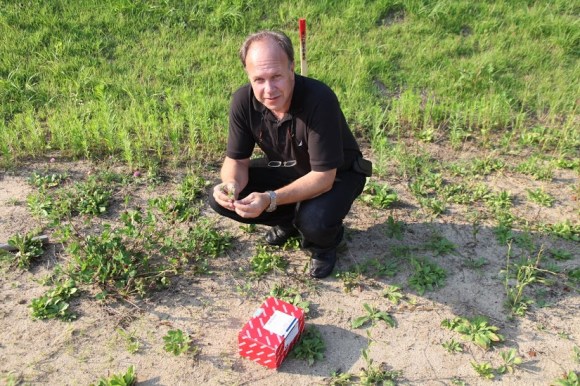
▼ Mousseau collecting samples in Fukushima
Citing years of research in Chernobyl and meta-analysis of studies on areas with naturally occurring radiation, Mouseau says, “Contrary to government reports, there is now an abundance of information demonstrating consequences, in other words, injury, to individuals, populations, species, and ecosystem function stemming from low-dose radiation.”
What we need now, he continues, is more funding for research into what this means in the long term, for the flora and fauna of Fukushima, as well as for the people who live alongside them.
Source: Timothy Mousseau
Images: Courtesy Timothy Mousseau
 Fukushima Prefecture Produces First Thesis on the Effects of Internal Radiation Exposure: Children of Fukushima Unaffected?
 Radiation fears as report shows Fukushima fir trees to be growing strangely
 New study shows wildlife thriving in areas evacuated after Fukushima nuclear meltdown【Video】
 Lawson convenience store at popular tourist site is one of the most unusual in Japan
 30 Pikachus want to share a Tokyo hotel room with you that has separate Grass, Water, Fire spaces
 McDonald’s Japan adds new Hello Kitty and Pompompurin drinks to the menu for a limited time
 Downtown Tokyo’s meaty monster Kaibutsu ramen will challenge your stomach, thrill your taste buds
 Travel to a Japanese convenience store at an active volcano
 Train station platform ramen store closes its doors on half a century of history in Tokyo
 How to make your own Pringles-flavor instant noodles【SoraKitchen】
 Live out your own Roman Holiday by eating the same gelato that Audrey Hepburn ate…in Tokyo!
 16 Things I Learned From Dressing in Drag: Confessions of a One-night Crossdresser
 Japanese government considering raising foreign resident visa renewal fees by 400 percent or more
 Japan reportedly adding Japanese language skill requirement to most common foreigner work visa
 Pokémon and Ikea Japan cross over into each other’s worlds with collaboration events
 Mt. Fuji decorated with a 500,000-flower pink carpet is Japan’s ultimate spring view
 Starbucks Japan closing only Shinkansen platform branch for popularity-triggered renovations
 You can assemble a well-balanced team of Pokémon, them eat them, thanks to Japanese cake chain
 Two food hacks take Japan’s convenience store fried chicken to amazing new sandwich heights
 7-Eleven Japan’s new baked-in-store sweet treat is only available in three parts of the country
 Man bites woman at cherry blossom park in Japan, dies shortly after
 Peanuts and Coke becomes a viral hit in Japan, but is it a trend worth joining?
 Japan now has a special desk for people who work at home with a pet cat[Photos]
 Famous Tokyo cherry blossom spot installs view-blocking screens to fight overcrowding[Video]
 Uniqlo announces new T-shirts for One Piece, Naruto and more for manga publisher’s 100th birthday
 Starbucks Japan releases new My Fruit³ Frappuccino at only 34 stores around the country
 Krispy Kreme releases Super Mario doughnuts in Japan for a limited time
 Japanese onsen egg maker from 100-yen store Daiso needs to be on your shopping list
 Studio Ghibli releases Catbus pullback keychain that runs like the anime character
 Survey asks foreign tourists what bothered them in Japan, more than half gave same answer
 Japan’s human washing machines will go on sale to general public, demos to be held in Tokyo
 Starbucks Japan releases new drinkware and goods for Valentine’s Day
 We deeply regret going into this tunnel on our walk in the mountains of Japan
 Starbucks Japan releases new sakura goods and drinkware for cherry blossom season 2026
 Studio Ghibli releases Kodama forest spirits from Princess Mononoke to light up your home
 Japan’s newest Shinkansen has no seats…or passengers [Video]
 Major Japanese hotel chain says reservations via overseas booking sites may not be valid
 Put sesame oil in your coffee? Japanese maker says it’s the best way to start your day【Taste test】
 No more using real katana for tourism activities, Japan’s National Police Agency says